
Due Diligence Checklist for Buying Rebranded Source Code
Buying rebranded source code is one of the fastest ways to launch a software business. Instead of spending nine months and tens of thousands of dollars on custom development, you buy a pre-built codebase, apply your own branding, and hit the market. But if you skip a comprehensive source code due diligence checklist, you risk acquiring a technical and legal nightmare.
Rigorous technical due diligence during software acquisitions reduces post-deal integration timelines by up to 35%, according to research by McKinsey & Company. When you are licensing or buying code specifically to rebrand it, this step is even more critical. You aren't just acquiring an operating business; you are taking ownership of a codebase that must be flexible enough to support your new brand, clean enough for your developers to maintain, and completely free of intellectual property (IP) liabilities.
This guide outlines a step-by-step technical tutorial to help you audit, verify, and safely acquire rebranded software.
Prerequisites: What Do You Need Before Starting Your Source Code Due Diligence Checklist?
Before you look at a single line of code, you must lay the groundwork. You cannot simply ask a seller to email you a .zip file of their repository. Doing so exposes both parties to security risks and intellectual property disputes.
Setting Up a Secure Repository Sandbox
Establish an isolated, read-only environment—such as a private GitHub or GitLab sandbox—where your team can run automated scanners. This ensures you do not risk IP leaks or contaminate your own production environments with unverified code.
Assembling Your Technical and Legal Due Diligence Team
You need the right eyes on the project. At a minimum, your team should include:
- A Senior Software Architect: To evaluate the backend structure, database efficiency, and overall code maintainability.
- A DevOps Engineer: To test the deployment scripts, infrastructure configurations, and containerization.
- An IP Attorney: To verify software copyright ownership, review transfer agreements, and audit open-source licenses.
Executing a Non-Disclosure Agreement (NDA) and Intent Agreement
Ensure mutual NDAs are active and a formal Letter of Intent (LOI) is signed before requesting raw repository access, API keys, or database schemas. This protects the seller's proprietary assets while giving you the legal clearance to inspect them.
Step 1: How Do You Verify IP Rights Before Licensing SaaS Code?
To verify IP rights before licensing SaaS, you must trace the code's lineage. If the seller does not have clear, unencumbered ownership of the intellectual property, your entire investment could be wiped out by a cease-and-desist letter.
Chain of Ownership and Copyright Auditing
Review all developer contracts and work-for-hire provisions. If the founders hired offshore agencies or freelance contractors to build the product, you must inspect the signed IP assignment agreements. Under many jurisdictions, freelance developers retain copyright ownership of their code unless a written contract explicitly transfers those rights to the hiring entity. Check the World Intellectual Property Organization resources for global standards on software copyright protections.
Open-Source Software (OSS) License Compliance Checks
Modern software is rarely built entirely from scratch. According to the Synopsys Open Source Security and Risk Analysis (OSSRA) report published on Synopsys, 96% of audited codebases contain open-source components, and 76% contain open-source license conflicts or security vulnerabilities.
Your job is to identify "copyleft" licenses (like GPL or AGPL) embedded within proprietary modules. If a core feature relies on a GPL-licensed library, you may be legally required to release your entire rebranded SaaS codebase to the public. Stick to permissive licenses like MIT, Apache 2.0, or BSD.
Contractor and Employee IP Assignment Verification
Confirm whether any third-party frameworks, AI models, or stock design libraries require separate commercial distribution permits. If the software uses proprietary UI kits or paid fonts, verify who owns those licenses and whether they can be legally transferred to you.
Before finalizing your transaction, make sure you understand the exact legal frameworks governing these deals by reading our SaaS License Compliance Guide for Buyers & Sellers.
Step 2: How Do You Conduct a Technical Inspection for SaaS Buyers?
A thorough technical inspection for SaaS buyers focuses on the health, scalability, and maintainability of the codebase. You need to know if you are buying a modern, agile system or a fragile monolith that will break the moment you scale.
Code Architecture and Maintainability Assessment
Ask your software architect to evaluate the backend structure and database schema.
- Is the code modular and easy to read?
- Does it follow industry-standard design patterns (e.g., MVC, clean architecture)?
- Is the database normalized, and are queries indexed properly to prevent performance bottlenecks?
Automated Static Analysis and Tech Debt Quantification
Do not rely solely on manual code reviews. Run automated static analysis tools like SonarQube, developed by SonarSource, to identify code smells, cyclomatic complexity, and test coverage metrics.
Research from Gartner shows that technical debt can account for up to 40% of IT project budgets and significantly slow post-acquisition product iteration. If your static analysis reveals high technical debt, you can use this data to negotiate a lower purchase price or require the seller to refactor the code before closing.
Documentation and API Quality Inspection
A codebase without documentation is a black box. Verify that the repository includes:
- Clear Setup Instructions: A README file that allows a new developer to spin up the local environment in under an hour.
- API Documentation: Up-to-date Swagger, Postman, or OpenAPI collections.
- Deployment Scripts: Well-documented Dockerfiles, CI/CD pipelines, or Kubernetes configurations.
If you are sourcing code from a B2B marketplace, check out our guide on What to Check in a SaaS Catalogue Before Licensing.
Step 3: How Do You Perform a White Label Code Quality Review?
Rebranding software requires a highly specific codebase architecture. A standard SaaS product is built to serve one brand. A white-label codebase, however, must be engineered for easy mutation and multi-tenancy.
Multi-Tenancy and Customization Architecture
If you plan to run the software as a multi-tenant platform—where different clients get their own custom domains, custom branding, and isolated databases—the partition architecture must be ironclad. Ensure that tenant isolation is handled at the database or application layer to prevent cross-tenant data leaks.
Decoupling Branding and Hardcoded Assets
During your white label code quality review, check how branding assets are managed.
- Are logos, color schemes, and font choices hardcoded directly into the HTML and CSS?
- Or are they decoupled and managed via environment variables, CSS custom properties, or a centralized database configuration?
Why Decoupled Frontend Architecture is Underrated
In my experience, many "white-label" codebases sold on cheap marketplaces are just standard SaaS products with a few configuration files thrown in. If your developers have to manually edit core React or Vue components and rebuild the entire container image just to change a client's primary color, you do not have a white-label product—you have a manual maintenance nightmare. True white-label code should support dynamic runtime customization via an administrative dashboard.
Extensibility and Plugin/Hook Capabilities
Ensure the codebase uses an event-driven architecture or a clean plugin/hook system. This allows you to add custom features for specific high-value clients without modifying the core codebase, making future upstream updates much easier to merge.
Step 4: How Do You Audit Licensed Software Code for Security and Dependencies?
Security vulnerabilities can ruin your launch before you even acquire your first customer. You must audit licensed software code to protect your business from data breaches and unexpected operational costs.
Scanning for Hardcoded Secrets and Exposed API Keys
Developers often hardcode sensitive credentials during early development cycles. Use automated tools to scan the entire Git commit history for:
- Database passwords
- AWS, GCP, or Azure IAM keys
- Stripe, SendGrid, or OpenAI API tokens
Even if a secret was deleted in the latest commit, it remains accessible in the Git history unless the history is completely purged.
Vulnerability and Patch Management Audit
Check for known Common Vulnerabilities and Exposures (CVEs) in third-party packages, libraries, and container base images. Refer to the OWASP code review and security benchmarking guides to ensure the software complies with modern security standards.
Third-Party Service and AI API Cost Analysis
If the software relies on external APIs—especially generative AI models like OpenAI, Anthropic, or Pinecone—calculate the unit economics.
- How many tokens does a single user query consume?
- Are there inefficient prompt chains that will inflate your API bill?
- What hosting infrastructure (e.g., AWS, Vercel, Supabase) is required to run the app, and what is the minimum monthly baseline cost?
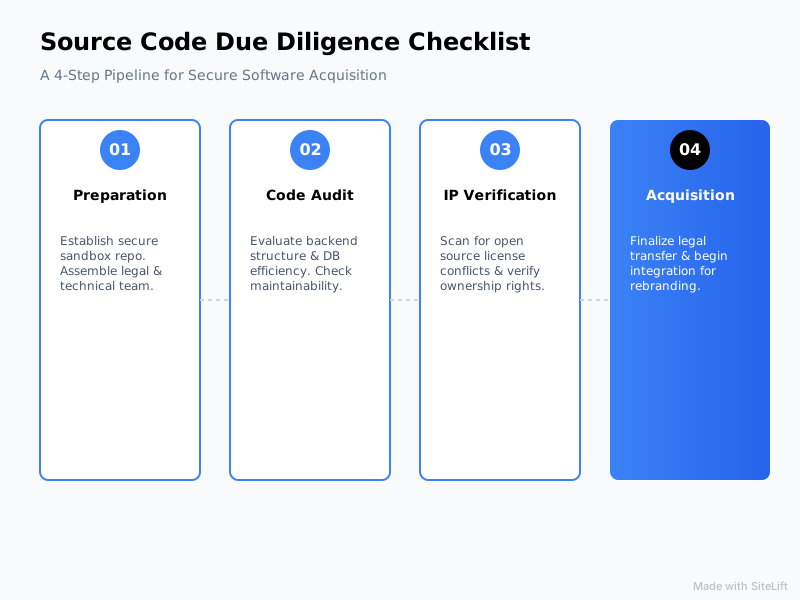
Infographic by SiteLift
Licensing & Technical Risk Matrix
| Risk Factor | Red Flag (High Risk) | Green Flag (Low Risk) | Mitigation Action |
|---|---|---|---|
| Open-Source Licenses | GPL, AGPL in core modules | MIT, Apache 2.0, BSD | Rewrite or isolate copyleft modules |
| Branding Assets | Hardcoded in HTML/CSS | Managed via CSS variables/DB | Refactor to environment variables |
| Technical Debt | > 20% of codebase (SonarQube) | < 5% of codebase | Negotiate price reduction |
| Secrets Management | Hardcoded API keys in Git | Loaded via .env files |
Rotate all keys; purge Git history |
Troubleshooting: Common Due Diligence Landmines and How to Avoid Them
Even with a structured source code due diligence checklist, you can run into unexpected technical hurdles. Here is how to handle the most common landmines:
Hidden GPL Contamination
- The Problem: You discover a GPL-licensed library embedded deep within a proprietary module.
- The Fix: Do not panic. You have two options: negotiate with the seller to replace the library with an MIT-licensed alternative before closing, or isolate the GPL component behind a microservices API so it does not legally contaminate your proprietary code.
Orphaned Third-Party Dependencies
- The Problem: The software relies on unmaintained or legacy NPM/PyPI packages that have not been updated in years.
- The Fix: Budget time and engineering resources post-acquisition to upgrade these dependencies. If a core feature relies on an orphaned package, verify if a modern fork exists.
Incomplete Database Migrations or Legacy Code Sprawl
- The Problem: The local setup fails because the SQL seed files do not match the current backend Object-Relational Mapping (ORM) models.
- The Fix: Require the seller to provide a clean database migration script that runs successfully from scratch in a containerized environment.
Expected Outcome: Closing the Deal with a Complete Source Code Due Diligence Checklist
Once your team has completed the audit and verified that the codebase is clean, secure, and legally compliant, you are ready to close the transaction.
Clean Repository Handoff Protocol
The seller should transfer ownership of the master Git repository to your secure organization account. Ensure they delete all local copies, forks, and backups of the code once the transaction is finalized.
Escrow Milestone Trigger and Verification
Never pay for source code upfront without protection. Use a modern software escrow platform to hold your funds. The escrow agent will only release the payment to the seller once your technical team verifies that the code builds, deploys, and runs successfully in your environment.
Pro Tip: Set a 14-day verification window in your escrow agreement. This gives your developers ample time to deploy the system to a staging server and run real-world integration tests before the funds are released.
To learn more about securing your transaction, read our Software Escrow Protection Guide: Securing Code & Capital.
Post-Acquisition Deployment and Rebranding Launch
With the code safely in your possession, you can rotate all third-party API keys, update the environment variables, and begin your rebranding efforts.
If you want to buy, sell, or license pre-audited SaaS source code under escrow-protected terms, explore the B2B marketplace at licensesaas.com. We streamline the entire lifecycle—from deal matching to license compliance and deployment—helping you acquire software assets with full operational confidence.

For more information on deal structures and royalty models, check out our How to License Source Code [2026 Guide].
— licensesaas.com
FAQ
What is included in a source code due diligence checklist for SaaS buyers?
A comprehensive checklist includes an IP audit (checking developer contracts, open-source licenses, and work-for-hire agreements), a technical inspection (code architecture, static analysis, and documentation review), a white-label review (modularity, theme decoupling, and multi-tenancy), and a security audit (scanning for hardcoded secrets and known vulnerabilities).
How do I verify that a seller actually owns the source code IP before licensing it?
You must inspect the chain of ownership. This involves reviewing contracts for all developers who contributed to the codebase, ensuring they signed clear "work-for-hire" and IP assignment agreements. Additionally, run automated software composition analysis (SCA) tools to ensure the code does not contain stolen or uncredited proprietary assets.
What happens if open-source code inside a SaaS product has a copyleft (GPL) license?
If proprietary modules rely on copyleft licenses like GPL or AGPL, you may be legally required to release your entire derivative codebase to the public. To mitigate this risk, you must either replace the GPL-licensed components with permissive alternatives (like MIT or Apache 2.0) or isolate them behind microservices APIs.
How long does a technical code inspection typically take when buying or white-labeling software?
A standard technical inspection takes between 5 to 14 business days, depending on the size and complexity of the codebase. This timeline allows your developers to set up a sandbox environment, run automated static analysis tools, manually review the architecture, and verify deployment scripts.
Why should I use an escrow service when purchasing rebranded source code?
An escrow service protects your capital by holding your funds in a secure account until your technical team verifies that the transferred source code compiles, deploys, and runs successfully. This prevents sellers from delivering incomplete, broken, or non-functional codebases.
More from the Blog

License Compliance for White-Label Resellers: Stay Audit-Proof When Rebranding SaaS and AI Agents
Master license compliance for white-label SaaS & AI resellers. Audits, checklists & automation to stay audit-proof.

White Label Sportsbook Software: How to License and Launch Your Betting Brand
Learn how white label sportsbook software works, costs, licensing & launch steps. License safely and scale your betting brand.

Social Media Management Software White Label: Agencies Shortcut to Recurring Revenue
Discover how social media management software white label platforms help agencies launch proprietary dashboards, stop churn, and unlock high-margin MRR.