
Social Media Management Software White Label: Agencies Shortcut to Recurring Revenue

Running a digital marketing agency often feels like running on a treadmill that never slows down. You prospect, close a client, deliver customized campaigns, and battle client turnover every single quarter. When growth depends strictly on billable client hours, your agency hits a growth ceiling fast.
Adopting a social media management software white label solution gives modern agencies an immediate escape hatch from this cycle. Instead of sending clients off to third-party tools or burning hundreds of thousands of dollars trying to engineer a proprietary app from scratch, you can deploy an enterprise-grade platform wrapped in your own brand.
By delivering a fully branded tech stack, you stop selling ephemeral service hours and start capturing predictable recurring revenue.
Key Takeaways
| Strategic Area | Traditional Agency Model | White-Label SaaS Agency Model |
|---|---|---|
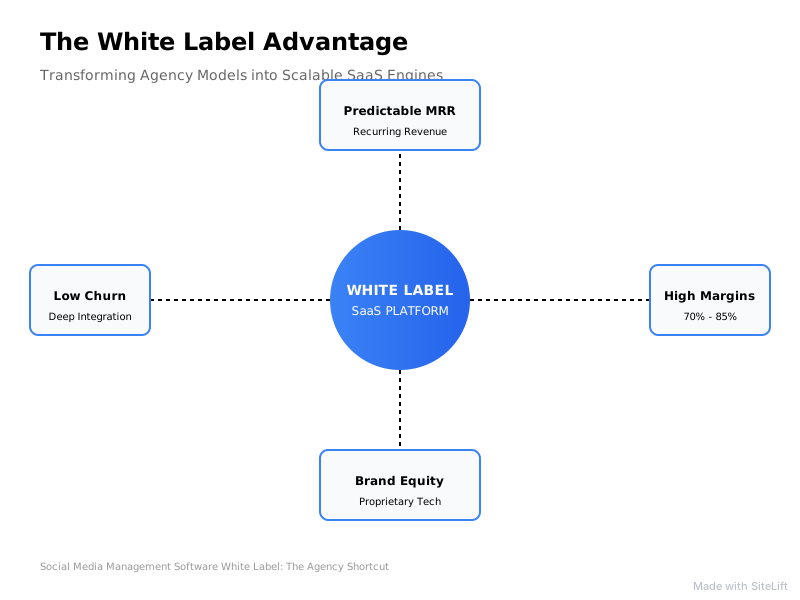
| Revenue Structure | Volatile monthly retainers based on hours | Predictable Monthly Recurring Revenue (MRR) |
| Client Retention | High churn risk after 6–9 months | Deep integration with low switching probability |
| Gross Margins | 35%–55% (labor-constrained) | 70%–85% on software-backed packages |
| Brand Equity | Seen as an interchangeable contractor | Perceived as a proprietary technology partner |
| Time to Market | Immediate (services only) | Days to launch with zero engineering overhead |
What Is Social Media Management Software White Label?
At its core, social media management software white label architecture allows an agency to license a proven publishing, analytics, and community management engine, mask all third-party vendor identities, and present the interface to clients as its own proprietary technology.
How White Labeling Works for Modern Digital Agencies
White labeling operates on a multi-tenant software structure. The parent vendor maintains the underlying codebase, manages platform updates, and deals with complex API changes from networks like Meta, LinkedIn, and TikTok.
As the agency, you re-skin the front end. You map your custom domain (such as app.youragency.com), upload your brand marks, set custom CSS color palettes, and configure custom transactional email notifications. When your clients log in to review drafts or inspect performance, they interact exclusively with your brand ecosystem.
+---------------------------------------------------------------+
|                      Client Web Browser                       |
|                   (app.youragencydomain.com)                  |
+-------------------------------+-------------------------------+
                                |
                                v
+-------------------------------+-------------------------------+
|                       Agency Brand Layer                      |
|       Custom Logos • Brand Colors • Transactional Emails      |
+-------------------------------+-------------------------------+
                                |
                                v
+-------------------------------+-------------------------------+
|                  Multi-Tenant White-Label Core                |
|       Scheduling • Analytics Engine • Permission Workflows    |
+-------------------------------+-------------------------------+
                                |
                                v
+---------------------------------------------------------------+
|                      Third-Party Social APIs                  |
|          Meta Graph • LinkedIn v2 • X API • TikTok API        |
+---------------------------------------------------------------+
This dynamic completely shifts client perception. Traditional referral schemes give you a nominal 15% affiliate kickback while your clients build a direct relationship with a major software provider. True white labeling positions your agency as a software-enabled service firm.
Core Capabilities: From Publishing Engines to Branded Social Media Dashboards
A complete white-label package delivers a comprehensive feature set through a single interface:
- Multi-Account Content Scheduling: A centralized calendar interface allowing cross-platform queueing, bulk uploading, and asset tagging.
- The Branded Social Media Dashboard: A unified portal where clients view campaign calendars, download executive reports, and monitor social engagement.
- Asset Libraries and Media Storage: Cloud-based repositories for approved brand collateral, video shorts, and caption presets.
- Approval Gateways: Structured permission workflows where drafts require external client or internal account director sign-off before hitting social networks.
- Unified Inboxes: Direct message, comment, and mention streams aggregated across multiple channels into a single inbox for team triage.
White Label Multi-Tenant SaaS vs. Source Code Acquisition
Agencies typically approach software ownership via two distinct paths:
- Hosted Multi-Tenant Reselling: You pay a recurring wholesale fee per seat or per client portal to a white-label vendor. The vendor handles server infrastructure, database backups, and API maintenance. This is the fastest, lowest-overhead path to launch.
- Source Code Licensing and Self-Hosting: You acquire a perpetual license or buy the underlying source code via a specialized marketplace. You host the application on your own AWS or Google Cloud servers. While this requires dedicated DevOps capabilities, it eliminates per-seat platform taxes and gives you full control over your platform's valuation.
Why Social Media Management Software White Label Is the Agency Shortcut to Recurring Revenue
The fundamental business problem facing service agencies is revenue instability. Retainers get cancelled during economic downturns, creative deliverables are commoditized, and margin compression is real.

Transitioning from Billable Service Hours to High-Margin SaaS MRR
Software margins routinely hit 80% or higher. When you act as an agency social media reseller, you layer automated, high-margin software subscriptions directly on top of your existing service retainers.
The market appetite for these tools is expanding rapidly. According to Grand View Research, the global social media management software market was valued at USD 17.5 billion in 2022 and is projected to expand at a compound annual growth rate (CAGR) exceeding 20% through 2030.
By capturing a fraction of this market spend inside your own client roster, you build reliable Monthly Recurring Revenue (MRR) that continues to bill even if a client pauses their creative management package.
Strengthening Retention Through Daily Client Software Touchpoints
Client churn often happens simply because clients lose sight of the work you perform behind the scenes. When clients log into your branded social media dashboard every morning to review scheduled posts or view social metrics, your agency stays top-of-mind.
The software embeds your agency into the client's internal operations. If they decide to fire your creative team, doing so means exporting their scheduled queues, unhooking team member permissions, and finding a replacement platform. That operational friction dramatically reduces client churn.
Eliminating the Financial and Technical Risks of Building In-House
Every ambitious agency owner occasionally dreams of building their own SaaS. However, building custom publishing tools is a notorious financial trap:
- Development Capital: Building a basic multi-platform publishing engine from scratch runs anywhere from $80,000 to $250,000 in direct engineering costs.
- API Maintenance: Social platforms update their APIs constantly. Keeping up with endpoint deprecations, breaking changes, and shifting rate limits requires at least one dedicated full-time developer on payroll.
- Compliance Approvals: Gaining verified developer status and enterprise app permissions across Meta, TikTok, and X requires extensive audits and operational security reviews.
White-labeling lets you bypass this entire technical burden. You inherit a battle-tested software engine overnight, letting you focus entirely on go-to-market execution and account expansion.
What Features Must You Require in a White Label Social Media Scheduler?
Not all white-label tools are built to agency standards. Before deploying a platform to paying enterprise accounts, ensure your vendor meets three critical functional requirements.
Infographic by SiteLift
Multi-Network API Support and Compliant Publishing Workflows
Your chosen white label social media scheduler must support direct, compliant publishing across every network your clients care about:
- Meta (Facebook & Instagram): Direct posting for Reels, carousel posts, stories, and feed updates, including native first-comment pinning.
- LinkedIn: Support for personal profiles, corporate showcase pages, and native PDF document carousels.
- X (formerly Twitter): Thread scheduling, video uploads, and quote-tweet automations.
- TikTok & YouTube Shorts: Short-form video scheduling with direct-to-publish authorization.
- Pinterest & Google Business Profile: Location-specific post publishing and image optimization.
According to HubSpot's State of Marketing report, over 80% of marketers leverage social media management tools to automate publishing and track cross-channel attribution. If your white-label tool fails to support automated posting for key formats like Instagram Reels or LinkedIn carousels, clients will quickly notice the operational gaps.
Client Approval Portals and Tiered Permission Hierarchies
Enterprise accounts require rigorous compliance controls. Your software should support customizable permission tiers:
- Draft Contributor: Internal copywriters or client interns can construct post drafts and upload assets, but lack authorization to queue or publish.
- Client Approver: External stakeholder accounts configured to view staging calendars, leave contextual feedback, and click an approval button.
- Account Manager: Agency personnel with global oversight on publishing schedules, post optimization, and network connections.
- Super Admin: Agency leadership controlling billing parameters, white-label configurations, and tenant workspaces.
Pro Tip: Always configure client access accounts with "Approval Only" defaults during client onboarding. This eliminates accidental publishing while providing a clean, distraction-free environment for stakeholder sign-offs.
Automated White-Label Reporting and Real-Time Analytics
Manual reporting is an agency margin killer. Your platform should automate this process completely:
- Scheduled Dispatch: PDF performance reports automatically emailed to clients on the first of every month, sent from your agency's domain.
- Cross-Channel Attribution: Unified metric rollups comparing impressions, engagement rates, audience growth, and top-performing post types across networks.
- Custom Modular Widgets: The ability to hide irrelevant metrics and surface client-specific business KPIs, such as link clicks or profile conversions.
If your agency offers comprehensive creative services, you can also pair your scheduling workflows with content creation tools like CreatorFlow Studio to generate hooks, scripts, and captions inside the same operational framework.
How to Package and Price Your Branded Social Media Dashboard for Maximum Profit
Winning as an agency social media reseller comes down to strategic packaging. Avoid simply reselling individual software accounts at break-even rates; instead, structure your software to drive higher margins across your service tiers.
| Packaging Tier | Target Audience | Target Price Point | Deliverables Included |
|---|---|---|---|
| Pure-Play DIY SaaS | Micro-businesses, bootstrapped founders | $79 – $199 / mo | Access to branded dashboard, 5 social accounts, scheduling engine, self-serve reports |
| Hybrid Retainer | Growing SMBs, funded startups | $1,500 – $4,500 / mo | Branded dashboard access, approval workflows, 15 custom posts/month, dedicated account manager |
| Enterprise Platform | Mid-market corporations, franchises | $5,000 – $10,000+ / mo | Full portal access, multi-location support, custom API workflows, listening tools, strategy sessions |
The Hybrid Retainer: Bundling Software Access with Managed Services
The most effective agency model bundles software directly into existing service agreements. Instead of charging $2,500 per month for pure copywriting and design, position your offer as:
"The Full-Service Agency Growth Engine: Proprietary Software Access + Done-For-You Campaign Execution."
This framing transforms your service from an easily cancelled expense into an operational utility. The perceived value increases, helping you justify higher upfront fees while anchoring the client to your software environment.
Pure-Play DIY SaaS Tiering for Smaller Budgets
Every agency encounters inbound prospects who want your expertise but lack the budget for a full creative retainer. Instead of turning those leads away, route them into a self-service software tier.
Offer them direct access to your branded social media dashboard for $99 per month. It costs you a fraction of that in underlying software seat costs, brings in pure-margin recurring revenue, and keeps leads inside your marketing funnel until they can afford your full-service packages.
White-Glove Enterprise Add-Ons: Custom Workflows and Dedicated IP
For enterprise clients, you can charge significant setup fees to configure dedicated workspaces:
- Bespoke Onboarding ($1,000–$2,500 one-time): Establishing approval hierarchies, importing digital assets, and configuring team permission rules.
- Custom Webhook Automations: Integrating social platform inboxes with client CRM tools like HubSpot or Salesforce.
- Dedicated IP Addresses: Providing enterprise clients with dedicated proxies to prevent social network security flags during high-volume posting campaigns.
Pro Tip: When pitching enterprise clients, present the platform's security controls and team approval hierarchies upfront. Mid-market buyers care far more about brand safety and internal controls than they do about basic post scheduling.
How to Implement and Launch Your White-Label Platform in 5 Steps
Rolling out your own agency software platform can be completed in just a few days if you follow a structured operational blueprint.
Step 1: Domain & Security Setup (CNAME, SSL, SPF/DKIM)
   │
   ▼
Step 2: Brand Styling (Logos, Color Palettes, UI Assets)
   │
   ▼
Step 3: Verification & API Testing (Meta, LinkedIn, X, TikTok)
   │
   ▼
Step 4: Internal Team Training (Account Managers, SOPs)
   │
   ▼
Step 5: Client Migration & Workspace Launch
1. Custom Domain, SSL, and Email Server Configuration
First, set up your technical infrastructure so no trace of the vendor software is visible:
- DNS Mapping: Access your domain registrar and create a CNAME record pointing your preferred subdomain (e.g.,
dashboard.youragency.com) to the host server address provided by the vendor. - SSL Provisioning: Ensure automated Let's Encrypt or dedicated SSL certification is active so clients access their portals over secure
https://protocols. - Email Deliverability (SPF/DKIM): Update your DNS records with your vendor's SPF, DKIM, and DMARC credentials. This guarantees that system emails—password resets, scheduled reports, draft approval notices—send directly from
[email protected].
2. Customizing UI Theme, Assets, and Client Onboarding Flows
Upload high-resolution vector logos for both dark and light modes. Select primary and secondary brand colors matching your agency's design system.
Build out standardized workspace templates. When a new client joins your agency, your team should be able to clone an existing onboarding workspace with pre-configured social channel slots, default approval workflows, and standard tagging categories in under ten minutes.
3. Testing API Connections and Account Linking
Before inviting clients, run extensive connection tests across all target networks:
- Authenticate test accounts across Facebook, Instagram, LinkedIn, and TikTok.
- Publish test updates using every format (plain text, single images, carousels, vertical video).
- Verify that API tokens refresh smoothly without throwing silent disconnect errors.
4. Training Your Account Managers and Internal Support
Your client-facing account managers must know the software inside and out. Run internal walkthroughs covering:
- Re-authenticating disconnected social accounts when client API tokens expire.
- Inviting and adjusting client user permission levels.
- Setting up recurring analytics reporting templates.
- Handling common media formatting errors (such as video aspect ratio or file size mismatches).
5. Client Migration and Live Rollout
Roll out the software to a select group of trusted clients first. Walk their team leads through the approval interfaces, collect feedback on the dashboard experience, and iron out any onboarding friction. Once validated, migrate the remainder of your agency client base and update your sales collateral to highlight your new proprietary software capabilities.
The Strategic Dilemma: Renting White-Label SaaS vs. Owning the Code
I have watched dozens of agencies build, rent, and acquire software over the last decade. Here is an editorial reality that typical white-label vendor articles won't tell you: Renting multi-tenant SaaS seats will eventually cap your agency's long-term enterprise valuation.
When an agency relies on a hosted white-label reseller subscription, you are effectively paying an operational rent tax. As your client base scales from 20 accounts to 200 accounts, your monthly software bill scales linearly right alongside it. Worse, if your vendor alters their pricing tiers, changes platform features, or gets acquired by a private equity roll-up, your entire client-facing product is held hostage.
Long-Term Software Strategy:
Hosted Reseller Seats   ---> Good for fast launches (0-20 clients)
Perpetual Code Ownership ---> Best for scale, valuation, and enterprise exit (20+ clients)
Industry data shows that buyers prize proprietary tech above almost everything else. According to market forecasts published on Statista, worldwide enterprise spending on cloud and SaaS applications continues to climb at double-digit annual percentages. When private equity firms and strategic acquirers look to buy an agency, a business with proprietary or perpetually licensed technology trades at significantly higher valuation multiples than an agency that merely resells third-party subscriptions.
If you are testing the waters, reselling a hosted multi-tenant white-label scheduler is a smart, low-risk way to get started.
However, if your agency plans to scale past 50 enterprise client accounts, look closely at licensing software assets or buying vetted source code outright. We have seen this same shift across other operational business categories, whether agencies are deploying white-label project management software to manage workflows or launching industry-specific CRM portals using engines like OctopusCRM Trademate.
Owning or perpetually licensing your underlying software codebase eliminates recurring per-seat fees, keeps your gross margins well above 80%, and turns your software stack into true intellectual property.
— licensesaas.com
Launch Your Agency Software Platform with LicenseSaaS
Finding dependable, enterprise-ready software to power your agency does not have to involve months of technical trial-and-error or opaque vendor relationships.
Whether you want to launch a turnkey branded social media dashboard, license high-converting workflow tools, or acquire the underlying source code for your proprietary stack, LicenseSaaS streamlines the entire process.
As a dedicated B2B software and digital asset marketplace, LicenseSaaS connects agencies, founders, and operators with fully vetted SaaS applications, AI agents, and developer APIs. With escrow-backed deal protection, straightforward licensing terms, and transparent platform audits, you can source the exact software foundation you need to launch a defensible, high-margin software business.
Explore the LicenseSaaS platform to find production-ready software solutions built to scale your recurring revenue.
Frequently Asked Questions
What is social media management software white label?
It is software built by a specialized technology provider that an agency licenses and fully rebrands. The agency adds its own custom domain, logos, and color palettes, presenting the platform to clients as its own proprietary social media management dashboard.
Can clients see the original software vendor's branding anywhere?
In a properly configured white-label setup, no. The vendor's branding is completely removed. All dashboard interfaces, login screens, transactional emails, and downloadable performance reports display only your agency's domain name, brand assets, and styling.
How does an agency make recurring revenue as a social media reseller?
Agencies generate recurring revenue by either bundling software access into their existing high-tier service retainers or selling direct, self-service dashboard access to smaller DIY clients for a monthly subscription fee (e.g., $49 to $199/month). Because wholesale licensing costs are fixed or low, the agency captures high-margin recurring income.
What is the difference between reselling a white-label tool and buying the software source code?
Reselling a white-label tool involves paying an ongoing subscription to a software provider to host and maintain the app on their infrastructure. Buying source code or acquiring a perpetual license through marketplaces like LicenseSaaS gives you direct access to the underlying software code, allowing you to self-host, customize features, eliminate monthly per-seat fees, and retain the intellectual property as an agency asset.
Do I need coding skills to launch a branded social media dashboard for my agency?
No. Standard multi-tenant white-label solutions require zero programming knowledge. Setup simply requires standard domain configurations (updating DNS CNAME records), uploading your brand visual assets, and setting up transactional email forwarding through standard administrative dashboards.
More from the Blog

White Label Sportsbook Software: How to License and Launch Your Betting Brand
Learn how white label sportsbook software works, costs, licensing & launch steps. License safely and scale your betting brand.

Apps White Label Explained: Launch Your Own Branded App Portfolio Fast
Discover how apps white label models work. Compare source code licensing to app builders, pass store reviews, and scale recurring agency revenue.

SaaS Business for Sale: Why Licensing Beats Buying Outright in 2026
Searching for a SaaS business for sale? Learn why commercial software licensing beats buying outright in 2026. Compare costs, risks, and ROI.