SaaS Business for Sale: Why Licensing Beats Buying Outright in 2026

If you have spent any time over the past few months browsing marketplaces for a saas business for sale, you have likely experienced the same sticker shock and quiet anxiety that plagues modern buyers.
A few years ago, scouring platforms like Acquire.com or Flippa for a healthy, cash-flowing micro-SaaS felt like an open frontier. You would find an unpolished tool generating $8,000 in monthly recurring revenue (MRR), negotiate a fair 3x multiple, run basic technical due diligence, wire the funds through escrow, and spend the next year optimizing growth loops.
Entering the market to buy saas business assets today presents a completely different risk profile.
Software moves at breakneck speed. Monolithic codebases age faster than ever, driven by daily leaps in foundational AI models, shifting third-party APIs, and relentless security maintenance. Paying a heavy upfront multiple for 100% equity in an aging codebase often means inheriting an unmanageable mountain of technical debt.
Many veteran operators and agencies are shifting strategy. Instead of tying up six-figure sums to buy fragile micro-products, they are securing commercial licensing and white-label rights to battle-tested software.
Let's unpack why acquiring 100% equity is no longer the default path to software ownership, explore the mechanics of modern software licensing, and evaluate which strategy fits your capital and operational model.
At a Glance: SaaS Acquisition vs. Commercial Licensing
Before breaking down the technical mechanics, here is how a conventional buyout compares directly with commercial licensing:
| Evaluation Metric | Traditional SaaS Acquisition (Buy Outright) | Commercial SaaS Licensing & White-Labeling |
|---|---|---|
| Upfront Capital Required | High ($50,000 to $1,000,000+ upfront) | Low to Moderate ($1,000 to $15,000 setup/license) |
| Median Valuation / Cost | 3.2x – 4.5x ARR for micro-SaaS | Predictable annual license or flat revenue share (10-20%) |
| Time to Market | 60–120 days (due diligence, migration, refactoring) | 1–7 days (instant deployment, custom domain setup) |
| Maintenance & Bug Fixes | 100% buyer responsibility (developer payroll required) | 100% vendor responsibility (handled under strict SLAs) |
| Infrastructure & Hosting | Direct buyer overhead (AWS/GCP/Database costs) | Handled by licensor or provisioned in turnkey containers |
| Risk of AI/API Obsolescence | Extreme (buyer absorbs rewrite costs when dependencies break) | Low (vendor continually modernizes the core platform) |
| IP & Balance Sheet Equity | Full exclusive ownership of source code & brand | Contractual rights to rebrand, resell, and monetize |
| Best For | Enterprise consolidators, core tech builders | Agencies, niche operators, domain experts with distribution |
Core Evaluation Framework: 5 Metrics to Assess Software Ownership
When an operator spots an attractive micro-saas for sale, emotions run high. You calculate churn scenarios, daydream about marketing flywheels, and project quick ARR expansion.
To make an objective decision, you need a disciplined framework. The actual value in software has shifted decisively away from basic code ownership toward distribution, domain trust, and market access. Use these five metrics to evaluate any software asset:
1. Upfront Capital Outlay vs. Operational Agility
Capital allocation defines your margin of error. When you deploy liquid reserves toward purchase prices and escrow fees, you choke off the capital needed for go-to-market (GTM) execution, customer acquisition, and hiring.
2. Technical Debt and Maintenance Overhead
Code is not a static asset like real estate. It decays. Third-party packages fall out of date, security patches surface weekly, and database queries fail as concurrent user counts scale. Every line of code you purchase outright is a liability you must pay engineers to maintain.
3. Time-to-Market and Distribution Readiness
How many days lapse between sending funds and earning your first dollar of revenue? Outright acquisitions require cloud infrastructure migration, Stripe ledger handoffs, code environment audits, and database transfers. Licensing skips these administrative hurdles, taking you straight to distribution.
4. Intellectual Property (IP) and Valuation Ceiling
Outright acquisition provides complete ownership of the underlying intellectual property. It belongs on your balance sheet, and you capture 100% of the enterprise value on exit. Licensing, on the other hand, grants defined commercial exploitation rights. You build equity in your distribution and brand rather than the raw codebase.
5. Risk of Platform Deprecation and API Shifts
Modern software relies heavily on third-party ecosystems (OpenAI, Stripe, Twilio, browser extension frameworks, social media APIs). If a core dependency revamps its pricing structure or deprecates an endpoint, who pays for the structural refactor?
Understanding the legal architecture behind these rights is vital. For a breakdown of operational permissions and legal mechanisms, see our guide on the core models and rights governing software licensing.

Option 1: Evaluating a Traditional SaaS Business for Sale (Outright Acquisition)
Buying an existing business on the open market remains a proven wealth-generation strategy. You skip the painful "zero-to-one" phase, acquiring a product with validated product-market fit, paying customers, and real cash flow.
When you evaluate a traditional saas business for sale, here is what the operational reality looks like under our framework.
Financial Mechanics: Valuation Multiples, SDE, and Escrow
The market for sub-scale software runs primarily on two metrics: Seller's Discretionary Earnings (SDE) for smaller lifestyle tools, and Annual Recurring Revenue (ARR) for high-growth platforms.
According to transaction data published by Acquire.com, micro-SaaS businesses under $1M ARR commonly command median multiples between 3.2x and 4.5x ARR. That means a tidy B2B micro-tool doing $200,000 in ARR will command an acquisition price between $640,000 and $900,000.
Beyond the baseline purchase price, you must budget for:
- Escrow transaction fees (typically 1% to 3%)
- Legal counsel fees for Asset Purchase Agreements (APAs)
- Third-party technical audit fees ($3,000 to $10,000)
- Initial working capital to absorb post-acquisition customer churn
The Reality of Technical Due Diligence and Code Refactoring
The biggest operational trap in an outright acquisition is "code rot."
Founders looking to sell micro-products frequently slash technical reinvestment 6 to 12 months before listing the business. They minimize updates, push off framework upgrades, cut customer support overhead, and run single-developer patch jobs to artificially inflate SDE.
Once the deal closes and you gain access to the repository, you often find:
- Spaghetti code lacking unit tests or documentation
- Hardcoded secrets and insecure API keys
- Outdated dependencies vulnerable to zero-day exploits
- Infrastructure tied to the previous founder's personal developer accounts
Post-acquisition integration is notorious for destroying shareholder value. Research published by the Harvard Business Review reveals that between 70% and 90% of mergers and acquisitions fail to achieve their anticipated strategic or financial goals. In the micro-SaaS arena, this failure frequently stems from non-technical buyers underestimating the payroll required to keep fragile code operational.
Pro Tip: If you do decide to buy a SaaS business outright, never waive a 30-day technical transition period. Require the seller to maintain active commit activity and fix all critical bugs documented during due diligence before the final escrow milestone is released.
Where Outright Ownership Excels: Full IP Control and Equity Upside
Outright ownership remains the gold standard for well-funded operators with in-house engineering talent.
When you own the source code outright, you maintain an unlimited valuation ceiling. You can modify core architecture, engineer proprietary algorithms, patent unique workflows, and package the asset for an institutional buyout or private equity roll-up. If you aim to build an enterprise platform with custom proprietary moats, buying the codebase is the necessary vehicle.
Option 2: Commercial SaaS Licensing & White-Labeling
Now let's examine the model disrupting how digital entrepreneurs allocate capital: commercial software licensing.
Rather than buying 100% of an equity entity or codebase, you license the commercial rights to an active, maintained, enterprise-grade application. You rebrand the interface, point your custom domains, integrate your own payment processor, and launch to your audience—while the underlying software engineering firm handles hosting, server scale, and core maintenance.
Financial Mechanics: Recurring Royalties and Fractional Entry Costs
The financial contrast between acquisition and licensing is dramatic.
Instead of writing a $300,000 check upfront, a commercial license or white-label agreement typically requires:
- A nominal onboarding or white-label setup fee ($1,000 to $5,000)
- A predictable flat monthly licensing fee ($250 to $1,500/month) OR a reasonable revenue share (often 10% to 20%)
This operational structure allows you to retain your liquid capital for market acquisition. Instead of spending 18 to 24 months paying back your initial purchase price, your venture turns cash-flow positive within your first handful of customer acquisitions.
Operators frequently preserve their capital by choosing to monetize software without selling the underlying equity. Licensing structures free both the creator and the distributor to focus entirely on their core strengths.
Operational Advantage: Vendor-Maintained Infrastructure and SLA Guarantees
When you run a licensed software platform, you eliminate the single largest headache in tech: engineering payroll.
The licensing vendor is legally and operationally obligated under Service Level Agreements (SLAs) to:
- Ensure 99.9% application uptime
- Push continuous security patches and framework updates
- Maintain database backups and auto-scaling server environments
- Update foundational APIs (such as adapting when OpenAI, Stripe, or cloud providers update endpoints)
This managed model mirrors the broader cloud transformation. Gartner forecasts worldwide public cloud spending to surpass $675 billion, driven directly by enterprises moving away from maintaining custom legacy codebases in favor of managed, licensed cloud software. Licensing SaaS democratizes this enterprise-level strategy for individual entrepreneurs.
Where Licensing Outperforms: Rapid Rebranding and Agency Monetization
Licensing shines brightest for operators who excel at sales, audience building, and community distribution.
Agencies, marketing consultants, and niche content creators often maintain deep trust with vertical audiences (e.g., dentists, real estate brokers, logistics providers). Building bespoke software for these niches is an expensive gamble.
By licensing a white-label engine, an agency can roll out a fully branded client portal or vertical platform under its own domain in a single weekend, retaining 80% to 90% gross margins without ever touching a command-line interface.
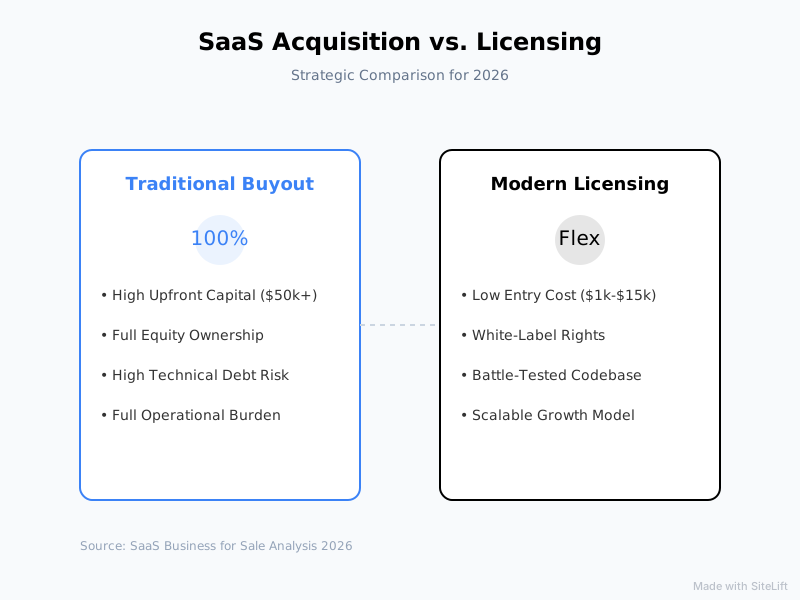
Infographic by SiteLift
Head-to-Head: SaaS Acquisition vs. Licensing in 2026
To understand why licensing is winning over modern operators, let's analyze a financial simulation over a three-year operating timeline.
Total Cost of Ownership (TCO) Simulation: 3-Year Horizon
Imagine you want to operate a B2B analytics platform targeting e-commerce stores. You are deciding between purchasing a micro-saas for sale generating $150,000 in ARR, or licensing a modern, white-label alternative with identical functionality.
========================================================================
3-YEAR TOTAL COST OF OWNERSHIP (TCO)
Scenario: Running a $150k ARR B2B Software Platform Over 36 Months
========================================================================

[OPTION A: Outright SaaS Acquisition]
- Purchase Price (3.5x ARR Multiple):        $525,000
- Due Diligence, Escrow & Legal Fees:          $15,000
- AWS/Database Hosting Costs ($800/mo):        $28,800
- Fractional DevOps/Engineer ($2,500/mo):      $90,000
- Emergency Code Refactoring / API Updates:    $25,000
------------------------------------------------------------------------
TOTAL CAPITAL EXPENDITURE (3 YEARS):          $683,800

[OPTION B: Commercial SaaS Licensing]
- Initial Setup & Whitelabel Onboarding:        $3,500
- Monthly License Fee ($1,000/mo x 36):        $36,000
- Hosting & Infrastructure:                         $0 (Included)
- DevOps / Engineering Payroll:                     $0 (Vendor Handled)
- 15% Platform Rev-Share (on $150k base):      $67,500
------------------------------------------------------------------------
TOTAL CAPITAL EXPENDITURE (3 YEARS):          $107,000

========================================================================
NET CAPITAL DIFFERENCE SAVED VIA LICENSING:   $576,800
========================================================================
That $576,800 difference represents capital that stays in your bank account. You can deploy it into paid acquisition, high-converting content marketing, customer onboarding, or building an unbeatable brand moat.
Strategic Decision Matrix: When Should You Buy vs. When Should You License?
Neither model is universally superior; each solves a distinct operational objective. Match your current resources, skills, and strategic goals against the profiles below:
                      Do you have dedicated in-house developers?
                                    |
                    +---------------+---------------+
                    |                               |
                   YES                              NO
                    |                               |
        Does the code contain            Can you distribute, brand,
      proprietary, patentable IP?        and sell to an audience?
              |             |                       |             |
             YES            NO                     YES            NO
              |             |                       |             |
       [ BUY OUTRIGHT ]     |               [ LICENSE SAAS ]      |
              |             |                       |             |
   Capture unlimited equity  Consider licensing    Zero engineering   Develop an audience
   upside; own the repo     to reduce overhead     payroll; fast GTM   first before buying
Scenario A: When to Buy Outright
You should search for an outright saas business for sale if:
- You have in-house software engineers: You have the technical capacity to audit, refactor, and modernize code without hiring outside development agencies.
- The software contains proprietary IP: The platform has unique, defensible algorithms, patented processes, or exclusive data moats that create an enterprise asset.
- You are executing an M&A roll-up strategy: You own complementary software tools and intend to merge the customer databases into a single corporate balance sheet for a future private equity recapitalization.
Scenario B: When to License
You should opt for a commercial licensing or white-label agreement if:
- You are an agency or consultancy: You already have active clients who need software solutions. You want to add a recurring software revenue stream without becoming a full-time software development studio.
- You want rapid time-to-market: You want to test a vertical market immediately without enduring 90 days of code review, escrow negotiations, and server migration.
- You run lean operations: You prefer to focus your energy on customer acquisition, conversion optimization, and community building, leaving infrastructure, server monitoring, and API maintenance to the product engineers.
Pro Tip: If you discover an underserved vertical—like home maintenance or local health services—license software tailored to that niche. Look into turnkey platforms like our home cleaning service software to instantly capture vertical market share without writing software from scratch.
Why Licensing Is the Most Underrated Strategy for 2026
I will share an opinion that runs counter to Silicon Valley startup lore: Source code ownership is increasingly a liability, not an asset.
Ten years ago, writing functional code was a formidable moat. Having a clean Rails or Django app that handled multi-tenant billing gave you an immediate edge over non-technical competitors.
That dynamic is gone. With generative code engines and open-source models, software creation has become commoditized. The world is not starved for code; it is starved for distribution, trust, and vertical expertise.
When you spend half a million dollars to buy an old codebase outright, you are buying yesterday's technical architecture at yesterday's prices.
Licensing inverts this dynamic. It treats the code as an outsourced utility—just like electricity or internet connectivity. You pay a predictable fee to an engineering team that specializes exclusively in building and refining that specific software tool. Meanwhile, you capture the customer relationship, manage billing, own the brand equity, and pocket high gross margins.
The smartest operators entering the software space today are not browsing traditional marketplaces to buy legacy problems. They are securing distribution rights, white-labeling proven engines, and leaving the code maintenance to someone else.
Accelerating Your Software Portfolio with LicenseSaaS
If you are ready to expand your recurring revenue without taking on the operational risks of a traditional buyout, licensesaas.com provides an efficient path forward.
LicenseSaaS is a dedicated B2B marketplace bridging the gap between world-class software developers and growth-focused operators. Our platform lets you license, white-label, or selectively acquire pre-vetted SaaS platforms, autonomous AI agents, and production-ready APIs.
Instead of navigating risky asset transfers on your own, the platform delivers:
- Escrow-Protected Transactions: Safe milestone verification for licensing fees and source-code transfers.
- Turnkey White-Label Deals: Clear commercial rights that let you rebrand, connect custom domains, and set your own subscription prices.
- Verified Codebases: Direct access to products built by verified founders, with SLA-backed maintenance and deployment support.
Skip the technical debt, avoid code rot, and launch your software business on terms that protect your capital.
Frequently Asked Questions
Can you rebrand and resell a software product if you only license it?
Yes, provided you secure a commercial white-label or reseller license. Under these agreements, the licensor grants you legal permission to strip their original branding, insert your own logos, map your custom domains, and connect your own Stripe account. Your end users interface exclusively with your brand, and you dictate the retail subscription pricing.
How does the upfront cost of licensing software compare to buying a SaaS business outright?
Buying an established SaaS business typically demands an upfront multiple between 3.2x and 4.5x ARR, meaning even a modest micro-SaaS can cost anywhere from $50,000 to over $500,000 in cash. Licensing, by contrast, normally requires an initial onboarding or white-label configuration fee of $1,000 to $15,000, followed by a flat monthly software fee or a modest revenue share (typically 10% to 20%).
What due diligence is required when purchasing a micro-SaaS business for sale?
When buying outright, you must conduct extensive financial due diligence (verifying Stripe revenue, customer churn, and refund rates), legal due diligence (confirming the seller owns 100% of the IP and has no contractor disputes), and in-depth technical due diligence. Technical reviews require auditing git commits, scanning for unpatched security vulnerabilities, checking open-source package licenses, and assessing the codebase for refactoring needs.
Who handles bug fixes, hosting, and platform updates in a SaaS licensing agreement?
The licensor (the software vendor) retains responsibility for core infrastructure, bug remediation, framework updates, database management, and platform uptime under a Service Level Agreement (SLA). The licensee (the operator) is responsible for frontline customer support, sales, marketing, and client onboarding.
Can you transition from a SaaS license to a full buyout of the source code later?
Yes. Many operators use a "license-to-buy" strategy. You first license a white-label software product to validate customer demand and build distribution in your chosen market. Once your ARR justifies the capital investment, you can negotiate a direct asset purchase agreement with the vendor to acquire exclusive rights to the source code and IP.
— licensesaas.com
More from the Blog

White Label Sportsbook Software: How to License and Launch Your Betting Brand
Learn how white label sportsbook software works, costs, licensing & launch steps. License safely and scale your betting brand.

Social Media Management Software White Label: Agencies Shortcut to Recurring Revenue
Discover how social media management software white label platforms help agencies launch proprietary dashboards, stop churn, and unlock high-margin MRR.

Apps White Label Explained: Launch Your Own Branded App Portfolio Fast
Discover how apps white label models work. Compare source code licensing to app builders, pass store reviews, and scale recurring agency revenue.