
Apps White Label Explained: Launch Your Own Branded App Portfolio Fast

Custom mobile app development can be a brutal endeavor. Building a bespoke native iOS and Android application typically demands six to nine months of engineering, an upfront budget north of $75,000, and ongoing maintenance that eats margins alive. For digital agencies, consultancies, and growth-minded entrepreneurs, that cost structure creates an unnecessary barrier to market entry.
Adopting apps white label infrastructure turns this outdated dynamic on its head. Instead of writing backend logic, notification engines, and user authentication from scratch, you deploy proven, pre-built mobile software rebranded entirely under your company or your client's name. You capture recurring software licensing fees, eliminate months of development runway, and deliver polished digital products within days.
Here is an architectural, legal, and operational breakdown of how white-label applications operate, how to navigate store compliance, and how to scale a high-margin portfolio without maintaining an expensive in-house engineering team.
What Are Apps White Label Solutions and How Do They Work?
At its core, the white-label software model involves decoupling software development from brand distribution. A specialized engineering team designs, tests, and refines a production-grade mobile codebase. You acquire the rights to license, rebrand, reconfigure, and distribute that software as your proprietary asset.
The client or end consumer never interacts with the original developers. They see your logo, your custom color palettes, your domain, and your terms of service.
+-------------------------------------------------------------+
|                Core Engine & Infrastructure                 |
|    (Backend APIs, Authentication, Databases, Webhooks)      |
+-------------------------------------------------------------+
                              |
        +---------------------+---------------------+
        |                                           |
+-------v-------+                           +-------v-------+
|  Brand A Skin |                           |  Brand B Skin |
|  - Custom UI  |                           |  - Custom UI  |
|  - Domain A   |                           |  - Domain B   |
|  - Store A    |                           |  - Store B    |
+---------------+                           +---------------+
Defining White Label Software in the Mobile Space
Unlike simple web templates, mobile applications demand platform-specific compilations for iOS (Swift/Objective-C) and Android (Kotlin/Java), or cross-platform compilation via frameworks like Flutter and React Native. A true white-label app setup delivers either:
- A modular build pipeline where custom theme variables, logos, and API endpoints are injected at compile time.
- A configurable multi-tenant client where the runtime dynamically pulls branded assets from a tenant-aware backend.
How White Label Differs from Custom App Development and SaaS
The contrast between custom engineering, traditional software-as-a-service (SaaS), and white labeling comes down to economics and ownership:
- Custom Development: You own the code, but you bear 100% of the financial risk, bug fixing, operating system deprecation fixes, and timeline delays.
- Standard SaaS: You pay a subscription to use an existing tool (like Shopify or Slack), but your brand remains secondary. You cannot resell the platform as your own intellectual property.
- White Label Licensing: You bypass the initial engineering lifecycle entirely while preserving the ability to monetize the software as your own asset, dictating your own pricing tiers and customer contracts.
According to research from Gartner, through 2026, low-code and pre-built development approaches will account for at least 75% of new application development globally. The drive toward modular, rebrandable core architecture reflects a fundamental shift across enterprise software: why rebuild standard operational wheels when you can simply skin and orchestrate them?
The Core Architecture: Multi-Tenant vs. Cloned Codebases
When evaluating an apps white label opportunity, you will encounter two primary engineering configurations:
- Multi-Tenant Cloud Deployments: All agency clients tap into a shared backend cluster running separated tenant databases or partitioned schemas. Updates apply universally across the network, making ongoing platform maintenance frictionless.
- Cloned/Forked Codebases: You receive an isolated copy of the mobile source code and the corresponding backend environment. While this requires manual updates when upstream features launch, it grants unrestricted freedom to write custom integrations, query raw databases, and satisfy stringent enterprise data-sovereignty mandates.
Why Invest in Rebrandable Apps for Agencies and Entrepreneurs?
For client-services businesses, relying exclusively on hourly billing or fixed-fee marketing retainers creates an exhausting revenue ceiling. The moment you stop billing hours, income flatlines.
Integrating rebrandable apps for agencies transforms an agency from a pure service vendor into a recurring technology partner.
Creating Predictable Recurring Revenue (MRR)
Instead of charging a local gym or medical practice a one-time fee of $5,000 to configure a third-party booking portal, you deploy a fully branded mobile app directly to their customers' phones. You charge an onboarding fee plus an ongoing monthly software maintenance retainer of $200 to $1,000.
Because the client's operations and end customers live inside the mobile environment, retention rates for mobile apps vastly outpace conventional agency services.
Accelerating Time-to-Market Without Development Overhead
Mobile software timelines are notoriously unpredictable. App store rejections, broken SDK updates, and edge-case device bugs derail launch targets routinely.
With verified white-label assets, the underlying features—push notification orchestration, Apple Pay integrations, biometric authentication, and data caching—have already been tested across thousands of live production devices. You reduce go-to-market cycles from three quarters to under two weeks.
Expanding Agency Service Offerings Without Expanding Payroll
Hiring a senior mobile engineer commands six-figure base salaries before factoring in product managers, QA testers, and DevOps specialists. Leveraging a turnkey or source-code-licensed model lets you sell specialized mobile solutions immediately, bypassing recruitment friction.
If your core focus is local search optimization or lead generation, pairing an off-the-shelf mobile product with tools like More Good Reviews creates an all-in-one digital utility that commands premium prices.

Evaluating Delivery Models: White Label Mobile App Builder vs. Source Code Licensing
Not all white-label avenues provide the same commercial freedom. How you deliver apps depends entirely on your technical capability and the level of customization your clients expect.
| Factor | Proprietary App Builder | Source Code Licensing | Reseller Partner Program |
|---|---|---|---|
| Setup Speed | 24–48 Hours | 1–3 Weeks | Immediate |
| Technical Skill Required | No-Code / Basic Design | Intermediate Full-Stack | Low (Sales Focused) |
| IP Ownership | None (Vendor Lock-in) | Partial or Full IP Rights | None |
| Custom Integration Freedom | Limited to builder API plugins | Unlimited (Full database access) | Strictly within vendor bounds |
| Profit Margins | 40% – 60% | 85% – 95% | 20% – 40% |
| Hosting Control | Closed cloud | Self-hosted (AWS, GCP, VPS) | Closed cloud |
Platform-as-a-Service (PaaS) and White Label Mobile App Builders
A white label mobile app builder operates on a no-code, drag-and-drop model. Platforms like this provide web-based dashboards where account managers can upload logos, toggle feature modules (e.g., loyalty points, event calendars, native ordering), and push updates without touching an IDE.
- The Advantage: Incredible speed. Non-technical agency staff can configure and ship a basic application in an afternoon.
- The Catch: You are married to the vendor's ecosystem. If their servers crash, your clients' apps go dark. If their pricing doubles, your margins take the hit. Worst of all, you cannot build bespoke backend integrations that sit outside their proprietary API boundaries.
Source Code Acquisition and Self-Hosted White Labeling
For teams that employ in-house developers or experienced technical product managers, acquiring complete source code through a curated marketplace offers superior control. You run the code on your own cloud infrastructure (such as AWS, Google Cloud, or DigitalOcean), manage the databases directly, and inspect every line for performance and security.
Platforms like the LicenseSaaS marketplace connect buyers directly with verified software sellers, facilitating escrow-protected code transfers and licensing agreements. This structure eliminates perpetual SaaS subscription markups, allowing you to capture near-total profit margins on client contracts.
Joining an Established White Label App Reseller Program
If you want to avoid both server maintenance and complex drag-and-drop builders, enrolling in a structured white label app reseller program offers a middle ground.
In this structure, a mature enterprise software vendor manages the entire infrastructure, code releases, and store maintenance. You act as the branded sales front, setting your own consumer-facing prices while paying the underlying provider a discounted wholesale rate.
How to Scale Apps White Label Deployments: A 5-Step Blueprint
Launching a commercial app portfolio requires careful technical orchestration, particularly when navigating app store compliance and client onboarding.
Step 1: Niche Discovery --> Step 2: Code Due Diligence --> Step 3: Customization --> Step 4: Store Submission --> Step 5: Client Monetization
Step 1: Identifying High-Demand Niche Use Cases
Avoid trying to launch "an app for everyone." The most profitable agency deployments zero in on distinct business verticals with urgent, operational needs:
- Service Bookings: Barbershops, med-spas, and mobile auto-detailing businesses needing automated schedule management.
- Community Portals: Creators, fitness coaches, and niche associations migrating away from social algorithms toward dedicated, owned member feeds.
- Hyper-Local Commerce: Multi-vendor food delivery, artisan collectives, and boutique retailers avoiding high marketplace commission rates.
Step 2: Sourcing and Due Diligence on Software Licenses
Before signing a contract or acquiring a codebase, audit the underlying technology. You need to verify:
- Dependency Age: Are the external packages deprecated, or are they compatible with the latest Android API levels and iOS SDK targets?
- Licensing Terms: Does your agreement grant unrestricted commercial resale, or are you constrained by single-client seats?
- Security Architecture: How are authentication tokens handled? Is user data encrypted at rest and in transit?
Exploring verified ecosystems like white-label SaaS for agencies reduces the risk of inheriting undocumented legacy code or non-compliant database structures.
Step 3: Customizing the UI, UX, and Feature Configurations
Surface-level rebranding—slapping a generic logo on a default layout—results in weak retention and app store scrutiny.
Work with dynamic style dictionaries. Ensure color palettes contrast according to modern accessibility guidelines, curate bespoke iconography, and personalize the notification copy to sound native to the target vertical.
Pro Tip: Always maintain a clean staging fork of your base codebase. Never apply client-specific custom branding directly to your main repository branch. Use environment configuration files (.env) to swap dynamic identifiers, API base URLs, and theme files cleanly during production compilation.

Infographic by SiteLift
Step 4: Managing App Store and Google Play Submissions
The mobile ecosystem is heavily policed. The public storefronts operate under strict structural rules that dictate how white-label software must be filed:
- Apple App Store: You must comply with Apple App Store Review Guidelines, paying particular attention to Guideline 4.2.6 regarding commercial templates.
- Google Play Store: You must satisfy developer registration and data transparency policies via the Google Play Console, detailing precise data collection and device permissions.
Step 5: Packaging, Pricing, and Client Onboarding
Structure your service contracts with a combination of upfront and ongoing revenue:
- Onboarding & Configuration Fee ($1,500 – $5,000): Covers design assets, developer account setup, catalog uploading, and submission workflows.
- Monthly Platform License ($150 – $750/mo): Grants access to the hosting infrastructure, automated push notification servers, customer support, and system health checks.
- Performance Add-ons: Value-added services such as specialized push notification campaigns, loyalty program optimization, or auxiliary tools like SiteForge Pro for coordinated web and app experiences.
What Are the Key Risks and Pitfalls of White Label Apps?
While white-labeling accelerates production, deploying commercial software demands continuous operational vigilance.
Vendor Lock-in and Roadmap Dependency
If you depend entirely on a closed app builder, your business is beholden to their roadmap. If their engineering team delays introducing a critical iOS capability, your agency takes the blame from frustrated clients.
Always negotiate clear data export clauses, or prioritize models where you control the underlying database and application source code.
App Store Review Rejections: Mastering Guideline 4.2.6
Apple's App Store Review Guideline 4.2.6 states plainly: "Apps created from a commercialized template or app generation service will be rejected unless they are submitted directly by the provider of the app's content."
This rule was enacted to prevent single developers from flooding the App Store with thousands of identical spam clones submitted from a single account.
WRONG SUBMISSION STRATEGY (High Rejection Risk):
[Agency Developer Account]
  ├── Client 1 App  --> Rejected (Guideline 4.2.6)
  ├── Client 2 App  --> Rejected (Guideline 4.2.6)
  └── Client 3 App  --> Rejected (Guideline 4.2.6)

CORRECT SUBMISSION STRATEGY (Fully Compliant):
[Client 1 Developer Account] --> Client 1 App (Approved)
[Client 2 Developer Account] --> Client 2 App (Approved)
[Client 3 Developer Account] --> Client 3 App (Approved)
To maintain complete compliance:
- Require Individual Client Accounts: Never publish your clients' apps under your internal agency developer account. Have each client register for their own Apple Developer Program ($99/year) and Google Play Console ($25 one-time) accounts.
- Request Administrative Access: Have your clients invite your engineering team as an "Admin" or "App Manager."
- Differentiate Content and Value: Ensure every app submitted features a distinct, functional purpose, custom metadata, and unique local assets rather than pure duplicated placeholder data.
Pro Tip: When submitting an app on behalf of a business entity to Apple, verify that their legal entity name matches their Dun & Bradstreet (D-U-N-S) number exactly during their Apple Developer enrollment. Mismatched operational paperwork can stall an app deployment for weeks before review even begins.
Maintenance, Security Patches, and OS Upgrades
Both Apple and Google regularly deprecate legacy SDKs. If an application is not re-compiled and republished using current development kits periodically, the stores will quietly remove it from algorithmic search results.
Running a successful portfolio requires scheduling quarterly audit windows to update runtime dependencies, verify target APIs, and address security updates.
Key Takeaways: White Label Mobile Architecture at a Glance
| Strategic Factor | Approach | Why It Matters |
|---|---|---|
| Monetization Engine | Upfront deployment fee + recurring monthly licensing | Shifts your commercial model from one-off creative projects to predictable, enterprise-grade software MRR. |
| Architecture Selection | Source code licensing for customization; PaaS for pure speed | Dictates your operating margins, customization freedom, and backend infrastructure ownership. |
| Store Compliance | Individual client developer accounts for all publications | Ensures full alignment with Apple Guideline 4.2.6, avoiding catastrophic network-wide app rejections. |
| Asset Due Diligence | Reviewing dependencies, licensing IP, and code security | Protects your agency from inheriting obsolete code, security exploits, or IP ownership challenges. |
Editorial: Why Full Code Ownership Beats Proprietary App Builders Every Time
No-code white-label app builders are easy to love early on. They hook you with drag-and-drop interfaces, easy setup panels, and the intoxicating promise of zero development overhead.
For agencies scaling beyond a few entry-level accounts, relying entirely on these closed platforms is an operational dead end.
When you rent your core product from a proprietary builder, you do not own a software business. You run an outsourced sales department for someone else's platform—while taking on all the client-facing liability yourself. If that builder changes its platform pricing, drops a critical integration, or goes out of business, your business takes the hit.
True operational leverage comes from owning the underlying codebase.
Acquiring verified software licenses or deploying self-hosted code might require basic engineering oversight, but it gives your business real enterprise equity. You control the databases, dictate the infrastructure costs, and build custom features whenever a client demands them. If you want to scale a truly durable software asset, license the code, maintain the keys, and build on an infrastructure you actually own.
— licensesaas.com
Scale Your Software Portfolio with LicenseSaaS
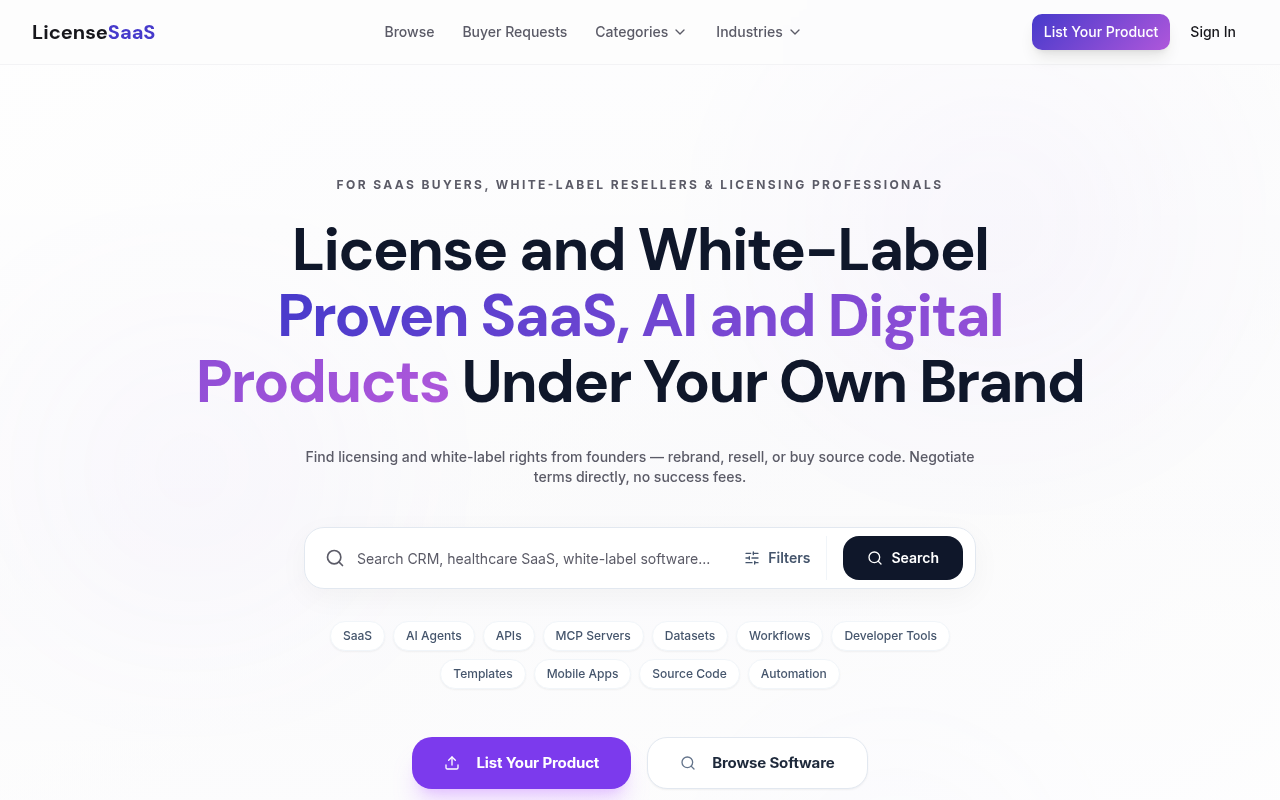
Scaling a profitable software offering does not require spending quarters writing backend boilerplate code. The fastest-growing digital agencies acquire battle-tested codebases, rebrand them rapidly, and pass the savings on to their enterprise clients.
Browse through the LicenseSaaS marketplace to review vetted, production-ready software solutions. From complete SaaS platforms to specialized AI agents, you can secure intellectual property and commercial source-code licenses backed by secure escrow processes and seamless technical transfers. Discover how our white-label SaaS licensing options can help you deploy your next high-margin branded application portfolio.
Frequently Asked Questions (FAQ)
What is the difference between white label apps and custom app development?
Custom app development requires writing an application's architecture, user interface, database models, and API integrations from scratch. This process typically takes six to nine months and costs between $50,000 and $200,000+.
In contrast, white-label apps leverage existing, production-tested software codebases. You rebrand the UI, attach your custom domains, and configure functionality, cutting deployment timelines down to mere days at a fraction of the cost.
Can you publish white label apps to the Apple App Store and Google Play Store?
Yes, provided you comply with platform publishing guidelines. Under Apple's App Store Guideline 4.2.6, white-label apps cannot be mass-published from a single master agency developer account.
Instead, each client must set up their own Apple Developer Program and Google Play Console accounts, inviting your team as a technical manager to handle the compilation, testing, and submission processes.
How much does it cost to start a white label app reseller business?
Getting started depends heavily on your delivery model. Joining a no-code white label mobile app builder platform generally costs between $100 and $500 per month.
Acquiring a perpetual commercial source-code license outright typically requires an upfront capital investment ranging from $1,000 to $15,000+, but eliminates perpetual platform fees, yielding profit margins exceeding 85% on subsequent client retainers.
Who actually owns the intellectual property (IP) when using white label apps?
IP allocation depends strictly on your licensing contract:
- When using SaaS-based app builders, the vendor retains 100% of the underlying software IP; you merely rent access to run your branding on top of their system.
- When using source-code licensing, you obtain specific commercial rights—often allowing unlimited modifications, private deployments, and commercial distribution under your own enterprise banner.
How does an agency charge clients for white-labeled mobile applications?
Agencies typically use a hybrid monetization model:
- Upfront Setup Fee: Charging $1,500 to $5,000+ to cover visual branding, database configuration, store submission workflows, and testing.
- Recurring License & Hosting Retainer: Billing $150 to $1,000+ per month to cover server hosting, routine operating system compatibility patches, bug updates, and customer support.
- Custom Integrations: Charging standard billable rates for building custom webhooks, proprietary third-party integrations, or custom reporting setups.
More from the Blog

White Label Sportsbook Software: How to License and Launch Your Betting Brand
Learn how white label sportsbook software works, costs, licensing & launch steps. License safely and scale your betting brand.

Social Media Management Software White Label: Agencies Shortcut to Recurring Revenue
Discover how social media management software white label platforms help agencies launch proprietary dashboards, stop churn, and unlock high-margin MRR.

SaaS Business for Sale: Why Licensing Beats Buying Outright in 2026
Searching for a SaaS business for sale? Learn why commercial software licensing beats buying outright in 2026. Compare costs, risks, and ROI.