
White Label Sportsbook Software: How to License and Launch Your Betting Brand

If you want to launch a betting brand in 2026 without spending a year building trading tools from scratch, white label sportsbook software is the fastest legal route. You license a pre-built, proven platform from a B2B provider, put your logo and domain on it, plug in payments and odds, and go live under your own brand.
I’ve watched dozens of founders take this path. The ones who succeed treat it like a real licensing deal — not just buying a website skin. They vet the odds feed, negotiate the sports betting software license, sort out iGaming compliance and licensing early, and plan for scale from day one.
This guide walks you through exactly that: what you get, what it costs, how to launch step-by-step, and how to avoid lock-in.
Key Takeaways: Licensing a Sportsbook at a Glance
| Topic | What You Need to Know |
|---|---|
| What it is | Pre-built betting platform you rebrand and operate. Provider handles core tech, odds, risk, and often payments. |
| White label vs turnkey | White label = your brand on shared infrastructure. Turnkey sportsbook solution = full operational package with PAM, CRM, payments, support, and managed trading. |
| Time to market | 4-8 weeks for white label; 8-16 weeks for full turnkey with custom integrations and license approval. |
| Cost range | Setup fee + monthly minimum + 5-20% revenue share + odds data + payments + gambling license fees. Custom builds typically start at $500k+. |
| License | You can operate under the provider’s master license in some jurisdictions, or get your own B2C license for more control and market access. |
| Biggest risk | Provider dependency, limited differentiation, and odds quality. Negotiate SLA, API access, and exit rights upfront. |
| Smartest path to scale | Start licensed, prove acquisition, then acquire source-code rights to own your platform. |
What Is White Label Sportsbook Software and How Does It Work?
White label sportsbook software is a complete, pre-built betting platform developed by a B2B provider and licensed to multiple operators. You get the sportsbook engine, bet slip, player account management, and back office, then you rebrand the frontend with your colors, logo, content, and domain.
Think of it like renting a fully staffed casino building and putting your name on the door. The plumbing works, the odds traders are already in the back room, but customers see only your brand.
Behind the scenes, your bets are processed on the provider’s infrastructure. They push the odds, settle markets, manage risk limits, and keep the platform updated. You focus on marketing, acquisition, and customer support — or in many deals, even support is shared.
White Label Sportsbook Software vs Turnkey Sportsbook Solution vs Custom Development
These terms get mixed up constantly, and vendors love the confusion.
A basic white label is a skin. Same core platform as 20 other brands, minimal code changes, fast launch, lower cost. You can change UI, banners, promotions, and some market settings, but you can’t rewrite the bet engine.
A turnkey sportsbook solution is operationally complete. It includes everything in a white label plus payment gateway aggregation, KYC/AML modules, CRM and bonus engine, affiliate system, 24/7 trading and risk management, customer support options, and iOS/Android apps. You literally turn the key and operate.
Custom development is building it all yourself. Full control, full IP ownership, 9-18 months of work, and a trading team to hire. I only recommend it if you have deep pockets and a truly differentiated product, like a novel exchange model or social betting mechanic.
Pay-per-head (PPH) is a fourth model you’ll see in the US offshore world. It’s cheaper and simpler — you pay per active player per week for odds and a basic site. It works for small bookies but lacks proper PAM, compliance tools, and scalability for a real brand.
Core Components Included in a Sports Betting Software License
A solid sports betting software license should include more than a pretty frontend. Here’s what I check for in every deal:
- Sportsbook engine: Pre-match and in-play bet placement, cash-out, bet builder, multi/single/system bets
- Odds and data feeds: Real-time pricing from providers like Betradar, Betgenius, or in-house trading
- Player Account Management (PAM): Registration, wallets, balances, transaction history, limits
- Risk and trading tools: Automated liability management, max stake controls, suspicious bet alerts
- Payment gateway: Cards, bank transfer, e-wallets, and crypto rails with multi-currency support
- CRM and bonus engine: Free bets, boosted odds, missions, segmentation, push/SMS/email
- Affiliate module: Tracking, rev-share/CPA plans, creatives
- Mobile apps: Responsive web plus native or wrapper iOS/Android apps
- Back office and reporting: GGR, turnover, hold, player LTV, jurisdictional reports
If any of those are “extra modules” with vague pricing, get it in writing before you sign.
White Label Revenue Models: Revenue Share, Fixed Fee, and Hybrid
Most providers price in three ways:
1. Revenue share: You pay 5-20% of Gross Gaming Revenue (GGR) monthly, often with a minimum monthly fee of $5,000-$15,000. Low upfront, but expensive if you scale fast.
2. Fixed fee / SaaS: Flat $8,000-$30,000+ per month depending on features and markets. More predictable, better for high-volume brands.
3. Hybrid: Reduced setup + lower monthly + smaller revenue share. This is the most common for serious startups.
Watch for hidden costs: odds data fees, live streaming fees, premium payment methods, extra language/currency packs, and dedicated trading coverage for your niche leagues.
Pro Tip: Always negotiate revenue share on NGR (net gaming revenue after bonuses, chargebacks, and betting duties) — not gross turnover. That one definition can save you five figures a year.
What Are the Benefits, Costs, and Risks of White Label Sportsbook Software?
The market timing is hard to ignore. According to Grand View Research, the global sports betting market was valued at over $80 billion in 2024 and is expected to grow at approximately 10% CAGR through 2030. In the U.S. alone, the American Gaming Association reported that U.S. commercial gaming revenue reached a record of over $71 billion in 2024, fueled by legal sports betting expansion.
You don’t need to capture much of that to build a profitable niche brand — if you launch lean and acquire smart.

Key Advantages for Founders, Agencies, and Entrepreneurs
- Speed to market in 4-8 weeks: No hiring odds compilers, no building settlement logic, no PCI audits from zero.
- Lower capex: You avoid the $500k+ custom build and a 12-person product team.
- Built-in trading expertise: Good providers have 24/7 traders managing liability while you sleep.
- Tested compliance stack: KYC, responsible gambling tools, and audit logs are already built for regulated markets.
- Proven UX: Bet slip, cash-out, and live betting flows have been A/B tested across millions of bets.
For agencies, it’s also a service play. You can launch betting brands for clients, run acquisition, and take a retainer + rev-share without becoming a software company. If you already work with sports communities, check this adjacent model: AI Football Prediction SaaS - White-Label Sports Prediction — many affiliates use prediction content to feed players into their sportsbook.
How Much Does White Label Sportsbook Software Cost?
Here’s a realistic breakdown I share with first-time operators:
| Cost Item | Typical Range | Notes |
|---|---|---|
| One-time setup / branding | $15,000 - $75,000 | UI skin, domain setup, language packs, apps submission |
| Monthly platform minimum | $5,000 - $30,000 | Depends on turnkey depth and traffic |
| Revenue share | 5% - 20% of NGR | Often tiered; decreases with volume |
| Odds data + live streaming | $3,000 - $15,000/mo | Varies by sports coverage and in-play depth |
| Payments processing | 2% - 5% + fixed fee | Plus rolling reserves for high-risk MCCs |
| Gambling license | $15,000 - $50,000+/yr | Curacao/Anjouan low end; Malta/UK much higher with compliance costs |
| KYC / AML / fraud tools | $0.50 - $2 per check | Sumsub, Jumio, SEON style pricing |
| Marketing launch budget | $30,000 minimum | Affiliates, PPC where allowed, influencers, SEO |
Total to launch properly? Plan for $75,000 to $250,000 in year one for a white label in an offshore or gray-market-friendly jurisdiction. Regulated Tier-1 (UK, Malta, US state) can easily double that due to licensing, certification, and compliance staffing.
Common Risks and Limitations to Evaluate
I’m bullish on white label, but not blind to the downsides:
- Limited differentiation: If 15 brands use the same engine and odds, your edge is brand, UX tweaks, and promotions — not product.
- Provider dependency: Downtime, slow settlement, or poor risk decisions hurt your reputation. Check uptime SLA in the contract, not the sales deck.
- Odds quality and latency: A 3-5 second delay in live betting kills conversion. Ask which feed they use and test in-play during a live match.
- Scalability ceilings: Shared infrastructure can throttle during World Cup or Super Bowl peaks. Ask for peak concurrency references.
- Contract lock-in: Auto-renewals, high exit fees, and no data portability are red flags. Insist on player data export rights.
Pro Tip: Ask for three live operator references in your target market — and actually call them. Ask about settlement speed on disputed bets, payout times, and how the provider handled a major sporting upset.
How to License and Launch Your Betting Brand Step by Step?
Step 1: Define Your Niche, Markets, and Business Model
Don’t launch a generic “bet on everything” brand. The winners niche down.
Pick your angle: football-first in Africa/LatAm, cricket in India, esports for Gen Z, US props and parlays, or crypto-native anonymous betting. Decide pre-match vs live betting focus — live now drives the majority of turnover, but needs low-latency feeds.
Choose fiat vs crypto vs hybrid. Crypto cuts payment friction and chargebacks but complicates licensing in Tier-1 markets. Choose B2C (your own players) vs B2B2C (powering agents/shops under your brand).
Most importantly, pick 1-2 target jurisdictions first. Your license, payments, and odds coverage all flow from that decision. Don’t try to be global on day one.
Step 2: Source, Vet, and Negotiate Your Sports Betting Software License
This is where most founders rush and regret it.
Start by sourcing 4-6 providers, not just the top Google ads. Marketplaces help because you can compare deal terms side-by-side instead of sitting through sales calls. Browse software built for gambling & casinos to license and white-label to see what license types, source-code options, and commercial models founders are actually offering.
My due diligence checklist:
- Live demo on mobile: Place a bet, cash out, request withdrawal. Time everything.
- Odds coverage: Confirm 30+ sports? Your top 5 leagues? Bet builder? Player props?
- PAM and compliance: Self-exclusion, deposit limits, reality checks, audit trails?
- Technology: Uptime SLA (ask for 99.9%+), API access, webhooks, data export?
- Commercials: Setup, minimum, rev-share base (GGR vs NGR), fee increases, term length?
- Legal: Who holds IP? What exactly does your sports betting software license cover — brand use, territory, sub-licensing? Escrow for payments and source code?
- Support: Dedicated account manager? Trading coverage hours? Migration help?
Negotiate escrow-protected payments for setup fees and any source-code purchase. Funds only release when milestones — branded staging, payment integration, UAT pass — are met. Also push for AI-driven deal matching signals: player volume fit, jurisdiction fit, and tech stack compatibility, so you don’t end up with a great platform built for the wrong market.
Step 3: Brand, Integrate, Test, and Go Live
Once the term sheet is signed, execution matters more than features.
- Brand the UI: Logo, fonts, homepage heroes, promotion pages, bet slip styling. Keep the betting flow familiar — bettors hate learning new UX.
- Domain + apps: Configure domain, SSL, app store listings. Gambling apps face extra review — start early.
- Payments + KYC: Integrate cards, local methods (Pix, M-Pesa, UPI where relevant), and crypto if planned. Wire KYC/AML with manual review queues.
- Odds configuration: Set margins, max payouts, restricted markets, and boosted odds rules with the trading team.
- UAT and soft launch: Test 200+ scenarios: voided matches, postponed games, cash-out edge cases, bonus abuse. Invite 200-500 real users before scaling spend.
- CRM and acquisition: Pre-load welcome bonus, affiliate links, and retention journeys. Most new books die from no traffic, not bad tech. Line up 5-10 affiliates before launch.
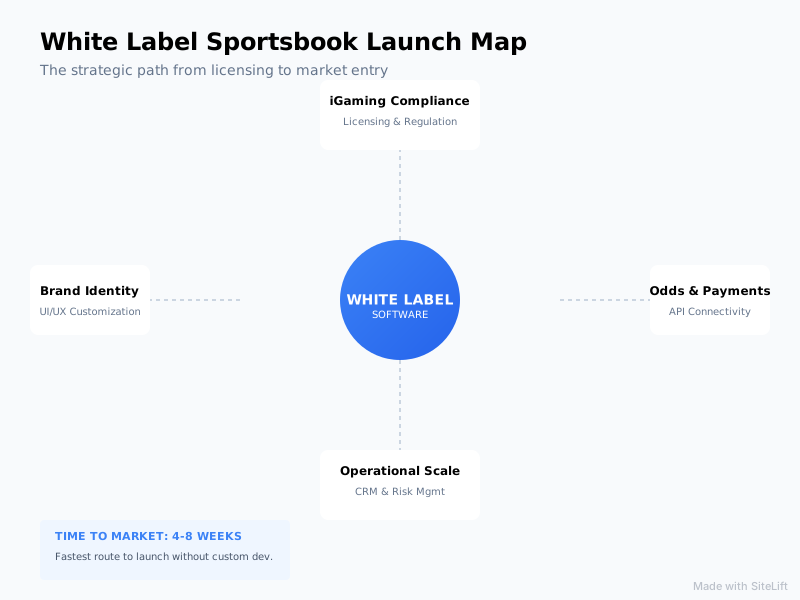
Infographic by SiteLift
What Are the iGaming Compliance and Licensing Requirements?
This is the section vendor landing pages gloss over. You can’t afford to.
Do You Need Your Own Gambling License for a White Label?
Sometimes no — but you still need legal cover.
In many offshore setups, you operate under the provider’s master license as a white-label skin. The provider is the license holder, you’re the branded operator. It’s faster and cheaper, but you have less control, share compliance risk, and can be shut off if the provider has issues.
In regulated markets, you usually need your own B2C license or a recognized white-label approval. The UK, for example, requires clear accountability for white-label arrangements — review the UK Gambling Commission guidance on operating licences and white label requirements before assuming the provider’s license covers you.
My rule: use the provider’s license to validate, get your own license to scale.
Tier-1 vs Offshore Jurisdictions: Malta, Curacao, UK, US State-by-State
| Jurisdiction | Cost & Timeline | Reputation / Access | Best For |
|---|---|---|---|
| Curacao / Anjouan | Lower cost, weeks to few months | Workable for crypto and emerging markets, weaker with banks | Fast launch, LatAm, Africa, crypto brands |
| Kahnawake | Mid cost, moderate timeline | Niche North American offshore history | Small startups targeting .com traffic |
| Malta (MGA) | Higher cost, 4-8+ months with audits | Strong EU reputation, bank-friendly | EU-facing brands planning scale; see the Malta Gaming Authority portal for B2B and B2C licensing types |
| UK (UKGC) | High cost, strict ongoing compliance | Gold standard, largest share of online GGY is digital per UKGC data | UK-facing serious operators |
| US State-by-State | Very high, partner + state approval | Must-have for legal US betting; track expansion via American Gaming Association research on sports betting legalization | US market access via casino/tribal partnerships |
Offshore gets you live fast but limits payment options and ad platforms. Tier-1 costs more but unlocks trust, better PSPs, and mainstream affiliates. Many brands run both: offshore .com + regulated local entities later.
For broader gaming plays beyond sports, also explore software built for gaming companies to license and white-label if you plan to add casino or esports verticals under the same brand.
Technical Compliance: Certification, Responsible Gambling, and AML/KYC
Even on a white label, regulators hold you responsible for player safety.
Expect: platform certification from labs like GLI or BMM Testlabs — you can read how Gaming Laboratories International handles platform certification and testing — plus RNG auditing if you add casino, responsible gambling tools (deposit limits, time-outs, self-exclusion, reality checks), and full AML/KYC workflows with source-of-funds checks in Tier-1.
You’ll also need data privacy compliance (GDPR and local equivalents), transaction monitoring, suspicious activity reporting, and immutable bet logs. Ask your provider: “What compliance reports do you generate out-of-the-box for MGA/UKGC audits?” If they hesitate, walk away.
How to Choose the Best White Label Sportsbook Provider?
Forget “top 10” listicles. Judge providers on money-making details.
Must-Have Features: Odds Coverage, Live Betting, Payments, and Mobile UX
- Odds coverage: 30+ sports, 50,000+ monthly live events, deep lower leagues if you target emerging markets
- In-play latency: Sub-5 second bet acceptance, instant suspension on key events (goals, red cards)
- Cash-out + bet builder: Full/partial cash-out and same-game parlays are now table stakes
- Live streaming + stats: Keeps bettors on-site longer; check data costs
- Payments: Local methods + cards + crypto, multi-currency wallets, fast withdrawals
- Mobile UX: 70%+ of bets are mobile. Test one-handed bet placement, slip speed, and biometric login
For market context on why mobile and digital matter, Statista’s global online gambling and sports betting revenue forecasts show online sports betting as a primary growth driver, with global online gambling revenue projected to exceed $130 billion by 2029.
Vendor Evaluation Checklist: Reputation, Technology, and Support
Score each vendor 1-5 on:
- Uptime SLA and historical performance during peak events
- Trading team quality and risk limits flexibility
- Customization depth: frontend only or backend rules, bonus logic, APIs?
- API + webhooks for CRM, affiliate, and data warehouse integration
- Migration support if you leave — data export, player password migration
- Client references and churn rate
- Contract fairness: term, auto-renew, price hike caps, termination for cause
I’d rather pay 2% more revenue share to a provider with elite trading and honest reporting than save money on a black-box platform that voids winners slowly.
How to Future-Proof and Scale Beyond Launch
Day one is about launching. Month twelve is about owning.
Plan to add casino, live casino, esports, and virtuals — margins are often better than sports. Build your affiliate program early; it compounds. Keep your player data clean and portable.
And think about IP. Licensing gets you to revenue, but owning source code gives you leverage on valuation, fundraising, and customization. I’ve seen founders 3x their exit multiple by moving from a pure license to owned code once they hit consistent NGR. Structure that option in your first contract: a buyout price or source-code license trigger at month 18-24.
My Take: Why Licensing First Is the Smartest Move Most Founders Ignore
I’ll be blunt: building a sportsbook from scratch in 2026 is ego, not strategy — unless you have a genuinely new betting mechanic.
I’ve talked to founders who burned $400k and 11 months building a “better bet slip” only to discover their odds feed latency was unusable and their risk team was one guy with spreadsheets. Meanwhile, a competitor licensed white label sportsbook software, launched in six weeks, spent that same $400k on affiliates and influencers, and was cash-flow positive before the custom build even passed certification.
That doesn’t mean white label is perfect. You will look similar to others at first. You will argue with your provider about trading limits. But similarity doesn’t kill brands — obscurity does. Your job in year one isn’t to reinvent pricing algorithms. It’s to earn trust in one niche, pay withdrawals fast, and acquire players cheaper than the next guy.
My playbook: license to learn, earn the right to own. Validate acquisition, understand your hold and bonus cost per player, then use profits to negotiate source-code rights or a custom fork. That’s how you get speed and defensibility.
If you do it that way, white label isn’t a shortcut. It’s a strategy.
— licensesaas.com
Where to License Safely Without Getting Locked In
If you’re ready to compare real deals instead of sales decks, don’t start with cold outreach to providers.
On licensesaas.com, you can discover vetted SaaS, AI, and gaming products available for licensing or white-label, chat directly with founders, and structure the deal with escrow-protected payments and clear license compliance. The AI-driven matching is genuinely useful here — it surfaces platforms that fit your jurisdiction, budget, and tech needs instead of forcing you into a one-size-fits-all rev-share trap.
Whether you want a pure white label to launch fast or a path to acquire source code later, get the IP rights, territory, SLA, and exit terms in writing before money moves.
FAQs About White Label Sportsbook Software
What is white label sportsbook software?
White label sportsbook software is a pre-built betting platform you license from a B2B provider and rebrand as your own. It typically includes the sportsbook engine, odds feeds, player accounts, payments, CRM, and back-office tools, so you can launch a betting brand without building the technology from scratch.
How much does white label sportsbook software cost to license and launch?
Expect $15,000-$75,000 setup, $5,000-$30,000 monthly minimum, plus 5-20% revenue share, odds data fees, payment processing, and license costs. Most serious launches need $75,000-$250,000 in year one for offshore markets; regulated Tier-1 markets cost significantly more due to compliance and certification.
Do I need a gambling license to operate a white label sportsbook?
In some offshore setups you can operate under your provider’s master license as an approved white-label skin. In regulated markets like the UK, Malta, or US states, you typically need your own B2C license or formal white-label approval. Always confirm iGaming compliance and licensing for your target jurisdiction with legal counsel before taking deposits.
What is the difference between a white label and a turnkey sportsbook solution?
A white label is your brand on shared infrastructure with limited customization. A turnkey sportsbook solution is a complete operational package — including payments, KYC, CRM, affiliate tools, mobile apps, and managed trading/risk — ready to operate from day one. Turnkey costs more but requires less operational setup.
How long does it take to launch a white label betting brand?
A basic white label can launch in 4-8 weeks if payments and license cover are ready. A full turnkey with custom integrations, apps, and your own license usually takes 8-16 weeks. Licensing delays, app store reviews, and payment approvals are the most common bottlenecks — start those in parallel, not sequentially.
More from the Blog
Social Media Management Software White Label: Agencies Shortcut to Recurring Revenue
Discover how social media management software white label platforms help agencies launch proprietary dashboards, stop churn, and unlock high-margin MRR.

Apps White Label Explained: Launch Your Own Branded App Portfolio Fast
Discover how apps white label models work. Compare source code licensing to app builders, pass store reviews, and scale recurring agency revenue.

SaaS Business for Sale: Why Licensing Beats Buying Outright in 2026
Searching for a SaaS business for sale? Learn why commercial software licensing beats buying outright in 2026. Compare costs, risks, and ROI.