License Compliance for White-Label Resellers: Stay Audit-Proof When Rebranding SaaS and AI Agents

If you rebrand SaaS or AI agents and sell them as your own, license compliance is what keeps you in business. I’ve seen agencies lose a flagship client over a single missing reseller addendum, and I’ve also seen solo founders sail through vendor audits because their paperwork was airtight.
This guide breaks down exactly how to stay audit-proof — from redistribution rights and AI-specific traps to self-audits, checklists, and automation.
Key Takeaways
| What You Need to Know | Why It Matters for Resellers |
|---|---|
| License compliance = proof you can rebrand, host, and sublicense | Without written redistribution rights, rebranding is infringement |
| AI agents add LLM, data, and API layers | You must comply with the vendor and OpenAI, Anthropic, data providers |
| SaaS license audit for agencies is now routine | Telemetry, seat overuse, and multi-domain use trigger reviews |
| White label license compliance checklist prevents 90% of issues | Pre-purchase, operations, and renewal controls keep you clean |
| Software license management for resellers + escrow = proof | Central records, usage metering, and escrow certificates win disputes |
What Is License Compliance for White-Label Resellers?
License compliance for white-label resellers means you have documented permission to take someone else’s software, rebrand it with your logo and domain, and sell access to your own clients — within the exact limits of your agreement.
It’s not the same as just buying a SaaS subscription. A standard subscription lets you use the software. A white-label license lets you let others use it under your brand. That one distinction changes everything about risk.
According to BSA’s software compliance resources, 37% of software installed on PCs worldwide was unlicensed in its Global Software Survey — a reminder of how aggressively vendors protect their IP. And with worldwide end-user spending on public cloud services forecast to total $723.4 billion in 2025, with SaaS remaining the largest segment, according to Gartner’s public cloud spending forecast, vendors have even more incentive to audit resellers.
How White-Label, Private-Label, and Reseller Licenses Differ
These terms get mixed up constantly, but your rights are completely different:
- White-label license: You can rebrand UI, domain, emails, and sell as your own. You usually handle first-line support and billing. Example: rebrand a review-management SaaS as “YourAgency Reputation Pro.”
- Private-label license: Similar to white-label, but often built specifically for you or with deeper customization. Think custom features, custom infrastructure.
- Reseller / referral license: You sell the vendor’s branded product for commission or margin. No rebranding allowed. You can’t remove “Powered by X.”
- OEM license: You embed the software or API inside your own product. Your clients may never know the third party exists, but OEM terms strictly control hosting, modification, and sub-licensing.
- Source-code assignment / sale: You buy the code outright. You own it, can fork it, and resell derivatives — if the assignment agreement actually transfers IP and doesn’t exclude third-party libraries.
Pro Tip: Never assume “white-label” includes sub-licensing. Many “white-label” deals only allow use on your own domain. If you want to let clients create their own sub-accounts, it must say “sublicense” or “right to grant sub-licenses” in writing.
Why SaaS and AI Agents Create New Compliance Risks
Traditional software audits were about counting installs. SaaS and AI audits are about counting everything: seats, tenants, domains, API calls, AI tokens, data storage, and automated agents.
AI agents multiply the risk because one “product” can contain five licensed layers:
- The agent framework itself
- The underlying LLM (OpenAI, Anthropic, Mistral, Llama)
- The training / RAG data
- Third-party APIs and plugins
- Your hosting infrastructure
If any layer prohibits redistribution, your whole white-label offer is non-compliant.
Who Is Responsible for Compliance: Vendor vs. Reseller vs. End Client?
Short answer: all three, but the reseller sits in the middle and takes the hit first.
- Vendor must grant clear rights and provide license keys, SLAs, and a Data Processing Addendum (DPA).
- Reseller (you) must enforce seat limits, domain limits, acceptable use, and privacy disclosures with your end clients.
- End client must use the product within your terms — but if they don’t, the vendor comes after you.
I always tell agencies: you are liable for misuse you didn’t commit. Your Master Service Agreement with clients should mirror the vendor’s restrictions upstream, or you’ll pay true-up fees for a client’s overuse.
What Redistribution Rights Do You Get When Rebranding SaaS and AI Agents?
Redistribution rights spell out what you can actually do after you slap your logo on it. Get this section wrong and nothing else matters.
Typical white-label rights include: rebrand UI and emails, set your own pricing, host on vendor or your infrastructure, create client tenants, and provide support. What’s often excluded: modifying source code, removing copyright notices, reselling outside approved geographies, or letting clients resell further.
For a deeper buyer-side view, see our SaaS License Compliance Guide for Founders which covers how to evaluate license terms before you buy.
AI Agent Redistribution Rights: Models, Prompts, Data, and Third-Party APIs
This is where most resellers get blindsided. AI agent redistribution rights are not one license — they’re a stack:
- LLM provider terms: If your agent calls OpenAI or Anthropic, their usage policies flow down to you. You can’t promise clients “unlimited uncensored outputs” if the model provider bans it. You’re also responsible for API key security and rate-limit overages.
- Prompts and workflows: Who owns custom system prompts? Good white-label agreements assign prompt IP to you or grant perpetual use. Bad ones license it back only while you pay.
- RAG and training data: If the agent was trained on scraped or licensed data, can you legally resell outputs in healthcare, finance, or the EU? Ask for data provenance in writing.
- Output ownership: Clarify who owns AI-generated content — you, your client, or the vendor. Enterprise clients will demand this.
- Third-party APIs: Maps, CRMs, voice, image models — each has its own redistribution limit. One expired ElevenLabs or Google Maps key can break your entire white-labeled agent.
Pro Tip: Ask for a “bill of materials” for any AI agent: model names + versions, data sources, API dependencies, and their license terms. If a seller can’t produce it, walk away.
Common Restrictions: Seats, Domains, Tenants, Branding, and Geography
Read the Reseller Addendum line by line. Watch for:
- Seats / MAUs: 50 seats does not mean 50 clients. It often means 50 total end-users across all clients.
- Domains / tenants: Single-domain licenses are common. Deploying the same white-label SaaS on client1.com and client2.com may require a multi-tenant or agency-unlimited plan.
- Branding limits: Can you remove “Powered by”? Can you use the vendor’s trademark in your marketing? The FTC’s business guidance on advertising and reselling is clear that white-labelers must not mislead customers about who provides security, support, or data handling.
- Geography and data residency: EU, UK, and APAC clients may require EU hosting and a signed DPA. Reselling a US-only hosted product globally is a compliance breach.
- No sub-licensing clause: This kills agency models. If it says “non-transferable, non-sublicensable,” you cannot legally provision client sub-accounts.
Source Code, API Keys, and Infrastructure: What You Can and Cannot Modify or Resell
- Source code: Unless you have a source-code assignment or escrow release, don’t modify core files. Use approved theming, webhooks, and white-label settings only.
- API keys: Never ship a single master API key inside every client deployment. Issue per-tenant keys, rotate them, and meter usage.
- Infrastructure: If the vendor hosts, you usually can’t scrape, clone, or self-host without an explicit self-hosting addendum. If you self-host, you inherit security patching and breach liability.
That breach liability is real. According to IBM’s Cost of a Data Breach Report, the global average cost of a data breach reached $4.88 million in 2024. When you white-label, your brand is on the breach notification, not the hidden vendor’s.

How to Conduct a SaaS License Audit for Agencies?
A SaaS license audit for agencies is simply a structured check: what did we buy vs. what did we deploy vs. what are clients actually using? Run it internally every quarter, and you’ll rarely fear a vendor audit.
What Triggers a SaaS License Audit for Agencies and Resellers?
From my experience, these are the top triggers:
- Seat or MAU overuse detected via vendor telemetry
- Multi-domain deployment — same license key on 12 client sites
- API or AI token overages that you didn’t pay for
- Client complaint to the vendor (“I bought X from agency, but login shows Y”)
- M&A or fundraising due diligence where buyers ask for proof of IP rights
- Renewal time — vendors audit before offering a bigger agency plan
- Whistleblower or former contractor reporting misuse
Vendors don’t need to warn you far in advance. Most contracts allow an audit with 15-30 days notice and require you to provide logs.
Step-by-Step Internal Self-Audit Process
Do this every 90 days, or monthly if you manage 10+ products:
1. Inventory everything. List every white-label SaaS, AI agent, template, API, and stock asset. Include vendor, plan name, renewal date, and license key / tenant ID.
2. Map entitlements to deployments. For each product, create a row: allowed seats, domains, tenants, API calls, AI credits vs. actual usage. Pull data from admin panels, Stripe, and hosting logs.
3. Check users and clients. Who has admin access? Which ex-clients still have active logins? Deprovision immediately — orphaned tenants are the #1 audit fail I see.
4. Verify branding and legal docs. Is the “Powered by” removed only where allowed? Is your privacy policy disclosing sub-processors? Is your DPA signed?
5. Review AI stack. Confirm LLM versions aren’t deprecated, RAG data is still licensed, and API keys haven’t leaked on GitHub or client-side code.
6. True-up or downgrade. Buy more seats before the vendor finds overuse. It’s always cheaper to self-report.
If you’re scaling fast, our breakdown on how companies manage SaaS licenses at scale pairs well with this workflow.
How to Document Proof of License, Consent, and Deployment
Auditors don’t accept “we had a call about it.” They accept paperwork. Build an evidence pack per product:
- Signed Master License + Reseller Addendum + SLA + DPA
- Invoices and payment receipts showing plan tier and term
- Seat logs, tenant provisioning records, domain list
- Escrow certificate or source-code delivery receipt (if applicable)
- Email approvals for extra domains, seats, or custom branding
- Client sub-license agreements mirroring upstream restrictions
- Change logs for version updates and model swaps
Store it in a central drive with naming like /licenses/[Vendor]-[Product]/2026-Q1/. When a vendor asks, you send one link, not a panicked inbox search.
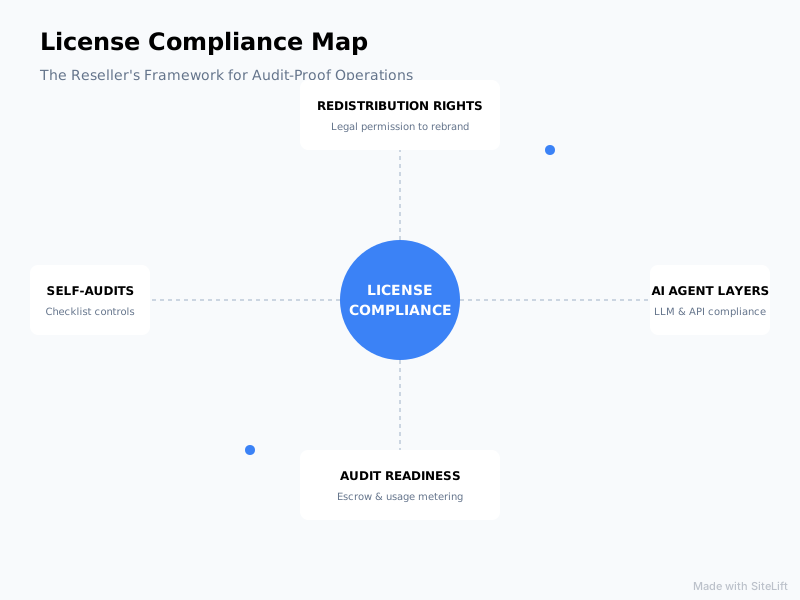
Infographic by SiteLift
What Is Your White Label License Compliance Checklist to Stay Audit-Proof?
Think of this white label license compliance checklist as your pre-flight, in-flight, and landing routine. Print it, assign owners, and run it religiously.
| Phase | Must-Verify Items | Owner |
|---|---|---|
| Pre-Purchase | Redistribution, sublicense, trademark, escrow, termination, SLA/DPA | Founder / Legal |
| Operations | Keys, tenants, seats, API metering, branding, privacy, support | Ops / Agency Manager |
| Renewal/Offboard | Expirations, price changes, model deprecations, data deletion | Finance / Ops |
Pre-Purchase Due Diligence Checklist
- Does the license explicitly allow rebranding and resale? Look for “white-label,” “sublicense,” “distribute.”
- How many domains, tenants, seats, and API calls are included? What does overage cost?
- Can you use the vendor trademark in marketing? Can you remove vendor branding?
- Is source code included, escrowed, or SaaS-only? What triggers escrow release?
- What happens on termination? Do client tenants shut off immediately? Is there a wind-down period?
- Is there an SLA (uptime, support times) and DPA (GDPR/CCPA) you can pass through to clients?
- Are LLM, data, and third-party API terms disclosed? Any geography or industry bans?
- Read Master License + Reseller Addendum + SLA + DPA together — restrictions hide in exhibits.
Post-Sale Operational Compliance Checklist
- Central license repository with keys, entitlements, and renewal dates
- Per-client tenant provisioning log (who got what, when)
- Monthly seat, storage, and API usage check vs. entitlement
- Branding QA: logo, domain, emails, login screen, footer, PDFs
- Privacy disclosures updated: list sub-processors, data location, retention
- Sub-licensee records: every end client signed your terms mirroring vendor terms
- Support handoff documented: who handles L1 vs. escalation to vendor
- Security hygiene: MFA, key rotation, least-privilege admin access
Annual Renewal and Offboarding Checklist
- Calendar alerts 60/30/7 days before renewal — auto-renewals trap agencies
- Reconcile price changes, seat true-ups, and AI credit repricing
- Check for version or model deprecations (e.g., LLM sunset forces prompt rebuilds)
- Confirm certificate renewals: SOC 2, ISO/IEC 19770 alignment for IT asset management best practices
- Offboard cleanly: revoke seats, export client data, delete per DPA, confirm in writing
- Archive evidence pack for 3+ years — disputes surface late
How to Build Software License Management for Resellers with Automation Tools?
Software license management for resellers doesn’t need to be enterprise SAM. You need a lightweight system that answers in 30 seconds: what do we own, where is it deployed, and are we over the limit?
I recommend starting with a spreadsheet + drive, then graduating to automation once you pass ~5 white-label products or 20 clients.
Core Components of Software License Management for Resellers
- Central repository: Single source of truth for contracts, keys, and entitlements. Notion, Airtable, or a dedicated SAM tool.
- Entitlement tracking: Allowed vs. used seats, domains, API calls, AI tokens per product per client.
- Usage metering: Pull from vendor dashboards, Stripe Metering, PostHog, or your API gateway. Don’t rely on memory.
- Alerts and audit logs: Renewal reminders, overage warnings, and who provisioned what.
- Client mapping: Which client uses which version on which domain. Critical for breach response and offboarding.
For a practical tool comparison, read License Tracking at Scale: Tools & Checklist.
License Compliance Automation Tools: What to Automate First
License compliance automation tools save the most time in this order:
- Contract extraction: AI tools that pull key terms (seats, domains, renewal, termination) from PDFs so you don’t miss buried clauses.
- SaaS discovery: Tools that find shadow SaaS, duplicate subscriptions, and unused seats across your team and clients.
- Seat and API monitoring: Automated sync of active users and token usage vs. entitlement, with Slack/email alerts at 80% and 100%.
- Renewal management: Auto-calendar, price-change detection, and approval workflows.
- Audit logs: Immutable logs of provisioning, deprovisioning, and key rotations for vendor audits.
You don’t need all five on day one. Automate renewals and seat metering first — those cause most penalties.
How Escrow, Deal Matching, and Compliance Workflows Reduce Risk
Escrow isn’t just for payments. When you buy white-label rights or source code through escrow, you get verified delivery, a timestamped ownership record, and release conditions. That certificate is gold in a dispute.
AI-driven deal matching helps too, because it filters for listings that actually include redistribution rights, source-code access, and DPA support — instead of you discovering gaps after paying.
Pro Tip: Always pay for white-label IP via escrow with the license agreement attached as an exhibit. A wire transfer with no attached terms proves you paid, not that you have rights to resell.
What Should You Do If You Fail an Audit or Face a License Dispute?
First, breathe. Most license compliance failures end in a true-up invoice, not a lawsuit — if you cooperate quickly and professionally.
Immediate Remediation Steps and Negotiating Cure Periods
Most agreements give you a 30-day cure period. Use it wisely:
Days 1-7: Contain and verify
- Acknowledge the audit in writing, assign one point of contact
- Freeze new deployments of the disputed product
- Validate the vendor’s findings against your own logs — telemetry can be wrong
Days 8-30: True-up and clean up
- Pay for overused seats/API credits or upgrade to an agency plan
- Take down non-compliant domains or move them to a proper license
- Rotate leaked keys, remove orphaned tenants, fix branding violations
Days 31-90: Harden and renegotiate
- Ask for retroactive discount in exchange for annual prepay or longer term
- Negotiate expanded redistribution rights so you don’t fail again next quarter
- Update client contracts to pass through limits and overage fees
When to get a lawyer: if the vendor alleges willful infringement, demands source-code deletion, threatens termination without cure, or claims data misuse. Don’t sign a backdated “audit settlement” without counsel.
My Take: Why Resellers Who Obsess Over Compliance Grow Faster
I’ll be honest — I used to see license compliance as boring admin work. Something to deal with after landing clients.
I was wrong. After watching agencies navigate this space, I’ve changed my mind completely.
The agencies that grow fastest aren’t the ones with the flashiest rebrand. They’re the ones who can answer enterprise procurement in one email: here’s our reseller addendum, here’s our DPA, here’s our escrow certificate, here’s our sub-processor list, here’s our uptime SLA.
That packet closes deals. It lets you charge 3x more than the freelancer running a nulled script on shared hosting. It lets you sell to healthcare, finance, and EU clients who must check boxes.
Compliance is also creative protection. When you document AI agent redistribution rights — models, prompts, RAG data, APIs — you actually understand your product better. You know your margins per 1,000 API calls. You know when to switch models. You stop guessing.
If you want a sustainable white-label business, stop treating compliance as a tax. Treat it as your moat.
— licensesaas.com
Next Steps to Future-Proof Your Reseller Business
You don’t need to build all this from scratch. The fastest way to stay audit-proof is to buy rights that are verified from day one.
On licensesaas.com, you can browse white-label SaaS and AI agents where redistribution rights, source-code access, and escrow-protected payments are part of the deal — not an afterthought. Look for listings that disclose seat/domain/API limits, include SLA/DPA docs, and offer AI-driven matching to your agency model.
Start with one product: run the self-audit above, build your evidence pack, and automate renewals. Then repeat for every product. In 90 days, you’ll be the reseller vendors want to promote, not audit.
For related reading on tracking growth without losing control, see our SaaS License Compliance Guide for Buyers & Sellers.
FAQ
What is license compliance for white-label SaaS resellers?
License compliance for white-label SaaS resellers means you hold written permission to rebrand, host, price, and sublicense a third-party product to your clients within defined limits. It includes respecting seat, domain, tenant, API, geography, and branding rules, plus maintaining proof like signed agreements, invoices, and usage logs. Without it, rebranding is copyright and trademark infringement, even if you paid for a subscription.
Can I legally rebrand and resell an AI agent as my own?
Yes, but only if your agreement grants AI agent redistribution rights covering all layers: the agent code, the LLM provider terms, training/RAG data licenses, and any third-party APIs. You also need rights to use your own branding, create client sub-accounts, and define who owns AI outputs. Always get a bill of materials and read the LLM and API terms — they flow down to you and your clients.
How often should agencies perform a SaaS license audit?
Run a lightweight SaaS license audit for agencies quarterly, and monthly if you manage 10+ white-label products or usage-based AI billing. Check entitlements vs. actual seats, domains, tenants, and API/AI usage, deprovision ex-clients, and verify renewals. Also audit before renewals, before onboarding a large client, and during fundraising or acquisition due diligence.
What happens if you fail a software license audit as a reseller?
Typically you get a cure notice and must pay true-up fees for overuse, upgrade your license, or remove non-compliant deployments within 30 days. Repeated or willful violations can lead to higher penalties, loss of white-label rights, termination, and reputational damage with clients. Cooperate quickly, validate findings with your own logs, and seek legal counsel if termination or data claims are involved.
What are the best license compliance automation tools for resellers?
The best license compliance automation tools for resellers cover contract AI extraction, SaaS discovery, seat and API usage metering, renewal alerts, and immutable audit logs. Start by automating renewal reminders and seat/API monitoring — those prevent most overages. Pair tools with a central license repository and escrow certificates proving ownership, so you can respond to any vendor audit with one evidence pack.
More from the Blog

White Label Sportsbook Software: How to License and Launch Your Betting Brand
Learn how white label sportsbook software works, costs, licensing & launch steps. License safely and scale your betting brand.

Social Media Management Software White Label: Agencies Shortcut to Recurring Revenue
Discover how social media management software white label platforms help agencies launch proprietary dashboards, stop churn, and unlock high-margin MRR.

Apps White Label Explained: Launch Your Own Branded App Portfolio Fast
Discover how apps white label models work. Compare source code licensing to app builders, pass store reviews, and scale recurring agency revenue.