White Label Software 101: How to Rebrand, License and Launch in Weeks

White label software lets you launch your own branded SaaS product without building it from scratch. You license a proven platform from a vendor, add your logo, domain, colors, and pricing, then sell it as your own.
I’ve watched agencies go from idea to paying customers in under three weeks using this model. No hiring developers, no six-month build cycle, no infrastructure headaches. This guide breaks down exactly how it works, what it costs, and how to launch safely.
Key Takeaways
| What You Need to Know | The Short Answer |
|---|---|
| What is it? | Third-party software you rebrand and resell as your own |
| Best for | Agencies, consultants, vertical SaaS founders, resellers |
| Hosting models | Hosted multi-tenant SaaS vs. self-hosted source code license |
| Typical license cost | $99–$1,500/mo for hosted; $5k–$100k+ for source code buyout |
| Launch timeline | 1–4 weeks for hosted, 6–12 weeks for source code |
| Biggest risk | Vendor lock-in, unclear reseller rights, and support gaps |
| Smart move | Use escrow, get reseller rights in writing, start niche |
What Is White Label Software and How Does It Work?
White label software is a finished product built by one company that another company rebrands and sells as its own. Think of it like store-brand cereal. Same factory, different box, different price.
The mechanics are simple on the surface. The vendor maintains the core codebase, servers, and feature updates. You control the customer-facing layer: brand name, logo, custom domain like app.youragency.com, color scheme, email sender, and billing plans. Your clients log in and see your company, not the vendor’s.
This is why a white label SaaS platform is so attractive to non-technical founders. You’re licensing outcomes — onboarding flows, dashboards, automations — not starting from a blank code editor.
White Label vs. Private Label vs. Custom Software Development
These terms get mixed up constantly. Here’s the clean distinction:
White label: One product sold to many resellers. Everyone gets the same core features with branding customization. Example: A CRM built for marketing agencies where 200 agencies each run it under their own name.
Private label: Similar concept but often exclusive or semi-exclusive for one retailer or region. Common in physical products and fintech. You might get more input on the roadmap.
Custom software development: Built just for you from scratch. You own the IP, but you also own the timeline, bugs, and maintenance bill.
| Model | Who Owns IP? | Upfront Cost | Maintenance | Speed to Market |
|---|---|---|---|---|
| White Label | Vendor | Low | Vendor handles | Days to weeks |
| Private Label | Vendor / Shared | Medium | Vendor handles | Weeks |
| Custom Build | You | High | You handle | Months to years |
If you want control and have budget, custom wins. If you want speed and cash flow, white label wins every time.
Hosted Multi-Tenant SaaS vs. Source Code Licensing
There are two very different ways to buy rebrandable software for agencies, and picking the wrong one causes pain later.
1. Hosted multi-tenant SaaS: You rent access to the vendor’s cloud. All resellers share the same infrastructure, but data is logically separated by tenant. You get an admin panel to create client accounts, set pricing, and toggle features. You don’t touch servers or deploy code.
Pros: Zero DevOps, instant updates, lower upfront cost. Cons: Limited deep customization, dependent on vendor uptime.
2. Source code licensing: You license or buy the actual codebase and host it yourself. You can modify features, self-host in your region, and often keep running even if the vendor disappears.
Pros: Full control, deeper differentiation, better for regulated niches. Cons: You handle hosting, security patches, and updates.
Pro Tip: If you have no in-house developers, start with hosted. Only move to source code when you have revenue to pay for maintenance and a clear reason to customize the core.
Key Architectural Components of Rebrandable Software
What actually makes software “rebrandable” under the hood? Look for these three layers:
1. Theming and branding layer: Dynamic CSS variables, logo upload, white-label email templates, and login page customization. The best platforms let you do this per-client, not just per-reseller.
2. Custom domain and SSL layer: This uses CNAME records and automated SSL provisioning. Your client points portal.clientdomain.com via CNAME to the vendor, and the platform serves your branded app with a valid certificate. Cloudflare has excellent technical documentation on how custom hostnames and CNAME setup work for SaaS providers if you want to understand the plumbing.
3. Tenant isolation and billing layer: Each of your customers gets isolated data, users, and API keys. Integrated webhooks connect to Stripe or Paddle for sub-billing, so you can mark up seats and keep the margin.
If a vendor can’t clearly explain these three, walk away. That’s not a true white label product — it’s just an affiliate dashboard with your logo pasted on.
Why Should Agencies and Entrepreneurs Adopt a White Label SaaS Platform?
Demand for turnkey cloud tools keeps climbing. Research from Statista shows the global Software-as-a-Service market size is estimated to exceed $230 billion, which you can explore in Statista’s global SaaS market outlook. According to Gartner, worldwide end-user spending on public cloud services is projected to surpass $675 billion, detailed in Gartner’s cloud spending forecast press release.
Translation: businesses already pay for SaaS. They’d just rather buy it from you — their trusted agency — than from a stranger.
Slashing Time-to-Market from Months to Days
Building even a simple client portal takes 4–6 months with a small dev team. A white label SaaS platform cuts that to days.
I’ve seen a lead-gen agency license a white-label CRM on Monday, connect their domain on Tuesday, import 300 contacts on Wednesday, and pitch it as a “Client Growth Hub” by Friday. That speed is impossible with custom development.
You skip wireframes, QA sprints, and server setup. You focus on what actually sells software: positioning, packaging, and onboarding.
Unlocking Predictable Recurring Revenue (MRR) for Agencies
Services are lumpy. Software is sticky.
When you bundle rebrandable software for agencies with your retainer — say, $299/mo for SEO + dashboard + review automation — churn drops. Clients don’t just cancel a report; they’d have to rip out the system their team logs into daily.
Typical agency playbook:
- License platform for $299/mo unlimited clients
- Resell at $99–$249/mo per client
- 10 clients = $990–$2,490 MRR on top of services
- Gross margin often 70–90% after infrastructure
For vertical SaaS aggregators, the math is even better. Launch one branded tool for dentists, lawyers, or gyms, then replicate onboarding across hundreds of similar clients.
Mitigating Technical Debt and Upfront Engineering Risk
Every custom feature you build is a future bug you own. With white label, the vendor ships updates, patches security holes, and scales servers.
That doesn’t mean zero risk. It means transferred risk. You trade engineering risk for vendor-dependency risk, which is far easier to manage with a good contract and escrow.
If you’re browsing options, start with curated marketplaces that list white-label SaaS for agencies to rebrand and sell to clients where terms are negotiated directly with founders. You’ll see real pricing and reseller terms instead of “book a demo” walls.
Pro Tip: Don’t sell generic software. Sell a transformation for one niche. “CRM for mortgage brokers with automated follow-up” beats “our all-in-one business platform” every time.

What Does a White Label Software License Cost? (Pricing Models Decoded)
Let’s talk about white label software license cost, because vendors love to hide it.
There’s no single price. I’ve seen solid hosted licenses at $97/mo and enterprise source-code deals over $150,000. What matters is total cost of ownership and your margin after resale.
Flat Monthly Subscription vs. Tiered Per-Seat Licensing
Flat monthly: You pay one fee, often $200–$1,500/mo, for unlimited client accounts or up to a high cap. Best for agencies scaling fast. Your margin grows with every new client you add.
Tiered per-seat / per-workspace: You pay per end-client, per user, or per active contact. Example: $29 per client workspace, you resell at $99. Cleaner for forecasting, but margins compress as you scale.
| Pricing Model | You Pay (Typical) | You Charge | Best When |
|---|---|---|---|
| Flat unlimited | $297–$999/mo | $99–$249/client/mo | You have 10+ clients |
| Per workspace | $20–$60/client/mo | $79–$199/client/mo | You have <10 clients |
| Per seat | $5–$15/user/mo | $19–$39/user/mo | Seat-heavy tools like CRM |
Always ask: Are test accounts free? What counts as “active”? Can I pause a client without losing data?
One-Time Source Code Buyout vs. Rev-Share Agreements
Source code buyout: One-time fee of $5,000 to $100,000+, sometimes plus annual updates at 20% of license fee. You host it, you keep 100% of revenue. Ideal if you want to build equity and eventually sell the business.
Rev-share: Little or no upfront fee, but you pay the vendor 10–30% of what you collect. Great for validating an idea with no capital, terrible long-term if you scale to $50k MRR and give away $15k.
I prefer a hybrid for beginners: low upfront + capped rev-share for 12 months, then convert to flat. Get it in writing.
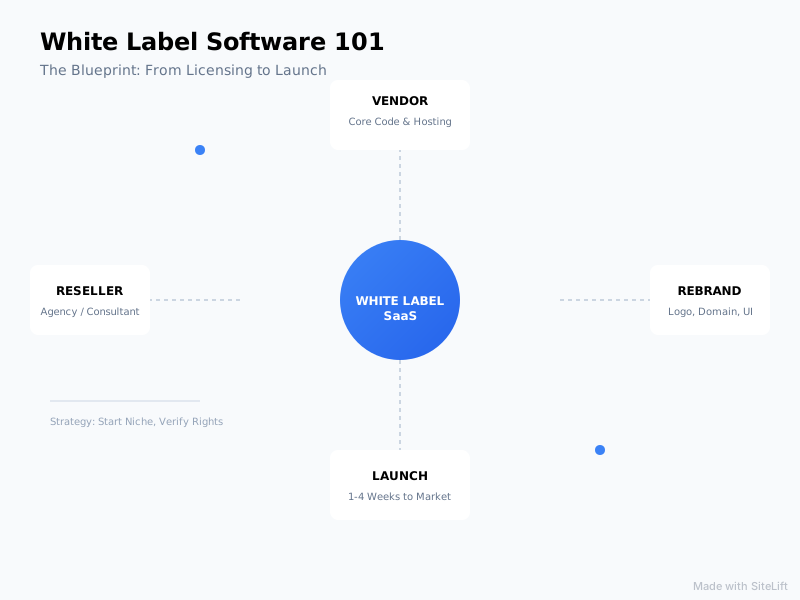
Infographic by SiteLift
Hidden Overhead: Infrastructure, Third-Party APIs, and Customer Support
The license fee is only half the story. Budget for:
- Cloud hosting (source code only): $50–$500/mo on AWS, Hetzner, or DigitalOcean
- Transactional email/SMS: SendGrid, Postmark, or Twilio — $20–$200/mo depending on volume
- Payment processing: Stripe takes 2.9% + 30¢ per transaction in the US; factor this into pricing
- Support time: Even if the vendor fixes bugs, you answer “how do I reset my password?” tickets
- Onboarding: Loom videos, help docs, and setup calls cost time or VA money
A $299/mo license can easily become $600/mo all-in. Still profitable if you price at $149/client with 10 clients, but do the math before you promise lifetime deals.
How to Rebrand, License, and Launch White Label Software in 5 Steps
This is the exact process I recommend to agencies licensing their first platform. It works for both hosted and source-code deals.
Step 1: Vetting Vendors, Codebases, and Escrow Protections
Don’t fall for a slick demo. Ask for:
- Live reseller examples (not just screenshots)
- Uptime history and status page for last 90 days
- Security practices: encryption at rest, backups, role-based access
- Roadmap: last 3 shipped features and next 3 planned
- Code quality (for source code): Git history, README, dependency list, test coverage
- Reference calls with 2 current resellers
And always negotiate escrow for source code or high-ticket licenses. Escrow means a neutral third party holds the code and releases it if the vendor disappears. The FTC’s business guidance on commercial practices and licensing is a useful baseline for understanding fair commercial claims before you sign anything.
For a founder-friendly breakdown of what good vendors should offer, read how to white-label your SaaS architecture guide. It flips the perspective and shows you what to demand.
Step 2: Technical Configuration (Custom Domains, SMTP, and Payment Gateways)
This is where most launches stall. Block out a focused afternoon:
- Custom domain: Create CNAME
app.yourdomain.com→proxy.vendor.com. Enable SSL (most vendors auto-provision via Let’s Encrypt). - Transactional email: Add SPF, DKIM, and DMARC records for
mail.yourdomain.comin your DNS. Verify in Postmark/SendGrid. This keeps login emails out of spam. - Payment gateway: Connect Stripe in test mode, create two plans (monthly/annual), test webhook for
customer.subscription.deletedso cancellations offboard cleanly. - SSO and roles: Set admin vs. client vs. viewer permissions. Turn on 2FA.
- Backups and data export: Confirm you can export all client data as CSV/API. Test it once.
Get this right and your platform feels native. Get it wrong and clients see “sent via vendor.com” — instant trust killer.
Step 3: UI/UX Customization and Positioning for Your Niche
Upload your logo, set brand colors, rewrite the empty states. But don’t stop at cosmetics.
Rename features for your niche. A generic “Pipelines” becomes “Guest Booking Pipeline” for a salon SaaS. “Automations” becomes “No-Show Rescue” for clinics. Same code, 10x perceived value.
Create a branded login page with a 90-second Loom: “Welcome to [YourBrand], here’s how to get your first win today.” That one video cuts support tickets in half.
Check live examples like Octopus white-label operations and CRM platform for agencies to see how a generic ops tool gets repositioned specifically for local tradespeople. Steal that positioning mindset.
Step 4: Establishing Support Protocols and SLAs
Who handles what? Define it before your first angry ticket:
- Level 1 (you): Password resets, how-tos, billing questions. Target: <4 hour response on business days.
- Level 2 (vendor): Bugs, downtime, data issues. Get their SLA in writing — 99.9% uptime and <24h bug acknowledgement is standard for B2B.
- Escalation path: Shared Slack or ticket portal? Who gets paged at 2am?
Publish a simple status page, even if it just embeds the vendor’s. Clients forgive downtime faster when you communicate proactively.
Step 5: Executing Your Go-To-Market and Client Onboarding Strategy
Don’t launch to everyone. Launch to 5 friendly clients:
- Offer “founding member” pricing locked for 12 months
- Do white-glove onboarding via Zoom and record it
- Ask for testimonial after first measurable win
- Turn recordings into a self-serve course
Then productize: one landing page, one demo video, one checkout link, one onboarding checklist. Agencies win with boring, repeatable onboarding — not custom setups every time.
What Legal and Compliance Pitfalls Should You Avoid When Licensing SaaS?
This section isn’t legal advice, but I’ve seen resellers learn these lessons the expensive way. Get a lawyer for the final agreement — especially above $10k/year.
For a detailed clause checklist, bookmark this white label software agreement guide covering branding rights and exit terms.
Master Services Agreements (MSA) and Reseller Rights Clauses
Your license must explicitly state:
- You can rebrand, market, and sub-license to end clients under your own terms
- You own the client relationship and can contact clients directly
- What happens if you leave: data migration window (minimum 30–60 days), export format, and non-solicitation limits
- Whether the vendor can sell direct in your niche or territory
If “white label” isn’t defined in the contract, you don’t have it. Verbal promises on sales calls mean nothing.
Data Sovereignty, Privacy Regulations (GDPR, CCPA), and SOC 2
When you resell software, you are the data controller in your clients’ eyes. If the vendor leaks data, your brand takes the hit.
Ask for: Data Processing Agreement (DPA), data residency options (US/EU hosting), GDPR/CCPA compliance docs, encryption standards, and SOC 2 Type II report if you sell to larger businesses.
If you serve EU clients, confirm where backups live — not just primary servers. And ensure you can delete a client’s data fully on request.
Code Escrow and Contingency Plans for Vendor Insolvency
What if the vendor shuts down, gets acquired, or triples prices? You need a Plan B.
Best protections:
- Source-code escrow with automatic release triggers (insolvency, 30-day sustained downtime)
- Data portability guarantee with API + full export
- Price-lock for 12–24 months with capped increases
- Self-hosting fallback option for critical clients
I won’t license mission-critical white label software without escrow anymore. It’s cheap insurance compared to migrating 50 angry clients over a weekend.
My Honest Take: Most People Buy White Label Software for the Wrong Reason
I’ll be blunt because I’ve made this mistake myself.
Most buyers obsess over features. They compare checklists, count integrations, and pick the platform with 147 things they’ll never use. Then they struggle to sell it because it looks like everything else.
The winners do the opposite. They pick good enough software with rock-solid uptime and fast support, then go all-in on niche, story, and service.
I’ve seen a plain white-label booking tool outsell a far superior competitor 10-to-1, simply because one agency called it “The 5-Star Review Engine for Dental Clinics” and bundled setup, templates, and monthly optimization. Clients didn’t buy software. They bought fewer no-shows and more Google reviews.
My opinion: white label isn’t a shortcut to avoid marketing. It’s leverage for marketing. The code is commoditized. Your understanding of 50 dentists in Austin or 30 roofers in Manchester is not.
If you’re technical, you’ll be tempted to buy source code and rebuild everything. Don’t — at least not in month one. Launch hosted, get 10 paying clients, learn their language, then invest in custom code for the one workflow they beg for. That’s how you build equity without burning six months on guesses.
— licensesaas.com
Where to Find Vetted White Label Software to License Without the Guesswork
You can hunt vendors on Google for weeks, sit through 12 demos, and still miss the reseller clause that matters. Or you can start where founders already expect white-label deals.
LicenseSaaS is a B2B marketplace built specifically for licensing, white-labeling, and buying SaaS, AI agents, and APIs. Instead of cold outreach, you can browse white-label SaaS for resellers to rebrand and resell, chat directly with founders, and close with escrow-protected payments and AI-matched deal terms.
What I like for first-time buyers: you see real products, real reseller rights, and compliance basics upfront. That cuts due diligence from weeks to days.
If you’re ready to launch in weeks, shortlist 3–5 niche tools, ask for a reseller demo account, and run the 5-step checklist above. Your future MRR will thank you.
FAQ
What is the difference between white label software and open-source software?
White label software is proprietary. You pay for a license to rebrand and resell it, but the vendor owns the IP and handles updates. Open-source software gives you access to the code under an open license (like MIT or GPL) — often free — but you handle hosting, security, and maintenance yourself. You can white-label open source, but you don’t get vendor support or SLAs unless you pay for them separately.
Can end-users tell that a software platform is white-labeled?
Not if it’s done well. With a custom domain, your logo, brand colors, and your sending domain for emails (SPF/DKIM authenticated), most users will never know. Sloppy setups leak clues: “powered by” footers, vendor URLs in password-reset emails, or mixed branding on invoices. Audit every email, subdomain, and PDF export before launch.
How much does a typical white label software license cost?
Hosted licenses typically run $99–$1,500 per month depending on client limits and features. Per-client models run $20–$60 per workspace that you resell for $79–$249. Source-code buyouts are usually a one-time $5,000–$100,000+ plus hosting and maintenance. Always add payment fees (around 2.9% + 30¢ via Stripe), email/SMS costs, and support time to calculate true margin.
Who handles customer support and bug fixes for white label software?
It’s split. You handle Level 1: onboarding, how-tos, and billing for your clients. The vendor handles Level 2: bugs, infrastructure, and security patches under their SLA. The best vendors give resellers a private support channel with faster response times. Clarify response targets and escalation paths in your agreement before you onboard paying clients.
Do I need coding experience to rebrand and launch a white label SaaS platform?
No, not for hosted platforms. If you can set a CNAME record, verify email DNS, and connect Stripe, you can launch. Most rebranding happens in a no-code admin panel. You only need developers if you license source code, need custom API integrations, or want to heavily modify the product beyond themes and configuration.
More from the Blog

Apps for Sale: How to Buy, License and Rebrand Without Building From Scratch
Explore how to evaluate apps for sale, safely navigate IP acquisitions or licensing, conduct technical due diligence, and launch without building from scratch.

SaaS Contract Essentials: What Founders and Buyers Must Check Before Signing
Learn what founders and buyers must check in a SaaS contract before signing. Review key licensing clauses, SLAs, liability caps, and auto-renewals.

Software and Licensing Explained: Models, Rights and How to Monetize
Demystify software and licensing. Learn about SaaS licensing models, source code licensing rights, and how to monetize your software safely.