Apps for Sale: How to Buy, License and Rebrand Without Building From Scratch

Building software from a blank canvas is an exhausting, capital-draining slog. Anyone who has spent months managing Jira tickets, debating frontend frameworks, or watching launch deadlines slip knows the reality: software development rarely stays on schedule or on budget.
Browsing verified apps for sale offers an alternative route. Instead of funding speculative engineering, entrepreneurs, agencies, and operators are acquiring tested codebases, licensing proven platforms, and getting to market in days rather than quarters.
Whether you want to launch a vertical SaaS, add mobile functionality to an existing service agency, or establish a foothold in a new niche, buying or licensing ready-to-deploy software is often the smartest move you can make.
Key Takeaways
| Consideration | Full IP Acquisition | Commercial White-Label Licensing |
|---|---|---|
| Upfront Capital | High (typically 2.5x–5x annual profit/revenue) | Low to moderate (flat setup or recurring royalty) |
| Speed to Deployment | Moderate (requires account transfers & hosting migration) | Immediate (turnkey deployment or source-code fork) |
| Technical Overhead | Full responsibility for bugs, infrastructure, and updates | Often shared; original author may push core patches |
| Exclusivity | 100% exclusive ownership of code, assets, and brand | Non-exclusive or territory-exclusive commercial rights |
| Best Suited For | Well-funded operators wanting complete operational control | Agencies and niche operators seeking fast monetization |
Why Browse Apps for Sale Instead of Building From Scratch?
Starting from zero carries massive hidden costs. When you build an application from scratch, you aren't just paying for features; you are paying to solve solved problems: setting up authentication pipelines, wiring Stripe webhooks, configuring responsive viewports, and debugging edge cases on legacy Android devices.
Buying an existing application bypasses these preliminary engineering bottlenecks.
Traditional Build vs. Turnkey Acquisition Lifecycle:

Traditional Build (6–9 Months):
[ Architecture & Design ] ➔ [ MVP Development ] ➔ [ QA & Bug Fixing ] ➔ [ Market Validation ]

Acquisition / Licensing (1–2 Weeks):
[ Due Diligence & Audit ] ➔ [ Escrow Transfer ] ➔ [ Rebrand & Modernize ] ➔ [ Immediate Distribution ]
Slashing Time-to-Market from Months to Days
A standard MVP takes anywhere from 6 to 9 months to bring to production. By the time you ship, your target market's needs may have shifted, or a competitor may have already established strong distribution.
When you evaluate apps for sale, you are inspecting an asset that already works. The database schemas are indexed, the external APIs are integrated, and the UI state management is handled. What previously took three quarters of engineering time collapses into an afternoon of due diligence and a few days of rebranding.
Bypassing Early-Stage Product-Market Validation Risks
Technical execution is rarely what kills a new venture; distribution and demand failure are. According to research from CB Insights, premature scaling and lack of market need account for over 35% of startup failures.
Acquiring an application with an active user base—or even a dormant one with historical engagement—gives you an immediate feedback loop. You aren't guessing whether users want an automated scheduling tool or a specialized dashboard; you have real churn numbers, support tickets, and feature requests to guide your product roadmap from day one.
The Financial Calculus: Development Costs vs. Turnkey Acquisition
Hiring custom software agencies is an expensive endeavor. According to GoodFirms research, the average cost to develop a feature-rich mobile application ranges between $40,000 and $150,000. That capital expenditure buys you an unproven asset with zero revenue.
Contrast that with acquiring an existing micro-SaaS or licensing pre-built code:
- For a fraction of agency development costs, you can secure complete source-code ownership or a commercial white-label license.
- The remaining budget can be directed toward customer acquisition, conversion rate optimization, and brand positioning—the areas that actually drive enterprise value.
Full Acquisition vs. Software Licensing: Which Path Should You Choose?
Before you bid on a marketplace listing, you must determine whether you need outright intellectual property (IP) ownership or a commercial software license. Each structure serves completely different operational goals.
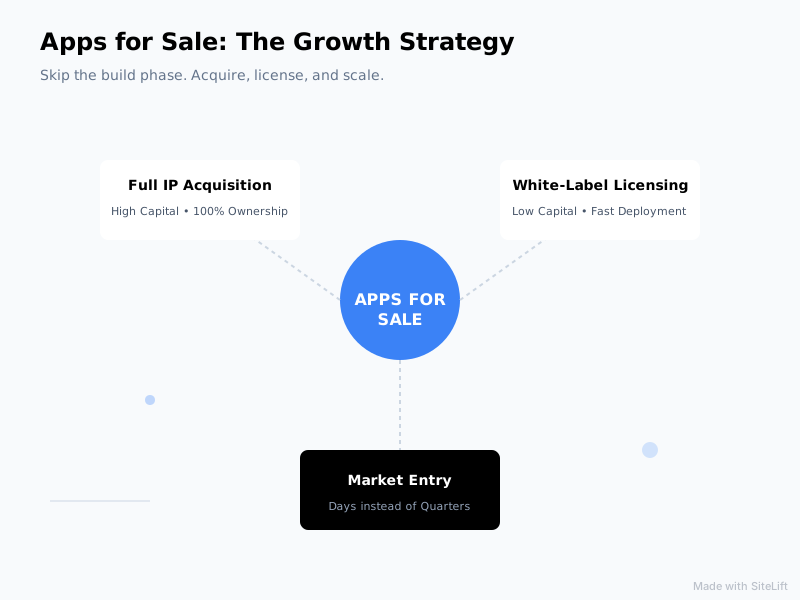
Infographic by SiteLift
Outright IP Purchase: Total Control and Exclusive Ownership
An outright acquisition transfers every line of code, design asset, trademark, domain, and database entry to your corporate entity.
- The Pros: Complete exclusivity. You can refactor the codebase, pivot the product, raise venture capital against the proprietary IP, or eventually sell the business at an institutional multiple.
- The Cons: You assume full responsibility for technical debt, legacy bugs, security patching, and infrastructure expenses. It requires the largest upfront capital allocation.
White-Label Source Code Licensing: Lower Entry Cost and Scalability
Licensing grants you legal permission to rebrand, host, modify, and monetize software without buying the underlying exclusive rights.
For agencies looking to expand their service catalog, this is often the superior model. An agency can license vertical tools—such as software built for real estate agencies or custom platforms for personal trainers—reskin them with their clients' branding, and charge recurring monthly retainers without carrying the core product development risk.
- The Pros: Dramatically lower upfront cost, access to continuous core updates from the primary developer, and the ability to test multiple market niches simultaneously.
- The Cons: You do not own the fundamental underlying IP, and the licensor may grant similar non-exclusive rights to operators targeting other geographic territories or non-competing verticals.
Strategic Comparison: Ongoing Maintenance, Liability, and Customization Freedom
| Feature / Dynamic | Outright Asset Acquisition | Commercial White-Label License |
|---|---|---|
| Intellectual Property | 100% assigned to buyer via APA | Retained by licensor; user gets commercial rights |
| Custom Code Modification | Unlimited; open-ended architectural changes | Dependent on license terms (source-available vs. compiled) |
| Capital Requirements | $10,000 to $500,000+ | $500 to $15,000 setup / ongoing royalties |
| Infrastructure Overhead | Buyer hosts, monitors, and patches | Buyer self-hosts OR uses licensor’s multi-tenant engine |
| Exit Potential | Asset can be sold to private equity or aggregators | Asset sale limited to client book and brand equity |

How to Vet Listings on an App Licensing Marketplace: Due Diligence Guide
Never buy code based solely on screenshots, sleek demo videos, or self-reported pitch decks. A thorough due diligence process protects your capital and prevents you from inheriting unmaintainable software.
Code Quality, Architecture, and Technical Debt Audits
Request repository access to run a thorough code inspection before releasing any funds. If the seller refuses read-only access under a standard Non-Disclosure Agreement (NDA), walk away immediately.
- Framework Versions: Verify whether the app runs on supported runtimes. An application written in Flutter 1.x, Swift 3, or AngularJS 1.x will require a costly rebuild just to compile under modern SDK requirements.
- Architecture Modularity: Look for clean separation of concerns. Spaghetti code with logic directly embedded in presentation views will dramatically inflate future feature development costs.
- Automated Audits: Run automated security static analysis tools (such as SonarQube or Snyk) to identify common vulnerabilities, SQL injection risks, and unmaintained npm or CocoaPods dependencies.
Financial and Metric Verification: MRR, Churn, and Unit Economics
If the listing claims existing recurring revenue, demand direct, view-only administrative access to payment processors like Stripe, Paddle, or Braintree.
Key Verification Checklist:
├── MRR Authenticity: Check Stripe for manual refunds or phantom subscriptions
├── Cohort Churn: Confirm whether logo retention drops off sharply after Month 2
├── LTV/CAC Ratios: Ensure traffic isn't artificially inflated by temporary ad spend
└── Unit Economics: Deduct hosting, SMS (Twilio), and third-party API costs from gross profit
Calculate customer acquisition cost (CAC) versus lifetime value (LTV). An app pulling $4,000 Monthly Recurring Revenue (MRR) is not attractive if it requires $3,800 in continuous Google Ads spend to keep churn from devouring the customer base.
Intellectual Property, Third-Party APIs, and Open-Source Compliance
Open-source compliance is one of the most overlooked risks in software deals.
- Check for viral open-source licenses, specifically GPL or AGPL. If a proprietary application integrates code licensed under GPL v3 without strict container isolation, you may be legally obligated to open-source the entire proprietary platform. Ensure dependencies use permissive frameworks like MIT, Apache 2.0, or BSD.
- Catalog every external third-party API. If the app relies heavily on proprietary data feeds, scrape endpoints, or services with pricing tiers tied to credit usage, calculate how those operating margins scale as active users double or triple.
Pro Tip: Before closing, check the commits across the git history. A healthy repository shows incremental, documented development over months or years. If the entire codebase was committed in a single commit titled "initial upload" two weeks prior to the sale, proceed with extreme caution—it is likely an unauthorized clone or an unlicensed script.
How to Buy a Mobile App Safely Using Escrow Protection
The only secure way to execute a digital asset transaction is through a dedicated third-party escrow service. A direct bank wire or peer-to-peer transfer leaves you with zero recourse if the seller sends an incomplete repository or fails to transfer the developer accounts.
Structuring Milestone-Based Escrow Protected App Purchases
When conducting an escrow protected app purchase, funds are deposited into a neutral holding account and disbursed to the seller only after technical milestones are completed and verified by the buyer.
Use a milestone framework via platforms like Escrow.com:
- Deposit: Buyer deposits 100% of the agreed purchase price into the escrow holding account.
- Milestone 1 (Source Transfer): Seller transfers primary git repositories, technical documentation, architectural diagrams, and administrative credentials for independent testing (Release 20-30%).
- Milestone 2 (Store & Asset Migration): Seller initiates and completes the app migration across developer platforms, domain registries, and transactional mail services (Release 50-60%).
- Milestone 3 (Inspection Period): Buyer completes a mandatory 5- to 10-day operational test run to verify telemetry, error logs, and real-time payment flow (Release remaining balance).
Transferring Developer Accounts: Apple App Store and Google Play Protocols
To buy mobile app safely, the application must move between developer accounts cleanly without interrupting existing users, breaking subscription billing, or resetting ratings.
- Apple App Store Connect: Consult the Apple Developer official documentation on transferring app ownership to verify your target app meets transfer criteria. The app must have at least one approved build, cannot use shared iCloud containers, and cannot possess active TestFlight builds using incompatible entitlements. Once accepted in your App Store Connect account, app IDs, ratings, and subscriptions transfer seamlessly.
- Google Play Console: Follow the Google Play Console Help for transferring apps to prepare both the target and destination developer account IDs. You will need transaction IDs from both accounts' registration fees. Unlike Apple, Google processes transfers on the backend within 48 to 72 hours without requiring code adjustments.
Asset Purchase Agreements (APA), Non-Competes, and Handover Support
Never rely on a marketplace's default "terms of service" as your sole contract. A customized Asset Purchase Agreement (APA) signed by both parties should explicitly mandate:
- IP Assignment: Unambiguous legal language assigning all source code, assets, trademarks, and documentation to your entity.
- Non-Compete Clause: A restrictive covenant prohibiting the seller from launching, contributing to, or financing a competing product within the same vertical for 24 to 36 months.
- Transition Support: A defined volume of developer hours (e.g., 20 hours over 30 days) to assist your engineering team with environment setup, deployment scripts, and architectural walkthroughs.
Evaluating Apps for Sale: Why White-Label Licensing Is the Underrated Play
I’ve watched dozens of founders and agency operators burn five- and six-figure budgets acquiring full IP for software they eventually struggled to maintain. They thought they wanted complete code ownership, but what they actually needed was distribution leverage.
Unless you are an experienced software operator with dedicated DevOps and full-stack engineering talent on payroll, buying exclusive IP forces you to take on technical liabilities: framework migrations, database indexing, infrastructure security, and unexpected breaking API updates.
When you purchase source code outright, you are on your own.
This is why licensing commercial source code or buying white-label operational rights is often the superior route for business-focused operators. You get a fully featured, continuously updated technical foundation, and you can focus your time and capital where equity value is actually created: vertical positioning, tailored onboarding, and performance marketing.
If you find an application with a solid engine, don't assume you must spend $100,000 buying out the founder's entire enterprise. Propose a commercial license or white-label agreement instead. You get to market next week, preserve your growth capital, and avoid the maintenance trap entirely.
— licensesaas.com
How Do You Rebrand, Modernize, and Scale an Acquired App?
Closing the deal is only step one. The real upside comes from repositioning a generic or neglected asset into a specialized, high-margin product.
        Acquired Asset
              │
              ▼
┌───────────────────────────┐
│     Modern UI/UX Skin     │  ➔ Custom Tailwind/Figma design tailored to niche
└─────────────┬─────────────┘
              ▼
┌───────────────────────────┐
│   AI Agents & Modern APIs │  ➔ Contextual LLMs, webhooks, specialized workflows
└─────────────┬─────────────┘
              ▼
┌───────────────────────────┐
│ Targeted Go-to-Market     │  ➔ Industry-specific positioning (e.g., Vertical SaaS)
└───────────────────────────┘
Refactoring the UI/UX and Implementing a Unique Brand Identity
Generic designs convert poorly. If you purchase a multi-tenant booking application, keep the backend logic, but rewrite the front-end presentation layer.
- Replace generic component libraries with a custom design system tailored to a specific audience.
- Simplify user onboarding: strip away bloated legacy configurations and build a streamlined, 3-step setup flow.
- Tailor the microcopy and product naming conventions around the operational language of your chosen target demographic.
Embedding Modern AI Agents, APIs, and Workflow Automations
Adding intelligent workflows to an older codebase can immediately justify higher subscription tiers. Data from Gartner indicates that through 2026, over 80% of enterprises will have used generative AI APIs or deployed AI-enabled applications, making modernization of acquired legacy codebases critical.
Instead of keeping an acquired application as a basic data-entry dashboard, layer in modern automations:
- Integrate LLM-driven endpoints to generate automated summaries, trigger smart alerts, or run predictive analytics over existing user data.
- Build external webhook support and public API endpoints, turning an isolated tool into an extensible platform that connects to Zapier, Make, and native enterprise software.
- If you acquire software targeting interactive industries—such as software built for gaming companies—integrate modern real-time data syncs, modular microservices, or custom billing structures.
Post-Acquisition Go-to-Market and User Acquisition Tactics
Once the rebrand is complete, focus on structured user acquisition:
- Reactivate Dormant Databases: If you acquired existing user accounts, send a warm reactivation sequence introducing the new ownership, highlighting stability updates, and offering grandfathered pricing on modernized tiers.
- Target Vertical Niches: Reposition generic horizontal tools into hyper-specific vertical solutions. A basic CRM is hard to sell against HubSpot; a custom CRM designed strictly for commercial roofing subcontractors commands high prices with zero platform confusion.
- Direct B2B Outbound: Leverage cold email, LinkedIn Sales Navigator, and strategic partnerships to sell directly to businesses that need the operational problems solved that your software addresses.
Accelerating Software Ownership with LicenseSaaS
Finding the right software deal shouldn't mean sifting through hundreds of dubious marketplace listings with unverifiable metrics and opaque codebases.
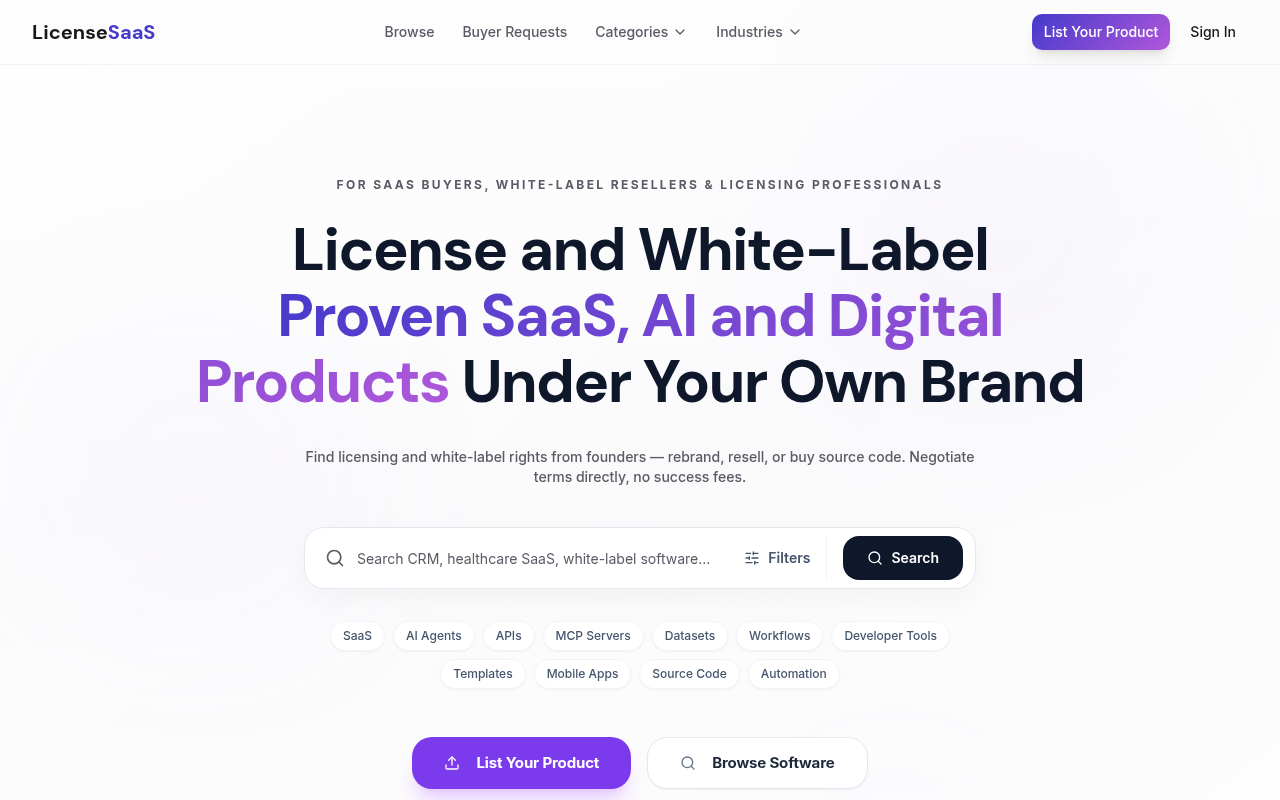
At licensesaas.com, we built an app licensing marketplace designed specifically for founders, operators, and agencies who want to deploy software without building from scratch. Our platform bridges the gap between software developers looking to monetize their codebases and ambitious entrepreneurs searching for vetted apps for sale.
Whether you want to license a turnkey AI agent platform, secure commercial white-label source code, or negotiate a full IP buyout, our platform streamlines the entire transaction lifecycle:
- AI-Driven Deal Matching: Connect instantly with products that align directly with your target industry, preferred tech stack, and budget.
- Escrow-Protected Transfers: Safeguard your capital at every stage of the deal with built-in escrow milestone verification.
- Streamlined License Compliance: Access pre-structured legal contracts, white-label operational agreements, and developer handoff frameworks designed to eliminate post-sale disputes.
Stop spending quarters in expensive development cycles. Browse our available software ecosystems and bring your next platform to market in days.
FAQ: Buying and Licensing Apps for Sale
What is the difference between buying an app and licensing an app?
Buying an app transfers 100% of the underlying intellectual property (IP), source code, design assets, and brand rights to your corporate entity via an Asset Purchase Agreement. Licensing grants you contractual permission to commercialize, rebrand, host, or resell the software—often on a white-label basis—while the original creator maintains core IP ownership and frequently handles foundational platform maintenance.
How does an escrow protected app purchase work?
In an escrow-protected purchase, the buyer deposits the transaction funds with an independent, licensed third party (such as Escrow.com) rather than sending money directly to the seller. The funds are securely held until the buyer receives the source code, validates repository integrity, and confirms successful app store and infrastructure migrations. Only after formal inspection and mutual sign-off are the funds released to the seller.
Can you transfer an app between Apple App Store and Google Play accounts without downtime?
Yes. Both Apple App Store Connect and the Google Play Console provide native transfer mechanics that migrate apps directly between developer accounts without removing the application from search results, breaking subscription billing, or deleting customer reviews. As long as both accounts meet developer platform transfer guidelines, the migration occurs seamlessly in the background.
What legal documents are necessary when buying apps for sale?
A secure software transaction requires an Asset Purchase Agreement (APA), an Intellectual Property Assignment Agreement, a comprehensive Bill of Sale, a Non-Disclosure Agreement (NDA) for due diligence phases, and a Non-Compete Agreement to prevent the seller from building a duplicate asset. If licensing rather than buying, you will execute a Commercial Software License Agreement defining your operational, branding, and territory permissions.
How do you determine a fair valuation for an app listing?
Valuations are typically calculated using a multiple of trailing twelve months (TTM) Seller’s Discretionary Earnings (SDE) or Annual Recurring Revenue (ARR). Mature, growing micro-SaaS businesses with low churn often trade between 2.5x and 5x SDE. Early-stage, pre-revenue applications or codebases without significant user traction are valued asset-by-asset, generally priced against the baseline engineering replacement cost of the technical stack minus accrued technical debt.
More from the Blog

White Label Software 101: How to Rebrand, License and Launch in Weeks
Learn how white label software works, license costs, and 5 steps to rebrand and launch your SaaS in weeks. Actionable guide for agencies.

SaaS Contract Essentials: What Founders and Buyers Must Check Before Signing
Learn what founders and buyers must check in a SaaS contract before signing. Review key licensing clauses, SLAs, liability caps, and auto-renewals.

Software and Licensing Explained: Models, Rights and How to Monetize
Demystify software and licensing. Learn about SaaS licensing models, source code licensing rights, and how to monetize your software safely.