SaaS Contract Essentials: What Founders and Buyers Must Check Before Signing

Negotiating a saas contract can feel like balancing on a razor's edge. If you are a buyer, you want ironclad assurances around uptime, data sovereignty, and an easy exit if the tool fails to deliver. If you are a founder or vendor, you want predictable recurring revenue, bounded operational liability, and unencumbered intellectual property rights.
Too often, both parties rush through the fine print to close the deal before quarter-end. That haste carries a measurable cost. According to research from World Commerce & Contracting, poor contracting practices and friction during agreement negotiations cost companies up to 9% of their annual revenue. When commercial software relationships turn sour, the root cause almost always traces back to ambiguities buried inside the initial agreement.
Whether you are signing your first five-figure enterprise deal or evaluating a core operational platform, understanding what goes into a modern contract protects your bottom line, keeps your operations resilient, and preserves long-term enterprise value.
What Is a SaaS Contract and How Does It Work?
At its core, a saas contract is a legally binding framework governing access to hosted software applications delivered over the internet. Unlike traditional software transactions where ownership or perpetual copies change hands, a Software-as-a-Service arrangement grants temporary, conditional access to a vendor’s hosted infrastructure.
┌────────────────────────────────────────────────────────┐
│               MODERN SAAS CONTRACT STACK               │
├──────────────────────────┬─────────────────────────────┤
│ Master Subscription      │ Core commercial terms,      │
│ Agreement (MSA)          │ licensing scope, liability  │
├──────────────────────────┼─────────────────────────────┤
│ Order Form / Statement   │ Pricing tiers, seat counts, │
│ of Work (SOW)            │ billing cadence, add-ons    │
├──────────────────────────┼─────────────────────────────┤
│ Service Level            │ Uptime commitments, cred-   │
│ Agreement (SLA)          │ its, support response times │
├──────────────────────────┼─────────────────────────────┤
│ Data Processing          │ GDPR / CCPA obligations,    │
│ Addendum (DPA)           │ sub-processors, security    │
└──────────────────────────┴─────────────────────────────┘
The fundamental mechanics depend on whether you are acquiring access via multi-tenant cloud environments or negotiating custom licensing arrangements that include white-label rights or proprietary source code escrows.
SaaS Subscription Agreement vs. Traditional Software Licensing
In legacy software procurement, an enterprise purchased a perpetual license to run executables on its own on-premises servers. The buyer controlled the hosting environment, managed database security, and shouldered hardware failure risks.
A modern saas subscription agreement flips this operational model completely:
- Infrastructure Custody: The vendor manages the servers, cloud dependencies, continuous updates, and security patching.
- Access vs. Ownership: The customer receives a non-exclusive, revocable, non-transferable right to access the software for a defined subscription period.
- Maintenance Continuity: Ongoing support, bug fixes, and feature releases are rolled directly into the recurring subscription fee rather than negotiated under separate, annual maintenance packages.
Because the vendor retains total custody of the technical environment, the agreement must clearly govern operational continuity, performance guarantees, and data security.
Key Parties and Core Commercial Objectives
A balanced commercial agreement aligns two divergent sets of interests:
| Party | Primary Operational Goals | Major Legal & Commercial Risks |
|---|---|---|
| Founders & Sellers | Reliable recurring revenue; low customer support overhead; strict liability ceilings; total retention of core IP. | Customer data breaches; crippling indemnification claims; bespoke feature creep; uncontrolled service credits. |
| Buyers & Procurement Teams | Reliable application uptime; enterprise security compliance; clear data export protocols; predictable pricing without runaway overages. | Unexpected vendor outages; vendor lock-in; unnotified auto-renewals; unauthorized use of customer data to train AI models. |
Why Standard Terms of Service Are Rarely Enough for B2B Deals
Self-serve click-through agreements—commonly presented as Terms of Service (ToS) or End User License Agreements (EULA)—work well enough for individual users testing low-cost productivity tools. However, they fall short for mission-critical B2B software deployments.
Click-through terms heavily favor the software vendor. They routinely feature unilateral modification clauses (allowing the vendor to alter pricing or feature sets at will), absolute disclaimers of warranties, and liability caps limited to the nominal fees paid in the preceding month.
When your business operations, proprietary customer records, or financial workflows depend on an external cloud system, you cannot rely on a standardized click-through contract. You need a bilateral agreement featuring negotiated commitments covering regulatory compliance, customized audit rights, and clear termination frameworks.
What Are the Essential SaaS Contract Licensing Clauses to Review?
Evaluating the operational clauses of a software contract requires looking past standard sales collateral. You need to analyze the specific language dictating data ownership, platform stability, and financial liability when incidents occur.

Data Ownership, Privacy, and Intellectual Property Rights
In any business-to-business relationship, the division of intellectual property must be unmistakable:
- Customer Data Ownership: The agreement should explicitly state that the customer retains all ownership, rights, title, and interest in and to all data, files, and intellectual assets inputted into the system (Customer Data).
- Vendor Platform IP: The vendor retains sole ownership of the software engine, underlying algorithms, user interface designs, and any updates or documentation.
The real battlefield in modern contracts centers on telemetry, derivative data, and artificial intelligence. Many modern subscription agreements include clauses granting the vendor the right to collect "anonymized, aggregated usage metrics" to improve product performance.
Pro Tip: Look out for clauses that quietly authorize the vendor to use your uploaded data to train proprietary machine learning or generative AI models. If your team handles regulated, proprietary, or confidential data, require explicit contract language prohibiting the use of customer inputs for model training without prior written consent.
Data privacy must also comply with global regulatory standards like the European Union’s General Data Protection Regulation (GDPR) and the California Consumer Privacy Act (CCPA). This is typically formalized through a Data Processing Addendum (DPA) that details sub-processor disclosures, international data transfer mechanisms, and strict notification timelines for security incidents.
Service Level Agreements (SLAs) and Uptime Warranties
A Service Level Agreement establishes the vendor's technical commitment to system availability. While marketing teams often tout "99.9% uptime," the contract language tells the true story.
Pay close attention to how availability is calculated:
$$\text{Uptime Percentage} = \frac{\text{Total Available Minutes} - \text{Unscheduled Downtime}}{\text{Total Available Minutes}} \times 100$$
Scrutinize the carve-outs in the definition of "Unscheduled Downtime." Vendors routinely exclude:
- Scheduled maintenance conducted during pre-agreed maintenance windows.
- Downtime caused by client-side network failures or misconfigurations.
- Force majeure events and regional outages of public cloud providers like AWS, Azure, or Google Cloud.
If uptime drops below the agreed baseline (often tiered across 99.9%, 99.5%, or 99.0%), the standard remedy is a service credit applied to subsequent billing cycles.
Buyers should push for clear thresholds where chronic downtime—such as availability dropping below 95% over two consecutive months—grants the buyer the right to terminate the contract for cause, complete with a full, pro-rata refund of any prepaid fees.
Limitation of Liability and Indemnification Safeguards
The Limitation of Liability (LoL) clause determines financial exposure if catastrophic platform failures, data leaks, or contract breaches occur.
Vendors naturally seek to limit aggregate liability to the total fees paid by the customer over the preceding 12 months. For buyers, a 12-month trailing fee cap provides very little protection if a major security incident compromises millions of customer records.
Standard Liability Cap (12 Months' Fees)
├─ Operational bug causing temporary disruption
└─ Minor feature downtime

Super-Cap (2x to 5x Annual Contract Value)
├─ Data protection addendum / security breaches
└─ Gross breach of confidentiality

Uncapped Liability (Mutual Exclusions)
├─ Third-party intellectual property indemnification
├─ Gross negligence and willful misconduct
└─ Breach of core payment terms
Buyers should negotiate "super-caps" (typically set at two to five times the annual contract value) covering breaches of data privacy and confidentiality.
Simultaneously, mutual indemnification obligations must be explicit:
- The vendor must indemnify the buyer against third-party claims alleging that the software infringes on patent, copyright, or trade secret rights.
- The buyer typically indemnifies the vendor against claims stemming from unlawful data uploaded directly by the buyer’s end-users.
For founders exploring customized distribution models, structuring these provisions correctly is critical. You can explore structured precedents in our guide to SaaS licensing agreement clauses.
How Do Pricing, Renewals, and Termination Terms Create Hidden Risks in a SaaS Contract?
Commercial disputes often stem from pricing mechanics, unexpected overages, and exit terms rather than technical failures.
Subscription Tiers, Usage Overages, and True-Up Audits
Modern cloud applications use a variety of billing models: flat-rate platform fees, seat-based subscriptions, usage-based consumption (such as API calls, database rows, or compute hours), or hybrid models.
When usage outpaces the initial contracted tier, vendors apply overage charges. If those unit rates are not clearly capped in the initial agreement, overages can arrive at inflated spot rates.
Watch out for vendor "true-up" audit clauses. In seat-based contracts, true-up provisions permit the vendor to periodically audit internal account provisioning. If they find 150 employees accessing an instance contracted for 100 seats, the vendor retroactively bills for those additional users at non-discounted, list prices.
Contracts should specify clear protocols for user provisioning, automated alerts before hitting consumption thresholds, and predictable, pre-negotiated volume tiers.
Auto-Renewal Clauses and Notice Deadlines
Few contractual traps cause as much operational friction as the Evergreen auto-renewal clause. Under standard language, multi-year or annual agreements renew automatically for identical terms unless the customer provides written notice of non-renewal within a rigid window—frequently 60 or 90 days before the contract expires.
According to enterprise SaaS tracking data published by Zylo, organizations manage an average of nearly 300 cloud applications, resulting in contract renewal dates occurring almost every single business day. Missing an unmonitored 90-day cancellation window can lock an organization into another year of paying for an unused, redundant platform.
[Contract Signed] ───────────────────────────► [Day 275] ───────────────► [Day 365]
                                                    │                            │
                                          Notice Window Closes          Term Renews
                                          (90-Day Requirement)           Automatically
Buyers should always negotiate for 30-day non-renewal notification windows. They should also require the vendor to send a written renewal reminder at least 30 days before that decision window closes.
Founders, on the other hand, should balance predictable churn forecasting with transparent client communications; springing surprise auto-renewals on disgruntled enterprise accounts rarely creates long-term customer value.
Termination for Cause, Convenience, and Post-Termination Data Offboarding
Every commercial contract must provide clear, workable exit paths:
- Termination for Convenience: The unilateral right to end the relationship without penalty, typically requires 30 to 60 days advance written notice. Vendors rarely grant this on annual or multi-year enterprise contracts without early termination fees, as it disrupts their revenue predictability.
- Termination for Cause: The right to immediately terminate the contract if the counterparty commits a material breach (such as a severe SLA failure, insolvency, or ongoing regulatory violation) and fails to cure that breach within 30 days of receiving written notice.
The critical, often-overlooked element of contract termination is post-contract data offboarding. What happens to your company's data the moment the contract terminates?
Your agreement must provide a guaranteed "Transition Window" (typically 30 to 90 days post-termination) during which your team maintains access to export historical data in standard, structured formats (such as JSON or CSV) at no additional charge. Following this data transition period, the vendor must deliver a formal, written certificate confirming the complete cryptographic deletion of all customer data across both production and backup environments.
To see how pricing strategies intersect with these exit terms, review our deep dive into SaaS pricing models and licensing contracts.
How Do SaaS Contracts Change for White-Labeling, Source Code, and APIs?
Standard subscription models break down when the engagement shifts from basic internal usage to commercial redistribution, software reselling, or deep programmatic integration.
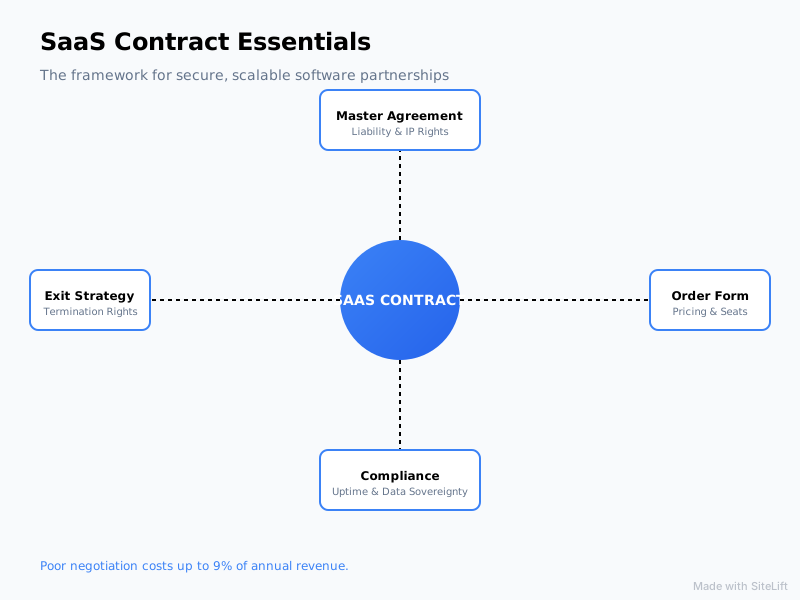
Infographic by SiteLift
White-Label Rebranding and Sub-Licensing Rights
When a company licenses a software engine to rebrand, repackage, and distribute it to downstream customers under its own corporate identity, a basic subscription agreement is insufficient.
┌────────────────────────────────────────────────────────┐
│             WHITE-LABEL DISTRIBUTION FLOW              │
│                                                        │
│  [Primary Software Vendor]                             │
│             │                                          │
│             ▼ (Grants Sub-Licensing Rights)            │
│  [White-Label Licensee] (Rebrands, sets custom prices) │
│             │                                          │
│             ▼ (Issues Downstream Sub-Licenses)         │
│  [End-User Customer]                                   │
└────────────────────────────────────────────────────────┘
A white-label software contract must explicitly address:
- Branding and Customization Scope: What parts of the UI, administrative controls, and documentation can be altered, and what intellectual property notices must remain intact.
- Downstream Sub-Licensing Authority: The licensee's authority to grant downstream subscriptions, draft enforceable customer terms, and set independent retail pricing without vendor interference.
- Tier-1 vs. Tier-2 Support Responsibilities: White-label agreements must draw a clear line between front-line user support (handled by the partner) and backend engineering maintenance (handled by the core vendor).
If you are setting up this type of commercial partnership, review our detailed guide on the white label software agreement.
Source Code Escrow and Intellectual Property Assignments
Enterprise buyers and strategic distributors face serious counterparty risks when relying on early-stage vendors: What happens if the vendor goes bankrupt, gets acquired by a direct competitor, or completely abandons product development?
To protect against this scenario, enterprise agreements often incorporate a source code escrow clause.
Under a source code escrow agreement:
- The vendor deposits their software source code, build scripts, deployment recipes, and database schemas with a neutral third-party escrow agent.
- The code is periodically updated whenever major production versions are released.
- The escrow agent releases the code directly to the customer only upon verified "release conditions"—such as the vendor filing for Chapter 7 bankruptcy, entering liquidation, or failing to meet critical support duties for an extended period.
The released code is typically granted under a restricted, internal-use license that permits the customer to maintain their deployment, rather than transferring outright commercial ownership of the vendor's intellectual property.
API Consumption Caps and Third-Party Dependencies
When applications depend on integrated API ecosystems, autonomous AI agents, or specialized microservices, system stability relies heavily on external connections. The Cloud Security Alliance emphasizes that organizations must carefully evaluate third-party cloud integrations and supply-chain vulnerabilities when structuring digital agreements.
API-specific contract clauses must address:
- Rate Limits and Concurrency: Explicit definitions of sustained requests per second (RPS), burst allowances, and system responses when limits are exceeded (e.g., HTTP 429 throttling versus overage billing).
- Breaking Changes and Version Deprecation: The vendor must commit to supporting deprecated API endpoints for an agreed period (such as 12 months) and provide advance written notice before rolling out breaking schema changes.
- Third-Party Model Dependencies: If a cloud service depends on underlying foundational models (such as OpenAI or Anthropic APIs), the contract must clearly state who bears operational responsibility if the underlying model changes, increases its pricing, or suffers an outage.
What Best Practices Streamline SaaS Contract Management?
As software stacks expand across organizations, maintaining systematic visibility over active agreements becomes critical for cost control and risk management.
Pre-Signature Legal and Security Due Diligence Checklist
Before your leadership team signs a long-term enterprise software agreement, run through a structured due diligence review:
- Data Security Certifications: Verify current, independent third-party audit reports, such as SOC 2 Type II and ISO/IEC 27001 certifications.
- Sub-Processor Transparency: Demand a binding list of all sub-processors hosting, routing, or transforming client data, along with mandatory notifications for any future changes.
- Security Breach Timelines: Require the vendor to notify you of any confirmed security incidents within 48 to 72 hours of discovery.
- Audit Rights: Secure the right to review third-party security audits annually or request relevant compliance materials.
- Governing Law and Forum: Choose a neutral, legally predictable jurisdiction (such as Delaware, New York, or England & Wales) to avoid costly cross-border litigation.
Centralized Repository and Renewal Tracking Frameworks
A contract signed and forgotten inside an executive’s email inbox is an operational liability waiting to happen. Unmonitored contracts lead to subscription sprawl, unneeded renewals, and wasted software budgets.
Technology research from Gartner shows that unmanaged software subscriptions and overlapping contracts consume up to 25% of an enterprise's total software spending.
                               CENTRALIZED CONTRACT AUDIT
                                           │
                    ┌──────────────────────┴──────────────────────┐
                    ▼                                             ▼
          Financial Governance                          Security & Compliance
     ├─ Track auto-renewal dates                    ├─ Validate active DPAs
     ├─ Flag unallocated seat counts                ├─ Audit SOC 2 updates
     └─ Consolidate duplicate tools                 └─ Verify sub-processor lists
Effective saas contract management requires maintaining a single, company-wide repository that tracks:
- Active contract start, renewal, and termination notice deadlines.
- Payment schedules, minimum commitments, and overage metrics.
- Assigned internal business owners responsible for verifying ongoing product usage and value.
Pro Tip: Set internal calendar alerts for contract renewals at 120, 90, and 60 days before the non-renewal notice window closes. This gives your team sufficient time to review actual platform utilization, assess competitor pricing, and negotiate renewal terms without facing artificial deadlines.
Balancing Founder Agility with Enterprise Procurement Standards
Founders often find enterprise procurement cycles slow and demanding. Lengthy legal reviews, redlines, and security questionnaires can delay sales cycles for months.
To accelerate sales velocity without taking on dangerous legal exposure, founders should build a modular, tiered contracting framework:
- Standardized Terms for Mid-Market Deals: Maintain clean, fair, pre-approved Master Subscription Agreements that offer balanced terms upfront. By offering reasonable liability caps (such as 12 months of paid fees) and clear IP ownership protections out of the gate, you reduce redlines and simplify the procurement process.
- Modular Enterprise Addenda: Rather than rewriting your core agreement for every enterprise client, package common requests—such as customized SLAs, source code escrow terms, or specialized DPAs—into standardized, pre-approved addenda that plug directly into your base contract.
- Firm Boundaries on Core Protections: Know your non-negotiables before talks begin. Never accept uncapped liability for general breaches of contract, never agree to customer ownership of your platform code, and never promise permanent, custom product development inside a shared multi-tenant subscription.
Key Takeaways: Evaluating SaaS Contracts
Before entering your next software negotiation, use this summary reference to check key terms:
| Contractual Area | High-Risk Term to Flag | Recommended Balanced Clause |
|---|---|---|
| Data Ownership | Vendor claims rights to aggregate, use, or train internal AI models on customer inputs. | Customer retains exclusive ownership over all input data; vendor usage is limited to operating the service. |
| Service Level (SLA) | Generic availability promises without defined remedies or clear downtime exclusions. | Explicit $\ge$99.9% uptime commitment; tiered service fee credits; right to terminate for cause on repeated failure. |
| Limitation of Liability | One-sided 1-month fee cap or buyer-only exposure; completely uncapped general indemnities. | Mutual 12-month trailing fee liability cap; separate 2x–5x super-cap covering data breaches and confidentiality. |
| Auto-Renewal | Silent auto-renewal featuring a 90-day non-renewal notification window and no reminder requirement. | 30-day notice window; vendor must deliver written renewal reminders at least 30 days before that cutoff. |
| Platform Integration | Unrestricted authority for the vendor to deprecate APIs, modify features, or cut access without notice. | 12-month deprecation support window for breaking changes; proactive notification on core feature adjustments. |
My Perspective: Why Source Code Escrow and Data Sovereignty Are Criminally Underrated
Having reviewed, negotiated, and audited dozens of digital software agreements, I have noticed that teams frequently spend days arguing over tiny changes to governing law clauses, while completely ignoring the two terms that can make or break their business: Data Portability Realism and Source Code Escrow Triggers.
Most buyers assume that their cloud vendor will operate indefinitely. But software startups run on narrow margins, face unpredictable funding environments, and regularly get acquired by larger firms that may sunset their product lines.
If your core business relies entirely on an external software engine, you must prepare for worst-case scenarios. A generic promise that the vendor will "return data upon written request" is useless if that vendor suddenly runs out of capital, their engineering team departs, and their servers go dark over a weekend.
Real data portability means securing a contractual guarantee for structured, self-serve automated data backups delivered via programmatic export endpoints. Similarly, for mission-critical core platforms, source code escrow should not be viewed as an expensive corporate formality. It is your only real insurance policy against vendor failure.
Insisting on realistic continuity protections does not make you a difficult customer. It simply demonstrates that you take your business resilience seriously.
— licensesaas.com
Streamlining Modern SaaS Licensing with LicenseSaaS
Finding the right balance between enterprise security protections and rapid software distribution does not have to mean reinventing the legal wheel for every deal. At licensesaas.com, we built a modern B2B marketplace and licensing platform designed specifically to streamline this process.
Whether you are an entrepreneur looking to acquire proven software, an agency seeking verified white-label assets, or a founder looking to commercialize your application through code licensing, LicenseSaaS simplifies the entire partnership lifecycle:
- Escrow-Protected Transactions: Protect your capital and digital assets with milestone-based, escrow-secured payment workflows designed specifically for software acquisitions and source code licensing.
- Pre-Structured Licensing Agreements: Avoid contracting delays by deploying proven, market-tested legal templates covering white-label distribution, intellectual property rights, and code transfer.
- Intelligent Deal Matching: Connect directly with vetted founders, developers, and enterprise buyers ready to negotiate transparent commercial partnerships without hidden terms.
From initial partner discovery to licensing compliance and codebase deployment, LicenseSaaS gives modern founders and technology buyers the foundation they need to build, scale, and distribute software safely.
Frequently Asked Questions About SaaS Contracts
What is the difference between a SaaS contract and an SLA?
A saas contract (typically structured as a Master Subscription Agreement) is the comprehensive legal agreement that defines the overall commercial relationship between vendor and customer, including pricing, payment structures, intellectual property rights, data handling, and limitations of liability.
A Service Level Agreement (SLA) is an operational addendum attached to that master contract. The SLA focuses exclusively on platform performance metrics, defining guaranteed uptime percentages, how scheduled maintenance windows are scheduled, support response times, and the financial credits issued if those performance targets are missed.
Can you negotiate a standard SaaS subscription agreement?
Yes, standard subscription agreements can be negotiated, particularly in enterprise B2B sales. While small-ticket or consumer software relies on non-negotiable click-through terms, enterprise platforms regularly negotiate customized contracts.
Negotiation leverage usually depends on deal size, contract duration, seat count, and your organization's industry-specific compliance requirements (such as healthcare, banking, or government regulations). Buyers can routinely negotiate changes to limitation of liability caps, Data Processing Addenda, customized SLAs, and auto-renewal notice terms.
What happens to customer data after a SaaS contract is terminated?
Following contract termination, the customer data lifecycle should follow strict procedures detailed in the initial agreement:
- Transition Period: The vendor provides a temporary window (typically 30 to 90 days) during which the customer can export their historical data in standard formats.
- Data Retention: The vendor retains data for an agreed, limited period in case of accidental cancellation or legal holds.
- Certified Destruction: The vendor is legally required to permanently and securely delete all customer records, including database rows and secondary backups, and provide written certification confirming that deletion.
What is a standard limitation of liability cap in a B2B SaaS contract?
The standard baseline limitation of liability cap in commercial B2B cloud agreements is typically set to 12 months of subscription fees paid or payable under the contract.
However, modern enterprise agreements frequently negotiate a two-tier framework. This structure pairs the standard 12-month cap for general operational breaches with a higher "super-cap" (typically 2x to 5x annual fees) or uncapped liability for serious incidents like third-party intellectual property infringement, gross negligence, or major breaches of data privacy and confidentiality.
Why is source code escrow necessary in certain SaaS licensing deals?
Source code escrow provides essential business continuity insurance when an organization relies on third-party software for mission-critical operations. Because cloud providers can face sudden bankruptcy, operational failure, or acquisition by competitors, code escrow ensures that a neutral third party holds the software's source code, build scripts, and dependencies.
If specific failure events occur (known as release conditions), that source code is released directly to the buyer. This allows their internal engineering team to maintain, host, and run the software independently, preventing devastating operational disruptions.
More from the Blog

Apps for Sale: How to Buy, License and Rebrand Without Building From Scratch
Explore how to evaluate apps for sale, safely navigate IP acquisitions or licensing, conduct technical due diligence, and launch without building from scratch.

White Label Software 101: How to Rebrand, License and Launch in Weeks
Learn how white label software works, license costs, and 5 steps to rebrand and launch your SaaS in weeks. Actionable guide for agencies.

Software and Licensing Explained: Models, Rights and How to Monetize
Demystify software and licensing. Learn about SaaS licensing models, source code licensing rights, and how to monetize your software safely.