White Label SEO Software: How Agencies Launch Branded Rank Trackers Without Coding

If you run an agency, you already know the awkward moment: you send a client a rank report and the footer says “Powered by [Someone Else’s Tool]”. That one line kills the illusion. White label SEO software fixes that by letting you deliver enterprise-grade rank tracking, audits, and reporting under your own logo, colors, and domain — no coding required.
I’ve watched dozens of agencies make this shift from renting generic tools to running a fully branded platform. The difference in perceived authority is night and day. According to Grand View Research, the global SEO services market is projected to reach over $120 billion by 2030, driven by automated analytics and reporting adoption. Clients aren’t just buying hours anymore; they’re buying access to technology.
This guide breaks down how it actually works: the architecture, the rebrand setup, the money models, and how to license or buy a platform safely.
Key Takeaways
| What You Need to Know | Why It Matters for Agencies |
|---|---|
| White label SEO software = your brand, someone else’s engine | Launch a rank tracker on track.youragency.com in days, not months |
| White label SaaS licensing > standard agency seats | True licensing removes third-party branding, gives you control over pricing, users, and data |
| Top agency SEO pricing models: bundled retainer, productized SaaS, usage-based add-ons | Turn a $49/mo cost center into $499-$2,000/mo in sticky MRR |
| SaaS escrow protection is essential when licensing or buying source code | Funds stay locked until code, IP, and credentials are verified |
| Best sourcing path: vetted marketplaces, not custom dev | Avoid 6-figure dev costs and 9-month delays by licensing turnkey IP |
What Is White Label SEO Software and How Does It Transform Agency Delivery?
At its core, white label SEO software is a complete SEO toolkit — rank tracker, site crawler, backlink monitor, reporting engine — built to be rebranded. You add your logo, pick your colors, connect your domain, and invite clients. They see your product. You didn’t have to hire backend engineers to scrape Google at scale.
That’s a massive shift from how most agencies start. Typically you pay $99-$399/mo for an “agency plan” on a well-known tool, then share a co-branded dashboard. The client logs in and immediately sees the vendor’s upsells. You’re building someone else’s brand equity.
The Mechanics of White Label SaaS Licensing vs. Standard Multi-Tenant Subscriptions
Here’s where most articles get it wrong. There are two very different things sold as “white label”:
1. Standard multi-tenant subscriptions with white-label features: You rent seats. You can upload a logo and change header colors. But you’re still on the vendor’s infrastructure, under their terms, with their subdomain fallback, their email servers, and their price increases. If you stop paying, you lose everything.
2. True white label SaaS licensing: You license the right to operate, modify, and monetize the software as your own. This can be a private-label license, an exclusive territory license, or a full source-code buyout. You control user provisioning, pricing tiers, and often hosting. You can rebrand SEO platform assets completely — login screen, emails, PDFs, even the Chrome extension name.
For agencies serious about valuation, option 2 wins. A proprietary dashboard becomes an asset on your balance sheet, not just another SaaS expense.
Pro Tip: If a vendor won’t let you use a custom domain with full SSL and white-label notification emails, it’s not true white label. Walk away.
Essential Modules: Automated SERP Rank Tracking, Site Auditing, and Backlink Intelligence
A credible branded platform needs at least three engines:
- Automated SERP rank tracking: Daily mobile vs. desktop tracking by location, ZIP, or GPS coordinates, with SERP feature detection (local pack, AI Overviews, featured snippets). Learn how search tracking methodologies evolve in this practical breakdown of how modern SEO reporting works.
- Site auditing: On-demand crawls that flag broken links, duplicate titles, Core Web Vitals issues, schema errors, and internal linking gaps.
- Backlink intelligence: New/lost link monitoring, toxic link flags, anchor text distribution, and competitor gap analysis.
The best platforms also include keyword research, content briefs, and local citation monitoring. You don’t need 50 features on day one. You need rank tracking and automated reports that are 100% accurate and beautiful.
Why Agencies Are Ditching Co-Branded Dashboards for Pure Brand Ownership
Research published by HubSpot shows that agencies packaging recurring software or technical portal access alongside services experience up to 25% higher annual client retention rates. I believe it. When a client logs into your tool every morning to check rankings, you’re no longer a vendor. You’re infrastructure.
Pure brand ownership also lets you:
- Command higher retainers because you look like a product company
- Reduce churn because migrating historical ranking data is painful
- Upsell self-serve seats to junior client staff who become internal champions
According to BrightLocal's Agency Industry survey, reporting and client communications account for up to 30% of a digital marketing agency's unbillable overhead when manual reporting tools are used. A branded, automated portal wipes most of that out.
How Do Agencies Rebrand White Label SEO Software Without Coding?
You don’t need developers. Modern turnkey platforms are built for marketers. If you can set up DNS and connect Google Search Console, you can launch.
Custom Domains, CNAME Mapping, and SSL Provisioning
This is the non-negotiable step for trust. Instead of app.vendor.com/youragency, you map seo.youragency.com or track.youragency.com via a CNAME record.
Typical flow:
- Create a CNAME in Cloudflare, GoDaddy, or Route53:
seo->proxy.whitelabelprovider.com - The platform auto-provisions SSL via Let’s Encrypt
- Upload logo SVG, favicon, login background, and brand colors
- Set sender domain for emails:
[email protected]with SPF/DKIM
From that point, clients never see the upstream vendor. Login, password resets, PDF footers, even the invoice line items can carry your brand.
Pro Tip: Use a dedicated subdomain just for the tool and keep it out of your main site navigation until you’ve tested client logins. It keeps support tickets clean during soft launch.
Plugging into Modern SERP Scraping and SEO Data APIs
You don’t scrape Google yourself — you’d get blocked in an hour. Good white label SEO software comes pre-wired to upstream data vendors like DataForSEO, or manages its own proxy rotation and SERP parsing.
What you do is connect your clients’ first-party data:
- Google Search Console: For verified clicks, impressions, and queries via the official Search Console monitoring setup guide
- Google Analytics 4: For landing page engagement tied to ranking improvements
- Google Business Profile: For local rank + review correlation
The magic is in the blend. Third-party SERP data shows position, first-party data shows revenue impact. Your branded report can say: “Keyword X moved #7 to #3, driving 214 extra clicks and 19 demo requests.” That’s what retains $3,000/mo retainers.

Automating White-Label Client Onboarding and Scheduled PDF Deliverables
Manual reporting is where agencies bleed margin. A proper setup automates 90% of it:
- Templates: Build one master PDF template with your cover page, KPI summary, rank movement table, and task list. Clone per client.
- Schedules: Monday 8am executive summary for owners, Friday detailed crawl report for in-house SEOs.
- Alerts: Slack/email when a money keyword drops 5+ positions or a site loses 20+ backlinks overnight.
- Permissions: Give clients view-only access, give your strategists edit rights, give white-label sub-accounts to franchisees.
If you already run a CRM for fulfillment, pair your SEO portal with a broader stack. Many agencies I talk to combine rank tracking with a rebranded operations hub like white-label CRM for agencies to manage pipeline and fulfillment under one login.
What Are the Most Profitable Agency SEO Pricing Models for White Label SEO Software?
Software without a pricing strategy is just a cost. The agencies winning with branded tools treat them as profit centers. Here are the three agency SEO pricing models that actually work.
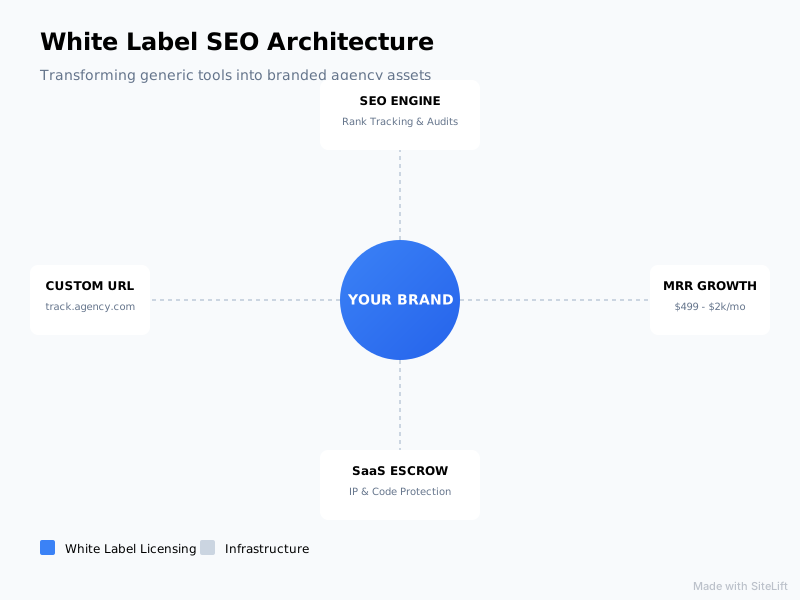
Infographic by SiteLift
The Bundled Retainer: Justifying 4-Figure Monthly Agency Fees
This is the simplest and most lucrative. Instead of selling “10 hours of SEO,” you sell “Growth Platform + Execution.”
Example structure:
- Starter Retainer $1,250/mo: 100 keywords tracked, monthly audit, branded dashboard + 2 seats
- Growth $2,500/mo: 500 keywords, weekly audits, competitor tracking, 10 seats, quarterly strategy
- Scale $4,500/mo: 2,000 keywords, daily crawls, API access, unlimited seats, dedicated strategist
Because the client sees proprietary tech, price shopping against $500/mo freelancers stops. Your cost? Maybe $0.15-$0.40 per keyword per month in data fees. The rest is margin.
| Retainer Tier | Keywords | Your Data Cost (est.) | Client Price | Gross Margin |
|---|---|---|---|---|
| Starter | 100 | $25 | $1,250 | ~98% on software portion |
| Growth | 500 | $125 | $2,500 | High, plus service leverage |
| Scale | 2,000 | $500 | $4,500 | Still 85%+ before labor |
The Pure Productized SaaS Model: Monetizing Client-Only Dashboards
Not every lead can afford done-for-you. So productize the tool itself.
Launch a low-touch tier: $99/mo for 50 keywords, automated audits, and email support only. No calls. No custom work. It’s perfect for startups, local shops, and former clients who paused services but still want monitoring.
I’ve seen agencies add $8k-$15k MRR in six months from this tier alone. It also creates a farm system — when those DIY users hit a ceiling, who do they hire? The agency whose logo is on the dashboard.
For local businesses, you can bundle this with review automation. For example, pairing rank tracking with a tool like AI reputation manager to automate Google review requests makes your $99 tier feel like $399 in value.
Usage-Based Add-Ons: Monetizing Tracked Keywords and On-Demand Crawls
This is where you protect margins as clients scale. Base plans include quotas; overages are billed automatically.
Profitable add-ons:
- Extra 100 keywords: $49/mo
- Daily vs. weekly crawl upgrade: $79/mo
- Competitor domain added: $29/mo
- White-label PDF report with custom commentary: $149/report
- Historical data export: one-time $199
Be transparent about limits in your MSA. Clients accept usage pricing when it’s tied to clear value — they hate surprise fees. Show a usage bar in the dashboard so they self-upgrade.
How Do You Secure Assets and Intellectual Property Using SaaS Escrow Protection?
Renting is easy. Licensing or buying is where real money and real risk live. If you’re moving from a $199/mo subscription to a $15,000 license or $80,000 source-code buyout to rebrand SEO platform IP as your own, you need protection.
The Legal & Financial Realities of Acquiring or Licensing White-Label Platforms
A white label SaaS licensing deal isn’t just a Stripe subscription. It includes:
- License scope (non-exclusive vs. exclusive vs. perpetual buyout)
- Source code and database access rights
- Trademark and redistribution rights
- SLA, uptime, and update obligations
- Non-compete and client ownership clauses
Without proper diligence, agencies get burned: vendor disappears, code doesn’t match demo, API keys are revoked, or the “exclusive” license was sold to three competitors.
Why SaaS Escrow Protection Is Non-Negotiable for Source Code and Turnkey Transfers
SaaS escrow protection means a neutral third party holds the buyer’s funds until all transfer milestones are verified. It’s the same principle used for domains and M&A, applied to code.
A clean escrow flow looks like this:
- Buyer and seller agree on scope, price, and verification checklist
- Buyer deposits funds with licensed escrow agent
- Seller delivers source code repo, deployment docs, API credentials, and signed IP assignment
- Buyer (or a technical auditor) verifies the build deploys and data feeds work
- Escrow releases funds, IP transfer is recorded
If you want to understand the mechanics, read how neutral custody works in this explanation of what escrow is and how funds are held. For software deals, look specifically for tech escrow that covers source code verification, not just domain escrow.
I would never wire five figures directly to a founder for a GitHub zip file. No matter how nice they seem on Zoom.
Conducting Technical Due Diligence: Codebases, Cloud Dependencies, and Security Audits
Before you release escrow, check:
- Codebase health: Laravel, Next.js, Django? Is documentation current? Are dependencies patched?
- Cloud costs: Does it require $2,000/mo in AWS + SERP API fees to run? Get last 3 months invoices.
- Data vendors: Are DataForSEO or other API contracts transferable?
- Security: SOC 2? Encrypted credentials? Role-based access?
- License compliance: Any GPL or AGPL libraries that force you to open-source your fork?
Ask for a staging deployment and a Loom walkthrough of the deploy process. If the seller can’t redeploy from scratch in under an hour, budget for dev help.
Step-by-Step Blueprint: Launching Your Agency's Branded Rank Tracker
Enough theory. Here’s the 21-day launch plan I recommend to agencies.
Step 1: Sourcing Verified Turnkey SaaS Solutions via Marketplaces
Don’t start with custom development. A custom rank tracker with accurate local tracking, proxy management, and PDF generation will cost $120k+ and take 9 months minimum.
Instead, source vetted, transfer-ready products on specialized marketplaces. You want listings with verified revenue, live demos, deployment docs, and escrow support built in. That’s exactly why platforms like licensesaas.com exist — to match agencies with licensable SaaS and handle compliance and deployment handoff.
Evaluate 3-5 options against this checklist:
- Live demo with custom domain support?
- Search Console + GA4 native integrations?
- PDF white-labeling down to footer and email headers?
- Clear licensing terms (seats, domains, resale rights)?
- Escrow available for source-code deals?
Step 2: Customizing the Brand Identity, Dashboards, and Reporting Templates
Once licensed, spend a full week on brand polish. This is what clients pay for.
- Upload primary logo, monochrome version, favicon, and OG image
- Match CSS to your website: button radius, font (Inter, Plus Jakarta, etc.), chart colors
- Rewrite empty states: “Powered by YourAgency Intelligence” not “No data”
- Build 2 report templates: Executive (2 pages, big wins) and Technical (12 pages, crawl + links)
- Record a 3-minute Loom: “Welcome to [Your] Command Center”
If you sell to trades or local services, consider how your SEO portal fits alongside operational tools. Some agencies white-label a full client OS like branded CRM platform for local trades businesses and embed rank snapshots inside it. One login = far less churn.
Step 3: Staging Client Migration and Launching the Proprietary Dashboard Feature
Don’t migrate 40 clients on a Friday. Pilot with 3 friendly accounts.
Week 1 email script that works:
Subject: You’re getting an upgrade: [Agency] Intelligence Portal
We’ve invested in building a private search intelligence platform for our clients. Starting Monday, you’ll get live rankings, site health, and weekly video summaries in one branded dashboard — no more third-party logins.
Then:
- Import keywords and historical data (most tools accept CSV)
- Backfill 60 days of rankings if possible for trend lines
- Invite clients with magic links, not passwords
- Host a 20-min onboarding call and record it
- After 14 days, roll out to remaining clients in batches of 10
Position it as innovation, not a tool switch. Raise prices 15-20% for new clients post-launch to reflect platform value.
My Take: Why Owning Beats Renting Your Agency's Tech Stack
I’ll be blunt: if your entire agency runs on rented agency seats, you don’t have a moat.
I’ve audited agencies doing $80k MRR that could be wiped out by a single vendor price hike or a “we’re sunsetting white-label” email. I’ve also seen $25k MRR shops sell for 4x because they owned a branded portal with 300 active client logins.
Renting tools is fine to start. But the endgame has to be ownership or long-term licensure. When you control the dashboard, you control the narrative, the data history, and the switching costs. Clients don’t leave technology they check daily, even if a competitor is $300 cheaper.
The second thing: stop thinking like a service provider and start thinking like a SaaS founder. Track logins, not just rankings. Track feature adoption. Charge for seats and usage. That mindset shift is what turns commoditized SEO retainers into sellable, recurring revenue.
You don’t need to code to do this. You need to license smart, brand obsessively, and protect the deal with escrow. That’s it.
— licensesaas.com
Find a Licensable SEO Platform Without the Build Risk
If building from scratch sounds exhausting — it should — start by browsing licensable, white-label-ready SaaS.
On licensesaas.com, you can discover vetted SEO tools, website builders like white-label website builder to offer site creation under your brand, and AI platforms, compare white label SaaS licensing terms side-by-side, and close with SaaS escrow protection and AI-matched deal support. From match to license compliance to deployment, the heavy lifting is handled.
Browse once, license once, rebrand forever. Your future retainers will thank you.
FAQ
What is the difference between white label SEO software and standard agency software tiers?
Standard agency tiers let you add your logo to someone else’s app, but the vendor’s domain, emails, and branding traces remain. True white label SEO software under a white label SaaS licensing agreement lets you use your own domain, email servers, PDF branding, pricing, and user limits. With source-code licenses, you can also self-host and modify features.
Can clients tell that our agency is using a third-party white-label rank tracker?
Not if it’s set up correctly. With custom CNAME (e.g., reports.youragency.com), SSL, white-label emails with SPF/DKIM, and custom PDF templates, there are no visible third-party traces. The giveaway is usually laziness — leaving “Powered by” footers on or sending password resets from the vendor’s domain. Audit every touchpoint before launch.
How does SaaS escrow protection work when licensing or acquiring a software platform?
You deposit payment with a neutral escrow provider. The seller then delivers source code, credentials, deployment docs, and signed IP assignment. You verify everything deploys and works as demoed. Only then does escrow release funds to the seller. If verification fails, funds return to you per the agreement terms.
What ongoing technical maintenance is required to run a white-label SEO tool?
For hosted licenses: almost none — just user management and template tweaks. The vendor handles servers, SERP proxies, and updates. For self-hosted/source-code deals: budget for monthly dependency updates, cloud hosting ($100-$800/mo typical), SERP data API costs, and monitoring. Always clarify who patches security vulnerabilities in your license.
How do agencies monetize branded SEO tools without cannibalizing core retainer services?
Use tiered fencing. Offer the tool standalone with no strategy (low-touch $99-$249/mo) for DIY clients, and bundle the same tool plus execution, content, and links in high-ticket retainers ($1,500+/mo). The software becomes a lead magnet for services, not a replacement. Usage limits on keywords and crawls naturally push growing SaaS-only users to upgrade to done-for-you.
More from the Blog

AI Marketplace Guide: How to License, White-Label and Sell AI Agents Safely
Learn how to safely license, white-label, buy, and sell AI agents. Discover escrow protections, legal frameworks, and AI deal matching strategies.

End-User License Agreements Explained: Key Clauses, Compliance and SaaS Examples
Master end-user license agreements (EULAs). Learn key clauses, SaaS compliance, and how to protect your software IP with our expert guide.

Reputation Management Software White Label: Turn Reviews Into Recurring Agency Revenue
License reputation management software white label to launch your white label review platform. Get MRR, pricing & SaaS license tips.