AI Marketplace Guide: How to License, White-Label and Sell AI Agents Safely

Key Takeaways
| Feature / Aspect | Developer Repositories (e.g., Hugging Face, GitHub) | Transactional B2B AI Marketplace |
|---|---|---|
| Primary Focus | Open-source code, model hosting, research | Commercial software monetization, licensing, and buyouts |
| Asset Types | Raw weights, scripts, datasets | Fully packageable AI agents, white-label apps, source code |
| Legal Protection | Open-source licenses (MIT, Apache 2.0) | Enforceable commercial contracts, IP transfers, escrow terms |
| Deal Structure | Free/freemium access | White-label rights, non-exclusive commercial licenses, complete asset acquisitions |
| Verification | Community star counts and issue trackers | Automated due diligence, benchmark audits, token cost checks |
Building software from scratch used to be the default playbook for ambitious founders and agencies. Today, that strategy is rapidly losing ground. The sheer speed of foundational model updates means that multi-month engineering cycles risk delivering obsolete tools before they ever reach production.
If you want to commercialize, white-label, or launch custom autonomous workflows, leveraging a dedicated ai marketplace is fast becoming the single most efficient path to revenue. Whether you are a developer looking to monetize a specialized agent or an agency seeking ready-to-brand software assets, understanding how to transact commercial AI safely is now a core competitive advantage.
What Is an AI Marketplace and How Is It Transforming B2B Software?
To understand where the software industry is headed, you have to look at how software assets are packaged, transferred, and commercialized. An ai marketplace in the transactional B2B space is not merely an app directory or an open-source model repository. It is a structured commercial platform that facilitates the exchange of intellectual property, commercial licensing agreements, and turnkey software architectures between builders and business buyers.
From Foundation Model Hubs to Commercial Agent Marketplaces
For years, platforms like GitHub and Hugging Face served as the epicenter of artificial intelligence innovation. They excel at hosting raw model weights, open-source python scripts, and academic research benchmarks. However, they were never designed to facilitate commercial asset transfers, white-label software distribution, or revenue-generating software sales.
Commercial platforms bridge this gap. Instead of sharing raw research models, sellers offer production-ready applications, fine-tuned agentic pipelines, and fully integrated SaaS wrappers. According to research published by McKinsey & Company, 65% of enterprise respondents report their organizations regularly use generative AI in at least one business function. As corporate adoption deepens, businesses want functional, outcome-driven solutions rather than bare model checkpoints.
This market demand is driving explosive growth across the entire industry. Data from Grand View Research shows that the global artificial intelligence market size was estimated at over USD 196 billion in 2023, with a projected compound annual growth rate (CAGR) exceeding 36% through 2030.
       TRADITIONAL SASS                         AGENTIC AI SOFTWARE
+------------------------------+         +------------------------------+
|  User provides input         |         |  User defines end objective  |
|  App provides UI tools       |   ===>  |  Agent executes reasoning,   |
|  User performs manual work   |         |  API calls, & task completion|
+------------------------------+         +------------------------------+
Key Asset Classes: Standalone Agents, Embedded Workflows, and Proprietary Codebases
When navigating a commercial venue for AI software, you will primarily encounter three core asset classes:
- Standalone Autonomous Agents: Independent software assets designed to execute end-to-end task chains (e.g., automated cold-outreach agents, autonomous customer support triage bots, or regulatory compliance auditors).
- Embedded Workflow Orchestrators: Middleware logic, often built using frameworks like LangChain or LlamaIndex, designed to plug directly into an existing enterprise database or enterprise resource planning (ERP) environment.
- Proprietary SaaS Codebases: Complete, full-stack applications—including billing integrations, multi-tenant UI layer, and backend inference pipelines—ready for complete asset acquisition or white-label rebranding.
According to enterprise forecasts from Gartner, by 2028, at least 15% of day-to-day work decisions will be made autonomously through agentic AI, up from virtually 0% in 2024. This paradigm shift means buyers are no longer looking for simple productivity tools; they are buying digital workers.
How Does Licensing and White-Labeling AI Software Actually Work?
Monetizing autonomous software requires moving beyond standard per-seat SaaS subscriptions. Licensing and white-labeling offer developers recurring upfront revenue while giving buyers immediate access to market-ready technology.
Licensing AI Agents: Exclusive vs. Non-Exclusive Commercial Rights
When evaluating ai agents for licensing, founders must decide which tier of commercial rights to grant.
- Non-Exclusive Licensing: Allows the developer to sell the exact same agent architecture to dozens or hundreds of agencies and enterprises simultaneously. Each licensee gets the right to run the software, brand it for their end clients, or integrate it into their product stack, while the original creator retains core intellectual property rights.
- Exclusive Commercial Rights: Transfers market exclusivity to a single buyer, often within a specific industry vertical or geographic territory. Exclusive licenses command significantly higher upfront fees because they restrict the seller from selling that exact code package elsewhere.
White-Labeling AI Solutions: Agency Deployment and Rebranding Mechanics
White-labeling allows digital agencies and systems integrators to purchase pre-built software, rebrand the user interface, attach custom domain names, and sell the solution directly to end clients at premium price points.
To make an AI agent cleanly white-labelable, developers must engineer a clear separation between:
- The Underlying Inference Engine: The orchestration logic, prompt chains, fine-tuned weights, and vector store retrieval pipelines.
- The Client Presentation Layer: Customizable CSS, brand logos, custom CNAME mapping, and isolated client billing portals.
By using pre-built software, agencies can skip 6 to 12 months of risky engineering work and launch a branded AI service in a matter of days. If you are an agency owner, exploring software built for AI & machine learning companies provides an immediate catalog of systems ready for deployment.

Commercial Pricing Models: Source Code Buyouts, Revenue Shares, and Tiered Royalties
Pricing modern software assets requires balancing upfront capital with continuous operational costs.
+-----------------------------------------------------------------------+
|                      COMMERCIAL PRICING MODELS                        |
+-----------------------------------------------------------------------+
|  1. Full Source Code Buyout  ==> High Upfront Fee / Zero Royalties    |
|  2. Tiered License Royalty   ==> Lower Upfront Fee / Monthly Per-Seat |
|  3. Revenue Share Hybrid     ==> Zero-to-Low Down / % of Usage Revenue|
+-----------------------------------------------------------------------+
- Full Source Code Buyouts: The seller transfers full title, repository access, and exclusive IP ownership to the buyer. This approach yields the highest immediate payout for developers.
- Tiered Monthly Licensing Royalties: The buyer pays a flat monthly or annual licensing fee to keep the software active, alongside usage-based tiering linked to active API calls or active end clients.
- Hybrid Usage Revenue Shares: The licensor charges a small base fee alongside a modest percentage cut of the recurring revenue the agency generates from deploying the agent.
Pro Tip: When structuring white-label agreements, always separate the licensing fee from the underlying model inference costs. The buyer or end client should directly attach their own API keys (e.g., OpenAI, Anthropic, or AWS Bedrock) so the seller isn't exposed to unpredictable token bill spikes.
How Can You Buy and Sell AI Software Safely Without Legal or Technical Risks?
When you buy and sell ai software, traditional software acquisition risks are multiplied by AI-specific liabilities like prompt leakage, fine-tuned model drift, third-party API dependencies, and copyright compliance. Secure transactions require explicit contractual and technical safeguards.
Protecting Proprietary Architecture, Prompts, and Fine-Tuned Weights
The core asset of an AI software company rarely lives in standard web-app code; it sits in system prompt orchestrations, vector database chunking strategies, and proprietary model weights fine-tuned on specialized domain data.
       PROPRIETARY AI AGENT ARCHITECTURE
+-----------------------------------------------+
|  1. Fine-Tuned Weights & Model Embeddings    |  <-- Core IP Asset
+-----------------------------------------------+
|  2. System Prompts & Chain Logic (LangChain)   |  <-- High Risk of Leakage
+-----------------------------------------------+
|  3. VectorDB Retrieval Augmented Logic (RAG)  |  <-- Knowledge Base IP
+-----------------------------------------------+
|  4. Full-Stack Web Interface (React / Next.js)|  <-- Standard SaaS UI
+-----------------------------------------------+
To protect these components during a transaction:
- System Prompts: Protect system instruction sets behind serverless execution layers rather than embedding them directly in frontend client bundles.
- Fine-Tuned Weights: Ensure model weights are stored in secure cloud buckets protected by hardware-level security modules and transferred strictly via encrypted key exchange.
- IP Transfer Agreements: Aligning with international legal standards set by the World Intellectual Property Organization, transactional contracts must clearly articulate whether the IP assignment includes the raw training corpus, the model weights, or merely an operational executable.
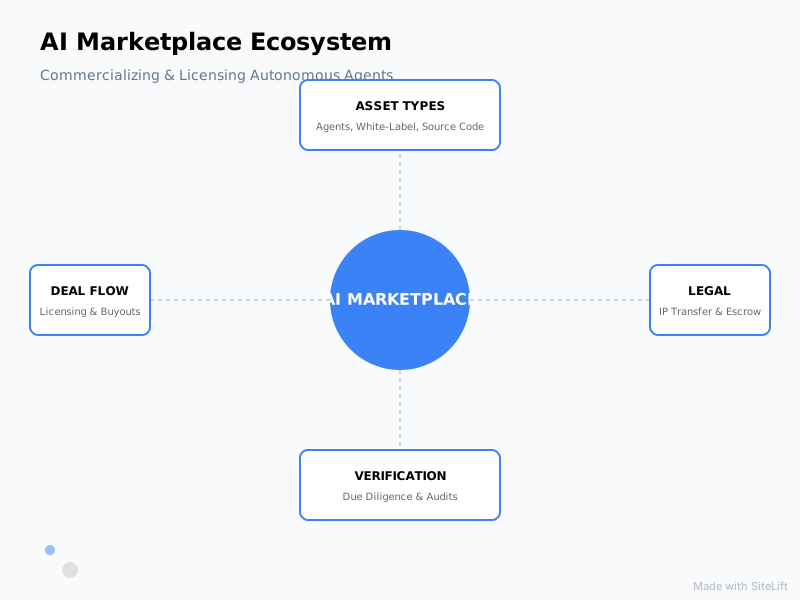
The Role of Escrow and Milestone-Based Code Inspection
Closing an software transaction on a basic handshake or standard wire transfer is extremely risky for both parties. Buying an agent that fails to perform under real-world server loads is a common pitfall, as is selling full source code access only to have a buyer reverse a transaction.
| Transaction Stage | Escrow Function | Safety Purpose |
|---|---|---|
| Stage 1: Deposit | Buyer places purchase funds into neutral escrow | Proves financial capacity without releasing funds to seller |
| Stage 2: Code Inspection | Source code transferred to a sandboxed environment | Allows buyer technical team to inspect architecture and test APIs |
| Stage 3: Benchmark Audit | Agent is stress-tested against latency and accuracy metrics | Verifies performance matches listing claims |
| Stage 4: Final Release | Escrow agent releases funds to seller | Complete IP and administrative transfer finalized |
Using a trusted platform with integrated escrow mechanisms guarantees that buyers only pay when technical deliverables pass inspection, while ensuring sellers receive guaranteed payment once milestones are fulfilled.
Infographic by SiteLift
Navigating Training Data Provenance, API Dependencies, and Liability
Beyond code quality, buyers must conduct thorough due diligence on three hidden operational liabilities:
- Training Data Provenance: Does the seller hold legal authorization for all datasets used to train or fine-tune the model? Unverifiable training data can expose buyers to intellectual property claims down the line.
- API Key & Rate Limit Dependencies: Is the agent dependent on third-party foundational LLM APIs? Buyers must verify whether rate limits or service terms allow for commercial re-licensing.
- Total Cost of Ownership (TCO) & Token Overhead: The seller must provide an accurate breakdown of inference costs. An agent that generates $1,000/month in revenue but consumes $900/month in Anthropic Claude 3.5 Sonnet token costs yields unsustainable margins.
Why Use an AI Deal Matching Platform in an AI Marketplace Instead of Traditional Brokerages?
Traditional business brokerages understand EBITDA multiples, but they rarely understand token optimization, vector retrieval latency, or software re-licensing rights. Transacting advanced software requires specialized infrastructure.
Algorithmic Pairing of Builders, Agencies, and Enterprise Buyers
An ai deal matching platform replaces manual brokerage outreach with automated, parameters-based deal matching algorithms.
       DEAL MATCHING ENGINE
[ Developer Listing ] ===> ( Tech Stack, Licensing Model, Revenue, API Efficiency )
                                       ||
                                algorithmic match
                                       ||
[ Agency Buyer ]    ===> ( Target Niche, White-Label Needs, Budget, Tech Requirements )
Instead of spending months pitching private equity groups or browsing generic business-for-sale message boards, developers are instantly matched with buyers based on:
- Technical stack compatibility (e.g., Python, Next.js, LangChain, Pinecone).
- Commercial licensing preferences (exclusive buyout vs. ongoing agency licensing).
- Target vertical markets (e.g., legal tech, healthcare automation, fintech).
Automated Technical Due Diligence and Benchmark Audits
Specialized deal platforms automate technical due diligence before a listing ever goes live. Rather than taking a seller's word for it, platforms audit key operational benchmarks:
- Hallucination Rate & Output Accuracy: Running standard benchmark queries across the agent's knowledge base to quantify accuracy metrics.
- Average Inference Latency: Measuring round-trip response times across concurrent API requests.
- Token Usage Efficiency: Auditing prompt structure to verify that context windows are optimized to minimize API overhead costs.
Streamlining Post-Sale Deployment and Continuous Compliance
The transaction doesn't end when funds leave escrow. Buyers often need assistance deploying software into their private cloud infrastructure (AWS, Azure, GCP) or connecting custom white-label portals. Specialized platforms provide contract templates, license key verification systems, and compliance frameworks to keep continuous software distribution simple.
If you are actively seeking software to rebrand, you can explore the curated selection available through the software licensing marketplace to evaluate real-world deal structures.
Step-by-Step Checklist: Preparing Your AI Agent for Marketplace Listing
If you are a developer planning to list an autonomous agent or full-stack software application for buyout or white-label licensing, following a systematic preparation process will drastically increase your asset valuation.
+---------------------------------------------------------------------------------+
|                         MARKETPLACE LISTING CHECKLIST                           |
+---------------------------------------------------------------------------------+
|  [ ] STEP 1: Containerize Architecture (Docker / Kubernetes)                    |
|  [ ] STEP 2: Decouple Engine from UI (Headless API Integration)                 |
|  [ ] STEP 3: Complete API Documentation & OpenAPI Schemas                       |
|  [ ] STEP 4: Build a Functional Sandbox / Demo Environment                      |
|  [ ] STEP 5: Define SLAs, Support Tiers, and Clear Licensing Terms              |
+---------------------------------------------------------------------------------+
1. Modular Architecture and Containerized Deployment
Buyers want clean, maintainable codebases they can deploy effortlessly.
- Containerize Everything: Package your agent, backend databases, and dependencies into lightweight Docker containers or Kubernetes deployment manifests.
- Modularize Orchestration Logic: Isolate your framework chains (LangChain, LlamaIndex, AutoGen) so buyers can swap underlying foundational models (e.g., switching from OpenAI to an open-source Llama model via Ollama) without breaking the front-end application.
2. Comprehensive Documentation, API Schemas, and Test Sandboxes
Thorough documentation builds buyer trust and speeds up technical due diligence:
- Produce fully annotated OpenAPI / Swagger schemas for all agent endpoints.
- Include clear environment setup guides (
.env.example) specifying all required environment variables and third-party API configurations. - Provide a functional sandbox or staging environment where prospective buyers can test the agent in real time without exposing production keys.
3. Structuring Clear Service Level Agreements (SLAs) and Support Terms
Clarify upfront what happens after the purchase closes:
- Support Period: State whether the buyout includes 30, 60, or 90 days of post-sale developer support or migration assistance.
- Maintenance SLA: If offering non-exclusive re-licensing, define standard bug-fix SLA timelines and specify who covers model drift updates when foundational model APIs upgrade.
Pro Tip: Clean, containerized code with explicit API documentation typically commands a 20% to 35% higher purchase multiple on transaction platforms compared to unorganized repositories.
My Take: Why White-Labeling AI Agents Is the Strategic Shortcut of the Decade
I've watched countless agency owners burn hundreds of thousands of dollars trying to build proprietary AI capabilities in-house. They hire expensive machine learning engineers, spend six months wrestling with model orchestration frameworks, and end up with a fragile prototype that breaks every time a provider updates their underlying API.
That approach is a waste of capital.
The smartest growth play right now is acquiring or white-labeling software that has already passed real-world technical stress tests. When you buy a license to a proven agentic pipeline, you are instantly converting someone else’s engineering expense into your recurring distribution margin.
For developers, the reverse is equally powerful. Trying to build an enterprise sales organization from scratch is brutal. By listing your software on a B2B deal platform, you turn dozens of established digital agencies and MSP and reseller partners into your outsourced sales force. They handle client onboarding, account management, and UI custom branding, while you focus purely on perfecting the underlying logic.
Accelerate Your AI Distribution with LicenseSaaS
Navigating software transactions without dedicated escrow, legal licensing templates, and technical due diligence is an unnecessary risk.
Whether you are an engineer ready to monetize custom code or an entrepreneur looking to acquire and rebrand autonomous agent workflows, LicenseSaaS provides the infrastructure to execute deals safely.
From AI-driven deal matching algorithms that connect builders with qualified buyers to milestone-backed escrow protocols that protect your capital, the platform takes the friction out of buying, selling, and licensing modern software assets.
FAQ
What is an AI marketplace and how does it differ from an open-source hub?
A commercial B2B platform focuses on monetizing, licensing, buying, and white-labeling functional software assets, complete applications, and autonomous agents. Unlike open-source developer hubs (such as GitHub or Hugging Face) which host free raw weights and code scripts, a transactional venue provides legal contract frameworks, escrow-protected payments, fine-tuned weight security, and automated technical due diligence for commercial transfers.
Can I legally white-label and resell an AI agent purchased on a marketplace?
Yes, provided the specific commercial rights license explicitly permits white-labeling or sub-licensing. Non-exclusive white-label licenses allow agencies to rebrand the software interface, host it on custom domains, and charge end clients recurring service fees. Full source code buyouts transfer complete intellectual property ownership, giving the buyer total freedom to rebrand, modify, or resell the code.
How does escrow protect buyers and sellers in an AI software transaction?
Escrow services act as a neutral third party that holds purchase funds until specific technical milestones are verified. For buyers, it ensures funds are not released until the software source code, fine-tuned model weights, and technical assets are delivered and pass inspection. For sellers, it guarantees that the buyer has verified funds deposited before any proprietary code, prompts, or IP transfers take place.
What technical due diligence should I conduct before purchasing an AI agent?
Buyers should audit four key areas:
- Inference Economics: Calculate token overhead and underlying API costs relative to subscription pricing.
- Code Modularization: Ensure code dependencies (e.g., Docker containers, LangChain setups) are clean and maintainable.
- Data Provenance: Verify that training data used for fine-tuning complies with IP standards.
- API Stability: Check how prompt templates handle edge cases and evaluate current latency and hallucination rates.
What is an AI deal matching platform and how does it work?
An algorithmic deal platform automatically pairs software developers with enterprise buyers, private equity groups, and digital agencies. Instead of relying on manual brokerage listing sites, the system analyzes parameters such as technical stack, target industry niche, licensing models, and transaction budgets to suggest verified, mutually compatible deal matches.
— licensesaas.com
More from the Blog

End-User License Agreements Explained: Key Clauses, Compliance and SaaS Examples
Master end-user license agreements (EULAs). Learn key clauses, SaaS compliance, and how to protect your software IP with our expert guide.

Reputation Management Software White Label: Turn Reviews Into Recurring Agency Revenue
License reputation management software white label to launch your white label review platform. Get MRR, pricing & SaaS license tips.

White Label SEO Software: How Agencies Launch Branded Rank Trackers Without Coding
Launch white label SEO software fast: rebrand rank trackers, price MRR plans & license safely with escrow. Actionable agency guide.