Reputation Management Software White Label: Turn Reviews Into Recurring Agency Revenue

If you run an agency, you already know reviews make or break local clients. What most agencies miss is that reputation management software white label deals let you sell that outcome as your own product — not just as a service. Instead of renting seats in someone else's tool, you license reputation SaaS, slap your logo on it, set your own price, and keep the monthly recurring revenue.
According to BrightLocal's Local Consumer Review Survey, 98% of consumers read online reviews for local businesses before making a purchase decision (see the full Local Consumer Review Survey results). That is not a nice-to-have. For dentists, plumbers, restaurants, and law firms, it's the front door. Agencies that own that front door win retainers.
Key Takeaways
| What You Need to Know | Why It Matters for Agencies |
|---|---|
| Reputation management software white label = rebrandable SaaS you sell as your own | You keep pricing power, branding, and client relationship |
| Agency reseller program vs. license reputation SaaS | Reseller = commission + their branding rules. License = control, higher margins, custom domain |
| Must-have features: SMS/email/QR review generation, Google Business Profile API sync, AI replies, sentiment analysis, white-label reporting | Without these, churn goes up and support tickets pile on |
| Pricing sweet spot: $99-$149/mo self-serve, $249-$499/mo bundled with management | Typical licensed cost $20-$50 per sub-account leaves 70-80% margin |
| SaaS license agreement must cover IP rights, data ownership, GDPR/TCPA compliance, and escrow | Protects you if the vendor disappears or sells the code |
What Is Reputation Management Software White Label?
Reputation management software white label is a ready-made review platform built by a SaaS founder that your agency can rebrand and resell as if you built it. Your clients log in to your domain, see your logo and colors, get emails from your business name, and pay you every month.
Under the hood, you're running on someone else's infrastructure. You didn't pay $150k+ to build review monitoring, SMS triggers, and reporting dashboards. You licensed it.
A true white label review platform usually includes:
- Multi-tenant agency dashboard to manage all clients from one login
- Client-level logins with your branding, no mention of the original vendor
- Custom domain mapping via CNAME (e.g., reviews.youragency.com)
- White-labeled email/SMS sender IDs, review request templates, and reports
- API access and integrations with Google, Facebook, CRM, and Zapier
When done right, clients never see the original software creator's branding. That's the whole point.
How White-Labeling Differs from Traditional Agency Reseller Programs
An agency reseller program and a white-label license sound similar, but the business model is completely different.
In a reseller program (think Birdeye, BrightLocal, or HighLevel affiliates), you refer clients to a vendor's tool. You might get 20-30% recurring commission. The vendor still owns the billing relationship, the roadmap, the data, and often the branding. If they raise prices or change terms, you eat it.
When you license reputation SaaS, you buy rights to operate and rebrand the software:
| Agency Reseller Program | Full SaaS License / White Label | |
|---|---|---|
| Branding | Co-branded or "Powered by" footer | 100% your brand, custom domain |
| Billing | Vendor bills client, you get commission | You bill client at your price, keep margin |
| Pricing control | Fixed by vendor | You set tiers, trials, upsells |
| Data ownership | Vendor owns, you get access | Contract defines you/client own client data |
| Exit risk | Lose income if program ends | Source code or tenant rights + escrow protect you |
Pro Tip: If a vendor won't let you remove "Powered by" branding or use your own CNAME domain, it's not true white label — it's a reseller deal with a white-label sticker.
For agencies serious about enterprise value, licensing wins. You're building MRR on an asset you control, not affiliate income someone else can turn off.
Core Technical Components of a White Label Review Platform
Don't get dazzled by a pretty dashboard. Before you license anything, check the plumbing:
- Multi-tenant architecture. You need one agency login that spins up unlimited sub-accounts with separate users, permissions, locations, and billing.
- Custom CNAME mapping + SSL. Your client portal should live at something like
reputation.youragency.comwith automatic SSL, custom logo, colors, favicon, and login screen. - Google Business Profile API integration. This is non-negotiable. The platform should pull new Google reviews in near real-time, push review request links, and track rating and volume by location. Direct API sync is far more reliable than scraping.
- Messaging infrastructure. Look for built-in SMS/email sending with TCPA-compliant opt-in, QR code triggers, and integrations with Twilio or native carriers.
- API + webhooks. You'll want to push review events into GoHighLevel, HubSpot, Salesforce, or Slack without manual exports.
If you browse the white-label SaaS marketplace to rebrand and resell, filter for these five. Anything missing them will cost you in workarounds later.
Why Should Digital Agencies License Reputation Management Software White Label for Recurring Revenue?

Because services churn, software sticks. I’ve watched dozens of agencies go from $5k project rollercoasters to $30k+ stable MRR just by productizing one sticky utility. Reviews are perfect because clients check them daily.
Research published by Harvard Business Review shows that a one-star increase in a business's online rating can lead to a 5% to 9% increase in revenue (read the HBR analysis on reputation and revenue). When you can tie your $299/mo product directly to that kind of lift, retention stops being a fight.
Unlocking High-Margin Monthly Recurring Revenue (MRR)
Here's the math agencies love:
You license a white label review platform for a flat fee or per-sub-account cost — say $499/mo for unlimited accounts, or $29 per active location. You sell it at $149/mo for single-location self-serve and $299/mo for multi-location or done-for-you.
Even at 20 clients on the mid-tier: 20 x $299 = $5,980 MRR billed by you Minus ~$580 in license costs = $5,400 gross margin
That's 90% margin before support, and support is minimal because review requests run on autopilot. Compare that to SEO or ads management where fulfillment eats 40-60%.
License once, sell infinitely. That's why to license reputation SaaS beats adding another labor-heavy service.
Boosting Client Retention and Lifetime Value (LTV)
Reputation software lives in the client's daily workflow. The owner gets a dopamine hit every time a 5-star review lands. Staff get alerts. Negative reviews get flagged before they blow up.
Data from Podium indicates that 56% of consumers say a business's quick response to reviews has directly changed their perspective on the company (explore Podium's online review statistics). When your platform drafts that response with AI in seconds, you become indispensable.
Agencies using white label tell me the same story: clients who adopt the review portal stay 2-3x longer than SEO-only clients. It's harder to cancel the tool your front desk uses every morning than to pause a blog package.
Expanding Your Service Suite Without In-House Development Costs
Building review software from scratch? Expect 9-12 months, $120k-$250k for a competent dev team, plus ongoing maintenance for Google API changes, SMS deliverability, and spam filters. And you still have zero customers.
Licensing flips that. You can launch in a weekend:
- No hiring developers or managing servers
- No fighting Google Business Profile verification quirks alone
- Instant feature parity with established players you can compare on G2's reputation management software category
You get to act like a SaaS company — onboarding emails, free trial, annual prepay upsell — without acting like a software company on the backend.
For a deeper breakdown of this model, check the White-Label SaaS for Agencies guide to reselling software to see how terms are typically agreed directly with founders.
What Core Features Must a White Label Review Platform Offer?
Not all review tools are licensable, and not all licensable tools are good. Use this checklist when you evaluate vendors.
Multi-Channel Review Generation via SMS, Email, and QR Triggers
Volume wins. Your platform must make asking automatic:
- SMS first: Post-appointment or post-purchase triggers with short links to Google. Include TCPA-compliant opt-in language and easy opt-out.
- Email sequences: Two-touch follow-up for non-openers, with smart timing.
- QR + NFC: Table tents, invoices, and checkout cards that open the review funnel on a phone. Essential for restaurants, salons, auto shops.
- Smart routing: Satisfied customers (4-5 stars on internal pre-screen) go to Google/Facebook. Unhappy customers go to a private feedback form first.
That last point matters legally. Google prohibits review gating — selectively soliciting only positive reviews. Your funnel should invite everyone to leave a public review, but you can offer a private feedback option alongside it. Good platforms document this flow to keep you compliant with review site terms of service.
Pro Tip: Ask vendors for deliverability stats and SMS sender options. Shared short codes get filtered. Dedicated 10DLC numbers or Toll-Free verification will save you from "message not delivered" hell.
Unified Review Monitoring and AI-Driven Response Automation
Collection is half the battle. Monitoring and response is where clients see value:
- Unified inbox for Google, Facebook, Yelp (where API allows), TripAdvisor, and niche sites like Healthgrades, Avvo, or Houzz
- Real-time alerts via email, SMS, and Slack for 1-3 star reviews
- AI reply drafting tuned to brand voice, with one-click approve and post
- Sentiment analysis and keyword tagging — e.g., "wait time," "pricing," "staff" — so multi-location owners spot patterns
The best tools now sync Google & Facebook, draft AI replies, and showcase feedback with widgets. For example, More Good Reviews - AI reputation manager for agencies automates review requests via email/SMS and drafts AI replies specifically for local businesses and agencies.
White-Label Reporting and Custom Domain Integration
If clients can't see ROI, they'll cancel. Demand:
- Fully unbranded reports with your logo, domain, and color palette
- Scheduled PDF summaries: review volume, average rating, response time, sentiment trend
- Embeddable website widgets (carousel, badge, floating review button) with no vendor branding
- Custom domain setup via CNAME:
reviews.clientdomain.comorreputation.youragency.com/client-name
Test this during trial: create a dummy client, map a subdomain, send a test campaign, and download a report. If you see the vendor's name anywhere — footer, email headers, favicon — negotiate it out in the SaaS license agreement before you pay.
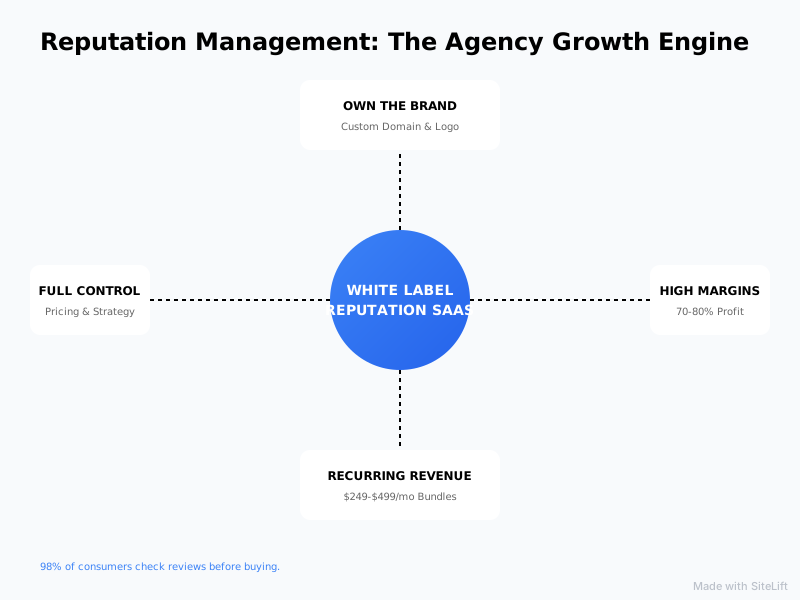
Infographic by SiteLift
How Do You Package and Price White Label Reputation SaaS for Clients?
Don't sell software. Sell outcomes: more 5-star reviews, faster responses, better local rankings. Then tier it.
Tiered SaaS Subscription Models for Local Businesses
A simple three-tier model works worldwide for local SMBs:
| Tier | Price (USD) | What's Included | Best For |
|---|---|---|---|
| Starter - Self Serve | $99/mo | 1 location, 500 review requests/mo, Google + Facebook sync, white-label dashboard | Solo dentist, cafe, freelancer |
| Growth - Assisted | $249-$299/mo | Up to 3 locations, 2,000 requests, AI responses, QR kit, monthly report | Home services, clinics, multi-staff |
| Scale / Done-For-You | $499-$799/mo | Unlimited locations, API + CRM integration, dedicated manager to respond to reviews | Franchises, auto groups, law firms |
Offer annual prepay (10-12 months for price of 12) to boost cash flow. Add $199 one-time onboarding for setup, logo import, and Google connection — clients happily pay for done-for-you setup.
Margin check: If your license cost is $29/location and you sell Growth at $299 for 3 locations ($87 cost), you keep $212/mo per client before labor. At 50 clients, that's over $10k/mo in near-passive margin.
Bundling Reputation Software with Managed SEO and Agency Services
Standalone SaaS is good. Bundled SaaS is sticky gold.
- Reputation + Local SEO: $499/mo includes review software + Google Business Profile optimization + citation cleanup. Reviews fuel rankings, rankings fuel reviews.
- Reputation + Ads: Offer review software free for 3 months with any $1,500/mo ads retainer. Once staff depend on it, they keep paying after the promo.
- Multi-location upsell: First location $299, each additional $99. Franchises love per-location reporting and regional leaderboards.
Never compete on price with free tools. Compete on done-for-you. Small business owners don't want another login — they want you to make bad reviews disappear and good ones appear on autopilot.
What Should Agencies Look for in a SaaS License Agreement?
This is where most agency owners get burned. A slick demo means nothing if the contract lets the vendor pull the plug, keep your client data, or resell to your clients directly.
When you license reputation SaaS, you need more than a Terms of Service checkbox. You need a real SaaS license agreement.
Source Code Ownership vs. Managed Tenant Licensing Rights
There are two main deal structures:
Managed tenant / white-label license: You get rights to rebrand, resell, and operate sub-accounts on the vendor's hosted infrastructure. You pay monthly/annually or revenue share. You don't get code. This is fastest and most common.
Source code sale + self-host: You buy the codebase outright, host it yourself, modify it freely. Higher upfront cost ($5k-$50k+), full control, but you own maintenance.
Key clauses to demand in either case:
- Scope of license: Exclusive or non-exclusive? Territory? Can you modify branding, pricing, and features? Can vendor sell direct to your niche?
- IP ownership: Who owns customizations you pay for? Ideally you do, or at least get perpetual rights.
- Term + renewal: Minimum 12-24 months with capped price increases (e.g., max 5% per year).
- SLA and uptime: 99.5%+ uptime, support response times, credits for downtime.
- Termination and transition: 60-90 day data export in standard format, continued read-only access for 30 days.
If a founder balks at putting this in writing, walk away. Serious sellers expect it.
Data Ownership, Privacy Compliance, and Escrow Protection
Reviews = personal data. Get this wrong and you're liable.
- Data ownership: Contract must state your agency and your clients own all review data, contacts, and message logs. Vendor is processor only.
- GDPR / CCPA: Vendor must offer DPA, data deletion on request, EU data residency option if you serve EU clients.
- TCPA SMS consent: Platform must log opt-in timestamps, provide STOP handling, and use verified 10DLC/Toll-Free numbers. You are responsible for how clients use it, so get indemnification language.
- Review platform ToS: Ensure the tool uses official Google Business Profile APIs, not scraping that could get client listings suspended.
- Escrow protection: For larger deals (especially source code), use escrow-protected payments where funds release only when code, credentials, and docs are delivered. Marketplaces built for this, like LicenseSaaS, hold funds until both sides confirm deployment and license compliance.
I always tell agencies: budget $500 for a lawyer to review the SaaS license agreement before you sign a $10k license. It's the cheapest insurance you'll ever buy.
My Take: Why Licensing Beats Reselling Every Time
I'll be blunt because I've been on both sides.
I started with reseller deals. They felt easy — sign up, get a link, earn 25%. Then the vendor changed their pricing, added their logo to my client reports, and started emailing my clients about upsells. I was building their brand, not mine.
When I switched to a true licensed model, everything changed. My pitch went from "I manage your reviews with [Someone Else's Tool]" to "We built ReputationOS for contractors like you." Close rates went up. Churn went down. And when a client asked to white-label further for their franchisees, I could say yes and charge for it.
Reselling rents you income. Licensing builds you an asset you can sell with your agency one day. If you want to be a vendor, not a middleman, own the brand, own the billing, own the relationship.
Yes, licensing requires more diligence — contracts, CNAMEs, SMS compliance. But that friction is your moat. Most agencies won't do the work, which is exactly why you should.
— licensesaas.com
Where to Find Reputation Software You Can Actually License?
You don't need to cold-email founders on LinkedIn and hope they offer white label. Go where licensing is the default.
licensesaas.com is a B2B marketplace built specifically for licensing, white-labeling, and buying SaaS, AI agents, and APIs. Instead of generic reseller programs, you deal directly with founders, negotiate branding rights, source-code options, and territory, and close with escrow-protected payments and AI-driven deal matching.
Start by browsing current review and reputation listings to compare tenant pricing vs. full code buyouts, then message founders about CNAME support, Google API sync, and removal of all vendor branding before you sign.
If you want a shortcut, look at listings like More Good Reviews that already package email/SMS automation, Google & Facebook sync, widgets, and AI replies for agency resale. It's the fastest way to test pricing with 5-10 beta clients before you commit to a larger license.
FAQ
What is white label reputation management software?
White label reputation management software is a pre-built review platform you rebrand as your own. You get your logo, colors, custom domain (via CNAME), and sender profiles, while the original vendor provides the infrastructure for review generation, monitoring, AI responses, and reporting. Your clients pay you, not the vendor.
How does an agency make money with a white label review platform?
You buy low and sell high on recurring billing. Example: you pay $29-$49 per location to license the software, then charge clients $149-$499/mo as a SaaS subscription or bundled with management. You keep the margin difference plus onboarding fees, annual prepay, and upsells for multi-location accounts.
What is the difference between an agency reseller program and acquiring a SaaS license?
An agency reseller program pays you a commission (usually 20-30%) to sell someone else's branded tool — they control pricing, billing, and data. Acquiring a SaaS license gives you rights to rebrand, set your own prices, bill clients directly, and define data ownership in a SaaS license agreement. Licensing offers higher margins and control; reselling offers faster start with less control.
What key legal terms should be in a SaaS license agreement for review software?
At minimum: scope of white-label rights (branding, pricing, territory), IP ownership of customizations, data ownership and DPA for GDPR/CCPA, TCPA SMS compliance responsibilities, uptime SLA, price-lock and renewal terms, termination with data export rights, non-compete (vendor won't poach your clients), and escrow terms for payment and source-code delivery if applicable.
Can clients see the original software creator's branding on a white label platform?
Not on a true white-label deal. Client dashboard, login page, emails, SMS sender, reports, and widgets should show only your brand on your custom domain. If you see "Powered by" footers, vendor URLs in email headers, or unchangeable favicons, negotiate their removal in writing before you license.
More from the Blog

AI Marketplace Guide: How to License, White-Label and Sell AI Agents Safely
Learn how to safely license, white-label, buy, and sell AI agents. Discover escrow protections, legal frameworks, and AI deal matching strategies.

End-User License Agreements Explained: Key Clauses, Compliance and SaaS Examples
Master end-user license agreements (EULAs). Learn key clauses, SaaS compliance, and how to protect your software IP with our expert guide.

White Label SEO Software: How Agencies Launch Branded Rank Trackers Without Coding
Launch white label SEO software fast: rebrand rank trackers, price MRR plans & license safely with escrow. Actionable agency guide.