End-User License Agreements Explained: Key Clauses, Compliance and SaaS Examples
When you build, buy, or distribute software, protecting your intellectual property is paramount. This is where end-user license agreements (EULAs) come into play. A EULA is the legal bridge between your code and your users, defining exactly what they can and cannot do with your product.
For modern SaaS founders, developers, and white-label buyers, understanding these agreements is no longer just a task for the legal department. It is a core business strategy. If you are licensing a product, rebranding an AI agent, or selling source code, your licensing terms dictate your revenue security and your liability limits.

Key Takeaways
| Feature | EULA (End-User License Agreement) | Terms of Service (ToS) | SLA (Service Level Agreement) |
|---|---|---|---|
| Primary Focus | Right to use a copy of the software. | Rules for using a platform or service. | Performance, uptime, and support guarantees. |
| Delivery Model | Desktop, mobile apps, on-premise, or embedded software. | Web apps, cloud platforms, and SaaS portals. | Enterprise SaaS and managed IT services. |
| IP Protection | Prevents reverse engineering, copying, and redistribution. | Governs user-generated content and platform abuse. | Identifies ownership of data and custom integrations. |
| Enforcement | Click-wrap or installation-prompt consent. | Account creation checkboxes or footer links. | Signed contracts and master service agreements. |
What is an End-User License Agreement (EULA) and Why Does Your SaaS Need One?
An end-user license agreement is a legally binding contract between a software developer (or vendor) and the end-user. Unlike a sale of physical goods, where ownership transfers completely to the buyer, software is licensed, not sold. The EULA grants the user a specific, limited right to use a copy of the software while the developer retains full ownership of the underlying intellectual property.
The Core Difference Between a EULA and Terms of Service (ToS)
Many founders confuse EULAs with Terms of Service (ToS) or Terms and Conditions (T&C). While they often overlap in cloud-based environments, they serve distinct legal purposes:
- EULA: Focuses specifically on the software client itself. It governs the installation, copying, and local execution of the software on a user’s device (like a desktop app, mobile app, or local database).
- Terms of Service: Governs the interaction with the host platform or service. It covers user conduct, payment terms, account termination, and user-generated content on a web platform.
For a pure web-based SaaS, a ToS is often sufficient. However, if your SaaS includes a downloadable desktop agent, a mobile app, a local browser extension, or an API client, you absolutely need a EULA to govern those local installations.
How EULAs Protect Intellectual Property in Software Licensing
Software is highly vulnerable to piracy, unauthorized replication, and intellectual property theft. A robust EULA acts as your primary legal shield. According to guidelines from the World Intellectual Property Organization, clear licensing terms are essential for maintaining patent and copyright protections across international borders.
Without a EULA, you lack a clear contractual mechanism to prevent users from:
- Making copies of your software and distributing them to third parties.
- Modifying your proprietary code to create derivative works.
- Using your software on more devices than they paid for.
When Do You Need a EULA vs. a Software License Agreement?
It helps to look at the scale of the transaction. A EULA is designed for mass-market distribution where individual users accept terms via a click-through interface.
On the other hand, a Software License Agreement (SLA) or Master Services Agreement (MSA) is typically a negotiated, bi-lateral contract used for enterprise B2B sales. If you are white-labeling software or selling source code rights, you will use a dedicated licensing contract rather than a standard consumer EULA. To understand the wider landscape of these terms, check out our SaaS Licensing Glossary — White-Label, Reseller & More.
What Are the Key Clauses Every End-User License Agreement Must Include?
To ensure your software is legally protected, your agreement must be built on a foundation of airtight clauses. A weak clause can leave your source code exposed or open you up to devastating lawsuits.
Grant of License and Scope of Use
This is the core of the entire agreement. The Grant of License clause defines exactly what the user is allowed to do with your software. To protect your business, this grant must be explicitly defined as:
- Non-exclusive: You retain the right to license the software to anyone else.
- Non-transferable: The user cannot sell, rent, lease, or give their license to another person.
- Revocable: You reserve the right to terminate their access if they violate the terms.
- Limited: The license is restricted to specific use cases, devices, or seats.
An example of a strong grant clause looks like this: "The Licensor hereby grants you a personal, non-exclusive, non-transferable, revocable, and limited license to install and use one copy of the Software on a single compatible device, solely for your internal business purposes."
Restrictions on Use (Reverse Engineering and Sublicensing)
If you do not explicitly forbid certain actions, users may exploit legal loopholes. Your end user license terms must clearly outline prohibited activities.
                                  PROHIBITED USES
                                         │
         ┌───────────────────────────────┼───────────────────────────────┐
         ▼                               ▼                               ▼
Reverse Engineering             Unauthorized Sublicensing            Derivative Works
Decompiling source code         Renting, leasing, or selling        Modifying or building
to clone your proprietary IP.   access to third parties.            competing products.
Preventing reverse engineering is particularly critical for AI agents, proprietary algorithms, and niche SaaS engines. If a competitor buys your software, decompiles it, and builds a clone, your EULA is your primary grounds for an injunction and damages. For a deeper dive into the legal mechanics of protecting your SaaS, read about the SaaS Licensing Agreement: Clauses You Can't Skip.
Limitation of Liability and Warranty Disclaimers
Software is rarely perfect. Bugs, server downtime, and data sync errors happen. Without a robust Limitation of Liability clause, a software glitch that costs your customer thousands of dollars in lost revenue could result in a massive lawsuit against your company.
Your EULA must state that the software is provided "AS IS" and "AS AVAILABLE", disclaiming all warranties, whether express or implied. Furthermore, you must cap your total liability—usually limiting it to the actual amount the user paid you for the software over a specific timeframe (e.g., the last 12 months).
Termination Clauses and Governing Law
What happens when a user breaches your terms? Your termination clause must give you the unilateral right to revoke the license immediately, without notice, if a breach occurs. It should also specify that upon termination, the user must cease all use of the software and destroy all copies in their possession.
Additionally, you must define the Governing Law and Jurisdiction. If your SaaS company is based in Delaware, you do not want to be forced to defend a lawsuit in a foreign court. Specifying a local jurisdiction ensures any disputes are handled on your home turf under familiar legal frameworks.

How Does SaaS License Compliance Differ from Traditional Software?
The rise of cloud computing has fundamentally altered how we manage software legalities. The traditional desktop "shrink-wrap" agreements of the 1990s—where opening the physical box constituted consent—have evolved into dynamic, cloud-based enforcement frameworks.
The Shift from On-Premise Installation to Cloud Access
In traditional software, compliance was binary: did the user install the software on more machines than permitted?
In the modern SaaS model, the software resides on your servers, and users access it via the web. This shifts the focus from physical installation compliance to saas license compliance based on access control, data flow, and usage metrics.
While traditional software relied on "click-wrap" agreements during the installation wizard, modern web apps use click-wrap agreements during user registration.
Pro Tip: Never rely on "browse-wrap" agreements (where terms are simply linked in the footer of your website with the assumption that browsing implies consent). Courts consistently rule that browse-wrap agreements are unenforceable. Always use a clear "click-wrap" checkbox during signup or checkout.
Managing Concurrent Users and API Licensing Limits
SaaS monetization models are highly diverse. Instead of licensing a single device, you might license:
- Seat-based usage: A set number of named users.
- Concurrent users: A maximum number of active sessions at any given time.
- API call volume: A defined limit on requests sent to your server per month.
- Resource consumption: Credits used for AI processing or database storage.
Your EULA must align perfectly with these technical metrics. If your license terms do not explicitly limit seat-sharing, users will inevitably share credentials, diluting your average revenue per account.
Auditing and Enforcing SaaS License Compliance
Enforcing compliance in a SaaS environment is both easier and more sensitive than in traditional software. Because you control the infrastructure, you can monitor usage in real-time.
According to data published by Gartner, organizations that actively manage and optimize their SaaS licenses can save up to 30% in software spend through compliance monitoring and usage tracking. This highlights a massive opportunity for B2B SaaS vendors: by providing clear usage dashboards, you help your enterprise clients stay compliant while naturally driving account upgrades.
However, over-aggressive enforcement can damage the user experience.
Instead of abruptly locking out a user who exceeds their seat limit, best-practice compliance includes:
- Soft Caps: Allowing the user to exceed limits temporarily while sending automated warnings.
- In-App Prompts: Prompting admins to upgrade their tier directly within the workflow.
- Auditing Rights: For enterprise contracts, reserving the right to review usage logs with reasonable notice.
Unlicensed or non-compliant software use remains a major vulnerability for businesses. Data from BSA | The Software Alliance shows that unlicensed software use still exposes organizations to severe security risks and legal penalties, reinforcing why robust, enforceable EULAs are non-negotiable for both vendors and buyers.
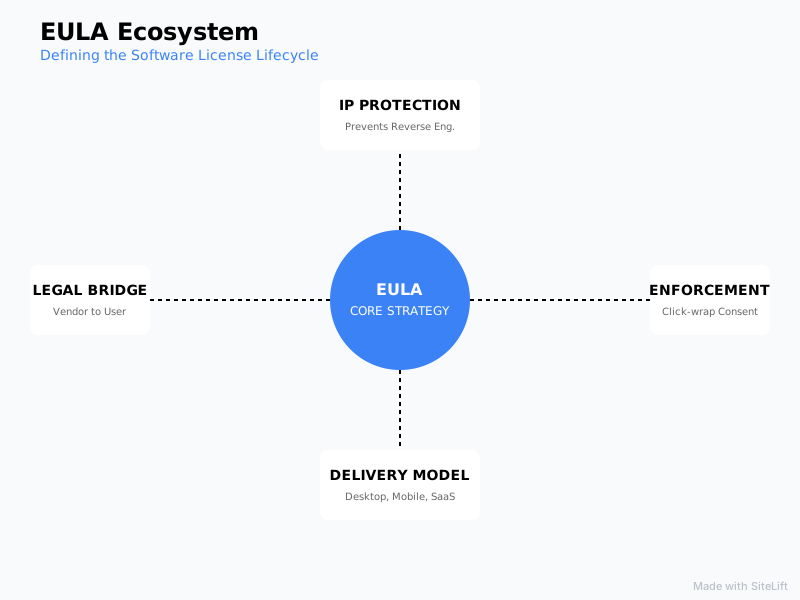
Infographic by SiteLift
Real-World SaaS EULA Examples to Learn From
To write a highly effective agreement, it helps to analyze how industry leaders structure their licensing terms. Let's break down three distinct models.
Adobe Creative Cloud: Multi-Device and Proprietary Asset Terms
Adobe’s model bridges the gap between local installation and cloud services. When you license Creative Cloud, you install heavy desktop applications (Photoshop, Premiere), but your license is managed via cloud subscription.
Key takeaways from Adobe's EULA:
- Device Limits: Users can install the software on multiple devices, but they can only activate and use it on two devices simultaneously.
- Asset Ownership: The terms clearly distinguish between the user's proprietary creative assets and Adobe's proprietary fonts, stock elements, and AI generation models (Adobe Firefly).
Slack: Enterprise vs. Individual User Licensing
Slack utilizes a dual-layered agreement structure. They have a Customer Agreement for the organization buying the workspace, and a separate User Terms of Service for the individual employees joining that workspace.
Key takeaways from Slack's terms:
- Workspace Controls: The organization (the "Customer") controls the data, integrations, and administrative settings.
- User Responsibilities: The individual "end user license terms" focus on acceptable use, preventing harassment, and securing personal login credentials. This protects Slack from liability if an employee misuses the platform.
Microsoft 365: Hybrid Cloud and On-Premise EULA Integration
Microsoft 365 is the ultimate hybrid licensing model. It covers local Windows/Mac office installations, web-based apps, mobile apps, and cloud storage (OneDrive).
Key takeaways from Microsoft's model:
- Rights of Use by Edition: The terms vary drastically depending on whether you purchase a Home, Business, or Enterprise license. Home editions strictly prohibit commercial use.
- Automatic Updates: The EULA explicitly grants Microsoft the right to download and install updates automatically on the user's local device, protecting their cloud ecosystem from outdated, vulnerable clients.
How to Choose and Customize a EULA Template for Software
For early-stage founders, building a legal agreement from scratch is expensive and unnecessary. Using a high-quality eula template for software is a standard starting point, but generic templates require careful customization to be effective.
Essential Elements of a High-Quality EULA Template
When evaluating a EULA template, ensure it contains modern clauses tailored for digital delivery. Avoid templates written before the cloud era. A modern template must include:
- Clear definitions of "Software," "Services," and "Updates."
- A flexible license grant that can accommodate seat, subscription, or usage-based pricing.
- Data privacy clauses that reference your Privacy Policy and Data Processing Agreement (DPA).
- IP indemnification terms, defining who defends whom if a third party claims the software infringes on their patent.
Customizing Terms for White-Labeling and SaaS Reselling
If you are purchasing software to rebrand and resell, or if you are using a platform like LicenseSaaS to buy/sell source code, standard consumer EULAs will not work. You must navigate the complex world of software white-labeling legalities.
Your customized agreement must address:
- Sublicensing Rights: Can your buyers issue their own sub-licenses to their end-users?
- Rebranding Rights: Are you permitted to strip the original developer's copyright notices and logos from the user interface?
- Source Code Modifications: If you bought the source code, do you have the right to modify it, and who owns those derivative modifications?
To ensure you cover these bases, explore our comprehensive guide on SaaS Licensing Agreement Template & Key Clauses to protect your transaction.
Legal Pitfalls to Avoid When Using Free Templates
Using free, unverified templates off the web is a major gamble. The most common pitfalls include:
- Outdated Delivery Models: Many free templates assume you are shipping a physical CD-ROM or an executable file, completely missing cloud, API, and SaaS-specific nuances.
- Ignoring Global Data Privacy Laws: A standard template may not comply with the strict requirements of the GDPR (Europe), CCPA (California), or LGPD (Brazil). If your software collects telemetry or user data, your EULA must align with these regulations.
- Overly Broad Disclaimers: In some jurisdictions (like the EU), you cannot legally disclaim all liability for gross negligence or willful misconduct. A poorly drafted, "all-or-nothing" disclaimer can be thrown out entirely by a European judge.
Editorial: Why We Need to Stop Treating EULAs as Afterthoughts
In the fast-paced world of software development, legal agreements are routinely treated as a check-the-box exercise. Founders spend months optimizing user onboarding flows, tweaking button colors, and shaving milliseconds off API response times. Then, right before launch, they copy-paste a competitor's EULA, swap out the company names, and call it a day.
This is a dangerous mistake.
Your licensing terms are not just legal defense mechanisms; they are an extension of your product design and business model. A poorly structured EULA can actively throttle your growth. For instance, if your terms are too restrictive, enterprise procurement teams will reject your software outright, dragging you into months of painful, manual contract redlines. Conversely, if your terms are too loose, you leave money on the table by allowing unauthorized account sharing, unlicensed white-labeling, or unchecked API usage.
At LicenseSaaS, we see this play out constantly in the B2B marketplace. When founders look to buy, sell, or white-label software, the value of the deal rests entirely on the clarity of the intellectual property transfer and the licensing compliance framework.
If you are selling an AI agent or a custom API, your license agreement is what turns raw code into a valuable, tradeable asset. It is time to stop treating your EULA as an afterthought. Treat it as a core feature of your product architecture.
FAQ
Is an End-User License Agreement (EULA) legally binding?
Yes. When properly implemented using a "click-wrap" model—where users must actively click "I Agree" before downloading, installing, or accessing the software—EULAs are highly enforceable in most global jurisdictions, including the US, EU, and UK.
What is the difference between a EULA and a SaaS Agreement?
A EULA is designed for software that is installed on a user's local device (desktops, mobile phones, servers). A SaaS Agreement is a broader contract governing access to hosted, cloud-based services. SaaS agreements typically focus on subscription terms, uptime guarantees, and cloud data security rather than local software installation.
Can a EULA prevent users from reverse engineering my software?
Yes, a EULA can legally prohibit reverse engineering, decompiling, and disassembling your software. While enforcement can be technically challenging, having this clause gives you clear legal grounds to sue for breach of contract and intellectual property theft if someone attempts to clone your proprietary technology.
How do I enforce an end-user license agreement for a web-based application?
To enforce your terms for a web application, require users to accept your click-wrap agreement during account creation. Additionally, implement automated software asset management tools to track active sessions, seat limits, and API usage. This allows you to programmatically enforce limits and prompt non-compliant users to upgrade.
If you are looking to acquire proprietary software, license a white-label SaaS, or securely sell your source code, LicenseSaaS provides the escrow-protected marketplace and AI-driven matching you need to close deals with complete legal confidence.
— licensesaas.com
More from the Blog

AI Marketplace Guide: How to License, White-Label and Sell AI Agents Safely
Learn how to safely license, white-label, buy, and sell AI agents. Discover escrow protections, legal frameworks, and AI deal matching strategies.

Reputation Management Software White Label: Turn Reviews Into Recurring Agency Revenue
License reputation management software white label to launch your white label review platform. Get MRR, pricing & SaaS license tips.

White Label SEO Software: How Agencies Launch Branded Rank Trackers Without Coding
Launch white label SEO software fast: rebrand rank trackers, price MRR plans & license safely with escrow. Actionable agency guide.