How to Sell Your App: Licensing vs Acquisition for Maximum Profit

When you build a software product, you eventually reach a major crossroads. Do you keep running the daily grind, or do you cash in on your hard work? If you want to sell app assets, you might automatically think of a clean, outright exit. But there is a massive, often overlooked alternative: licensing your source code.
Choosing between a full acquisition and a licensing model determines not just your immediate payout, but your long-term financial freedom. This step-by-step guide will walk you through both paths, showing you how to prepare, value, market, and safely transfer your software to maximize your profit.
Prerequisites: What Do You Need Before Trying to Sell Your App?
You cannot put a house on the market without cleaning the rooms and fixing the plumbing. The same rule applies to software. Before you reach out to prospective buyers, you must compile an app valuation checklist and clean up your technical and financial house.
Conducting an App Valuation Checklist
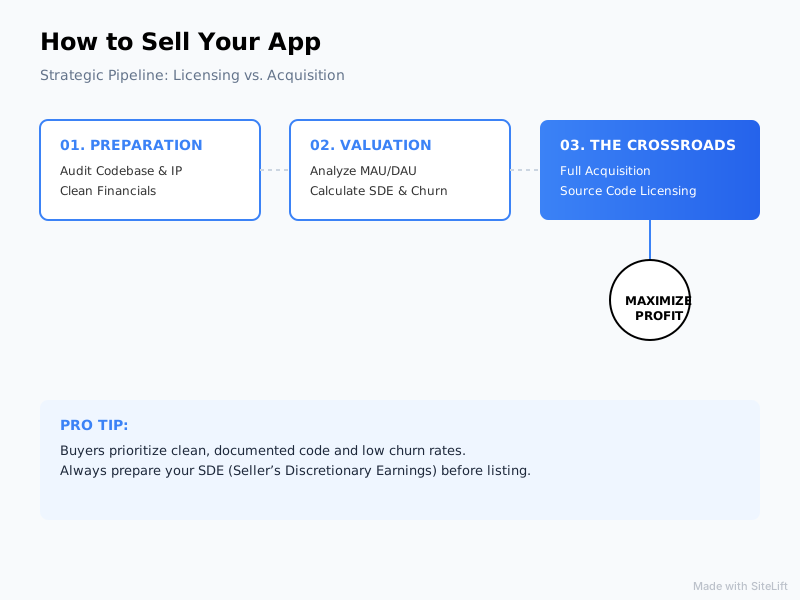
Buyers do not buy ideas; they buy assets, cash flow, and systems. To understand what your application is actually worth, you need to audit your metrics. Gather the following data points:
- Monthly Active Users (MAU) & Daily Active Users (DAU): This shows product engagement and stickiness.
- Churn Rate: High user churn is a major red flag for buyers. Keep this number as low as possible.
- Net ARR (Annual Recurring Revenue) & SDE (Seller’s Discretionary Earnings): SDE is your net revenue minus your operating expenses and your own salary. This is the baseline number buyers use to value your business.
Cleaning Up Your Source Code, IP, and Financial Documentation
If your codebase is a tangled mess of undocumented spaghetti code, expect buyers to slash their offers during due diligence.
- Audit Your Codebase: Ensure your code is clean, commented, and free of security vulnerabilities.
- Clear Intellectual Property (IP): You must prove absolute ownership of your proprietary code. Check all third-party libraries and APIs. If you have used open-source components, ensure they do not violate copyleft licenses. For guidance on software copyrights and international protection, consult the World Intellectual Property Organization resources.
- Organize Your Financials: Have at least 12 to 24 months of profit and loss (P&L) statements, tax returns, and bank statements ready.
Step 1: Choose How to Sell Your App — Full Acquisition vs. Licensing
The first strategic decision you must make is choosing your exit model.
┌───────────────────────────────────────────────────────────┐
│                 CHOOSE YOUR EXIT STRATEGY                 │
└─────────────────────────────┬─────────────────────────────┘
                              │
               ┌──────────────┴──────────────┐
               ▼                             ▼
┌─────────────────────────────┐┌─────────────────────────────┐
│      FULL ACQUISITION       ││    SOURCE CODE LICENSING    │
├─────────────────────────────┤├─────────────────────────────┤
│ • Outright asset sale       ││ • Non-exclusive rights      │
│ • Immediate cash buyout     ││ • Keep core IP ownership    │
│ • Hand over all operations  ││ • Multiple recurring sales  │
│ • Clean break from project  ││ • Scalable royalty streams  │
└─────────────────────────────┘└─────────────────────────────┘
Option A: Full App Acquisition (Outright Sale)
A full acquisition is a clean break. You sell the IP, the user base, the brand, the domain, and all associated assets to a buyer. In exchange, you receive a lump-sum payment (or a structured buyout with an earn-out period).
This is ideal if you are burnt out, want to fund a new venture, or believe the app has reached its peak under your management. However, the downside is obvious: once it is sold, you lose all future upside.
Option B: License App Source Code (White-Labeling & Recurring Royalties)
Why sell your golden goose once when you can lease it to dozens of buyers? When you license app source code, you retain ownership of the core IP while selling non-exclusive rights to other businesses. These businesses white-label your software, rebrand it, and sell it to their own customer bases.
For example, if you have built specialized retail stores software or a platform for e-commerce & online stores software, you can license the underlying engine to multiple agencies. They get to offer a proven solution to their clients instantly, and you generate highly profitable, recurring licensing fees.
My Editorial Take: Why Licensing is Highly Underrated
In my experience, most founders default to an outright sale because they do not realize licensing is an option. But look at the enterprise world.
Gartner's technology research shows that digital business models leveraging enterprise software licensing achieve up to 30% higher operating margins compared to single-sale models.
By licensing your source code, you transform a one-time exit into a repeatable business model. You can sell the same codebase to a buyer in Europe, another in Asia, and another in North America, without any of them competing directly.
Step 2: Determine Your App's Worth and Pricing to Sell Your App
Once you have chosen your path, you need to put a realistic price tag on your asset.
Applying Valuation Multiples to Software Assets
For an outright sale, software is typically valued as a multiple of its SDE or ARR. According to data from Acquire.com, SaaS and digital app assets typically sell at valuation multiples ranging between 3x to 6x of Seller's Discretionary Earnings (SDE).
If your app generates $100,000 in SDE per year, a realistic valuation range is $300,000 to $600,000. This multiple fluctuates based on your growth rate, churn, and how hands-off the business is for the new owner.
Structuring Licensing Fees vs. Acquisition Purchase Agreements
If you choose to license your source code, your pricing model changes entirely. You have two primary levers:
- Upfront License Fee: A one-time payment for access to the source code repository.
- Recurring Royalty/Maintenance Fee: An ongoing monthly or annual fee for updates, bug fixes, and support.
| Feature / Metric | Full Acquisition | Source Code Licensing |
|---|---|---|
| IP Ownership | Transferred completely to buyer | Retained by original founder |
| Typical Valuation | 3x to 6x SDE (one-time payment) | Upfront fee + monthly/annual recurring royalties |
| Operational Effort | Zero (post-transition phase) | Low to moderate (providing codebase updates) |
| Scalability | Single transaction | Unlimited (can license to multiple non-competing niches) |
| Target Buyer | Competitors, private equity, individual operators | Agencies, enterprise companies, SaaS startups |
Infographic by SiteLift
Pro Tip: If you license your software, restrict the buyer’s usage rights in the contract. For example, specify that they can only use the code for one brand, or prevent them from sub-licensing the source code to other developers.
Step 3: List Your Asset and Find Qualified B2B Buyers
Now that your assets are organized and priced, you need to get them in front of the right buyers.
Preparing Your Marketing Collateral and Teaser
Do not just post "App for Sale" on social media. You need a professional package.
- The Teaser: A one-page, anonymous document highlighting your metrics, tech stack, and growth opportunities.
- Confidential Information Memorandum (CIM): A detailed document shared only after a buyer signs a Non-Disclosure Agreement (NDA). The CIM covers your operational workflows, marketing strategies, code architecture, and detailed financial histories.
Selecting the Right Marketplace for SaaS and App Assets
For a standard outright sale, traditional brokerages and marketplaces work well. But if you want to leverage white-labeling or license your source code directly to B2B buyers without the friction of traditional brokers, specialized platforms are your best bet.
Using a dedicated platform like licensesaas.com allows you to connect directly with agencies, enterprises, and entrepreneurs who are actively looking to buy or license pre-built software. For instance, if you have developed niche tools like property management software, listing on a targeted marketplace matches you with buyers who understand the specific value of your code, saving you months of cold outreach.
Step 4: Execute Due Diligence and Transfer Assets Safely
The deal is negotiated, the Letter of Intent (LOI) is signed, and now you enter the most critical phase: due diligence and asset transfer. This is where most deals fall apart.
Navigating Technical and Financial Due Diligence
Buyers will want to verify everything you have claimed.
- Technical Audit: They will inspect your repositories. Never give a prospective buyer write-access or let them download your entire codebase before the money is secured. Use read-only, shared-screen walkthroughs or secure third-party code auditing services.
- Financial Audit: Provide read-only access to your payment processor (like Stripe or PayPal) to verify your revenue claims.
How to Sell Mobile App Assets with Escrow Protection
If you are selling a mobile app, you must migrate your developer accounts. For iOS, this means transferring the app from your Apple Developer account to the buyer's account. For Android, it involves migrating the package on the Google Play Console.
To protect yourself, never transfer these assets on trust. You must sell mobile app with escrow protection.
Data from Escrow.com indicates that utilizing third-party escrow services reduces payment and digital asset transfer disputes by over 90% in online business acquisitions.
┌───────────────────────────────────────────────────────────┐
│                 THE ESCROW TRANSFER PROCESS               │
└─────────────────────────────┬─────────────────────────────┘
                              │
                              ▼
┌───────────────────────────────────────────────────────────┐
│ 1. Buyer deposits purchase funds into Escrow              │
└─────────────────────────────┬─────────────────────────────┘
                              │
                              ▼
┌───────────────────────────────────────────────────────────┐
│ 2. Seller initiates developer account & code transfer     │
└─────────────────────────────┬─────────────────────────────┘
                              │
                              ▼
┌───────────────────────────────────────────────────────────┐
│ 3. Buyer verifies asset control and codebase integrity    │
└─────────────────────────────┬─────────────────────────────┘
                              │
                              ▼
┌───────────────────────────────────────────────────────────┐
│ 4. Escrow releases funds to Seller's bank account         │
└─────────────────────────────┘
By using a service like Escrow.com, the buyer deposits the funds into a secure account. Only after the buyer verifies that they have full control of the developer accounts and the code repositories does the escrow service release the funds to you.
Troubleshooting & Common Pitfalls: Why Do App Sales Fail?
Even with a signed agreement, things can go wrong. Understanding these common pitfalls will keep your deal on track.
IP Ownership Gaps and Licensing Non-Compliance
If your app uses open-source code governed by a GPL (General Public License) license, you might be legally required to make your entire codebase open-source. A sophisticated buyer’s legal team will spot this instantly and walk away. Always use permissive licenses (like MIT or Apache) for your dependencies, and document every third-party library you use.
Unrealistic Valuation Multiples and Poor Documentation
Many founders value their app based on the sweat equity they put in, rather than market realities. If your app has no revenue, expecting a 10x multiple is unrealistic unless you possess highly proprietary, revolutionary AI technology. Keep your valuation grounded in SDE multiples, and ensure your documentation is flawless to prevent buyers from negotiating the price down during escrow.
Pro Tip: Clearly define the boundaries of your post-sale support. Agree on a set number of transition hours (e.g., 20 hours over 30 days) in the contract. This prevents "scope creep" where the buyer expects you to act as their free developer for months after the sale.
Expected Outcome: Maximized Deal Value and Smooth Handoff
By following this structured approach, you ensure a clean, professional transaction.
Once the migration phase is complete, you will have successfully transferred your codebase, domain, and app store listings to the buyer. You walk away with your exit proceeds securely in your bank account, ready to be reinvested into your next venture.
Alternatively, if you chose the licensing route, you now have a repeatable framework to sell your source code to multiple non-competing buyers, establishing a highly profitable, hands-off stream of recurring licensing revenue.
If you are ready to explore your options, list your software, or find B2B buyers looking for white-label products, platforms like LicenseSaaS streamline this entire journey. From automated match-making to secure asset transfer, we help you unlock the true value of your code.
— licensesaas.com
FAQ
How much can I sell my app for?
Most revenue-generating apps sell for 3x to 6x of their Seller's Discretionary Earnings (SDE). If your app is pre-revenue, its value is determined by the cost to replicate the technology, the strategic value of your user base, or the uniqueness of your intellectual property.
What is the difference between selling an app outright and licensing its source code?
Selling an app outright transfers 100% of the IP, brand, and revenue to a single buyer for a one-time fee. Licensing allows you to retain ownership of the core source code while selling non-exclusive rights to multiple businesses, who white-label and rebrand the app for their own customers.
How do I sell a mobile app safely using escrow?
First, agree on the transaction terms and use a trusted service like Escrow.com. The buyer deposits the funds into escrow. Once the funds are verified, you transfer the Apple Developer and Google Play Console accounts, along with the source code. After the buyer confirms receipt and verifies the assets, the escrow service releases the money to you.
Can I sell an app if it isn't generating revenue yet?
Yes. Pre-revenue apps are valued as "asset sales." Buyers look at the quality of the codebase, the proprietary nature of the technology, active user engagement, or the value of the domain and design.
What documents do I need to prepare before selling my software asset?
You should prepare an app valuation checklist, a clean code repository, proof of intellectual property ownership, 12 to 24 months of detailed financial statements (P&L), and a Confidential Information Memorandum (CIM) to share with serious buyers under an NDA.
More from the Blog

White Label Sportsbook Software: How to License and Launch Your Betting Brand
Learn how white label sportsbook software works, costs, licensing & launch steps. License safely and scale your betting brand.
Social Media Management Software White Label: Agencies Shortcut to Recurring Revenue
Discover how social media management software white label platforms help agencies launch proprietary dashboards, stop churn, and unlock high-margin MRR.

Apps White Label Explained: Launch Your Own Branded App Portfolio Fast
Discover how apps white label models work. Compare source code licensing to app builders, pass store reviews, and scale recurring agency revenue.