17 Profitable Digital Products to Sell With SaaS Licensing in 2026

If you're searching for digital products to sell that actually generate recurring revenue, forget another ebook or Canva template pack. The real margin in 2026 is in licensable software.
I curated this list of 17 white label digital products and rebrandable SaaS products specifically for founders, agencies, and solopreneurs who want to launch fast without writing code from scratch. Each pick was evaluated on MRR potential, retention, demand, competition, and how easy it is to rebrand and deploy.
What Are the Most Profitable Digital Products to Sell in 2026?
When most blogs talk about digital products to sell, they mean downloads: printables, presets, courses. That model works for creators, but it's one-time revenue and a race to the bottom on price.
SaaS licensing flips that. Instead of selling a file, you license digital assets — a working chatbot, CRM, LMS, or API — then rebrand it as your own and charge monthly. You get the product, updates, and infrastructure from the original maker, while you own the customer relationship and pricing.
Why now? Cloud demand keeps climbing. According to Gartner, worldwide public cloud end-user spending was forecast to reach $723.4 billion in 2025, and SaaS remains the largest segment of that market with steady revenue growth projected through 2029. Add AI adoption — 72% of organizations reported using AI in at least one business function in 2024 according to McKinsey & Company — and every SMB suddenly wants AI-powered tools without enterprise pricing.
That's your opening: license it, white-label it, sell the outcome.
How Did We Choose These Rebrandable SaaS Products?
I didn't pick trendy toys. I picked software businesses that already have proven willingness to pay:
- Profit margin: 70%+ gross margin after license fees and hosting
- MRR potential: Can you charge $49-$499/mo per client?
- Retention: Is it embedded in daily workflow or easy to cancel?
- Demand vs. competition: Searched-for problem, but still room to niche down
- Rebrandability: Custom domain, logo, colors, client sub-accounts, and clean code
Licensing Models Compared
- White-label SaaS: Monthly license to original vendor, you set your price. Fastest to launch.
- API licensing: You pay per call/seat, build your own UI. Great for adding AI to existing offers.
- Single / Extended commercial license: One-time fee to use in one or unlimited client projects.
- Source-code acquisition: You own the code outright. Highest upfront cost, highest control and equity value.
For any deal, verify IP ownership, update terms, support SLAs, and use escrow-protected payments. If you're new to deal structure, read this guide on how to sell SaaS licensing rights — it explains pricing and contracts from the founder side, which helps you negotiate as a buyer.

1. AI Chatbots and AI Customer Support Agents
AI support agents are the top digital products to sell for agencies right now because every e-commerce store and service business feels the pain of missed chats.
- What it is: Trainable chatbot that answers FAQs, qualifies leads, books calls, and escalates to humans.
- Who it's best for: Marketing agencies and B2B freelancers selling retainers.
- Standout strength: Usage-based pricing scales with client value and runs 24/7.
- Main drawback: Needs good training data; poor setup = hallucinations and churn.
- Best model & pricing tip: White-label with custom domain and per-workspace billing. Sell at $197-$497/mo as a support + lead-gen add-on.
2. AI Content Generators and Copywriting Tools
Marketers still pay for speed. Niche content tools for real estate descriptions, Amazon listings, or SEO blogs have evergreen demand.
- What it is: Prompt-based generator for blogs, ads, emails, and product copy with brand voice presets.
- Who it's best for: SEO agencies, content studios, and creators.
- Standout strength: Low support burden, high perceived value.
- Main drawback: Crowded market if you stay generic.
- Best model & pricing tip: API-based licensing or seat-based SaaS. Bundle with an audit tool to lift ARPU.
3. White-Label CRM and Sales Pipeline Platforms
A CRM is sticky. Once a client's contacts, pipelines, and automations live inside, they rarely leave.
- What it is: Contact management, pipelines, email/SMS automation, and reporting under your brand.
- Who it's best for: Agencies wanting to become the client's operating system.
- Standout strength: Extremely high retention and expansion revenue.
- Main drawback: Heavier onboarding and migration work upfront.
- Best model & pricing tip: Full rebrand with multi-tenant sub-accounts. Charge $97-$297/mo per client plus a $500+ setup fee.
Pro Tip: Don't sell the CRM as software. Sell "missed-lead recovery" with done-for-you pipeline setup — clients stay for the outcome, not the dashboard.
4. Email Marketing and Marketing Automation Software
Email still drives ROI for creators and e-commerce, but Mailchimp fatigue is real. Branded, simpler alternatives win.
- What it is: Drag-and-drop builder, automations, segmentation, and SMTP deliverability tools.
- Who it's best for: Creators, consultants, and niche e-commerce operators.
- Standout strength: List-based pricing grows automatically as clients grow.
- Main drawback: Deliverability and spam compliance require ongoing attention.
- Best model & pricing tip: License digital assets with automation workflows included. Start at $29/mo for 2,500 contacts and upsell done-for-you flows.
5. Social Media Management and Scheduling Dashboards
This is proven product-market fit. Freelancers juggling 10+ clients will gladly pay for one login.
- What it is: Multi-channel scheduling, approval workflows, inbox, and client reports.
- Who it's best for: Social media managers and virtual assistant agencies.
- Standout strength: Immediate time savings = easy demo-to-sale.
- Main drawback: Dependent on social APIs that change frequently.
- Best model & pricing tip: White label digital products with branded reports. Upsell AI captions and analytics as premium tiers at $79-$199/mo.
6. SEO Audit, Rank Tracking, and Reporting Tools
Clients don't buy SEO, they buy proof. Branded PDF reports keep them paying.
- What it is: Site audits, keyword tracking, backlink monitoring, and white-label reports.
- Who it's best for: SEO freelancers and full-service agencies.
- Standout strength: Cheap to deliver, high perceived expertise.
- Main drawback: Data costs from third-party APIs can eat margin if you price too low.
- Best model & pricing tip: API + dashboard license. Offer $49/mo reporting as a foot-in-the-door, then upsell services.
7. Online Course Platforms and Learning Management Systems (LMS)
Coaches and companies both want their own branded academy, not another Udemy listing.
- What it is: Video hosting, quizzes, certificates, drip content, and payments.
- Who it's best for: Coaches, consultants, and HR teams.
- Standout strength: High-ticket buyers and corporate training budgets.
- Main drawback: Video storage and support can get expensive.
- Best model & pricing tip: Rebrandable SaaS products with Stripe integration. Sell to enterprises for onboarding at $299+/mo. For creator-specific angles, see software built for online course creators to license and white-label.
8. Membership, Community, and Subscription Platforms
Paid communities are among the most predictable digital products to sell because revenue compounds with cohorts.
- What it is: Gated content, tiers, forums, live events, and paid newsletters in one portal.
- Who it's best for: Niche B2B communities and creators worldwide.
- Standout strength: Strong network effects and low churn when engagement is high.
- Main drawback: You must help founders seed engagement or communities go quiet.
- Best model & pricing tip: Licensed platform with mobile-ready portal. Charge platform fee + $99-$249/mo.
9. Booking, Scheduling, and Appointment Software
Clinics, salons, consultants, and home services need this in every country — and hate no-shows.
- What it is: Online booking, calendar sync, reminders, payments, and multi-location support.
- Who it's best for: Local marketing agencies and SaaS resellers.
- Standout strength: Clear ROI from fewer no-shows.
- Main drawback: Calendar edge cases and time zones create support tickets.
- Best model & pricing tip: White-label with SMS reminders. Charge per location plus SMS credits.
10. Helpdesk, Ticketing, and Knowledge Base Systems
As customer expectations rise, even 5-person SaaS startups need AI-assisted support.
- What it is: Shared inbox, automations, SLA rules, and self-service help center.
- Who it's best for: SaaS startups and e-commerce brands.
- Standout strength: Becomes mission-critical quickly.
- Main drawback: Buyers expect security compliance and uptime guarantees.
- Best model & pricing tip: Rebrandable SaaS with AI summaries. Sell as compliance-ready stack at $69-$199/mo per workspace.
11. Invoicing, Billing, and Subscription Management Tools
Boring? Yes. Profitable? Absolutely. Freelancers will pay to get paid faster.
- What it is: Invoices, recurring billing, multi-currency, tax rules, and client portal.
- Who it's best for: Accountants, bookkeepers, and freelancer communities.
- Standout strength: Daily-use utility with global demand.
- Main drawback: Tax localization is complex across regions.
- Best model & pricing tip: License with payment gateway integrations. Win by localizing for your country's tax and invoicing norms, and follow subscription billing best practices for trials and dunning.
12. Analytics, KPI Dashboards, and Client Reporting Tools
Agencies lose clients when results are invisible. Unified dashboards fix that.
- What it is: White-label dashboard pulling from ads, CRM, and Stripe via API.
- Who it's best for: Performance marketing and RevOps agencies.
- Standout strength: Premium pricing and reduces churn on your other services.
- Main drawback: Initial API setup per client takes time.
- Best model & pricing tip: Offer as $149/mo add-on to other rebrandable SaaS products to lock in retention.
Pro Tip: Pre-build templates for 3 niches — e.g., dentists, e-com, law firms — so onboarding is 20 minutes, not 2 days.
13. E-commerce Storefronts and Headless Commerce APIs
Many niche DTC sellers want lightweight stores without Shopify bloat or fees.
- What it is: Headless storefront, cart, checkout, and product APIs you can customize.
- Who it's best for: Web agencies deploying multiple stores per year.
- Standout strength: High project fees plus ongoing hosting margin.
- Main drawback: Requires developer skills for custom builds.
- Best model & pricing tip: Source-code license or API licensing. Charge $2k-$5k build + $99/mo care plan.
14. Website Builders, Funnel Builders, and Landing Page Tools
Solopreneurs and local businesses still need fast sites and funnels that convert.
- What it is: Drag-and-drop builder with templates, hosting, and custom domains.
- Who it's best for: Web designers and local agencies.
- Standout strength: Easy to demo, fast time-to-value.
- Main drawback: Competitive space dominated by big brands.
- Best model & pricing tip: White label digital products with hosting included. Bundle maintenance for higher lifetime value. Compare options alongside white-label templates you can rebrand and resell.
15. HR, Hiring, and Employee Onboarding Automation
SMBs and staffing firms want affordable hiring without Workday complexity.
- What it is: Applicant tracking, resume parsing, interview scheduling, offers, and e-sign.
- Who it's best for: HR consultants and staffing agencies.
- Standout strength: Per-employee pricing scales nicely.
- Main drawback: Buyers ask about labor-law compliance and data privacy.
- Best model & pricing tip: Rebrandable SaaS with compliance docs. Sell per active job or per employee at $129-$399/mo.
16. API Products and Micro-SaaS Utilities
My favorite underrated category. Small, single-purpose APIs print cash with almost no support.
- What it is: Verification, PDF generation, image optimization, scraping, and data enrichment APIs.
- Who it's best for: Indie hackers and dev agencies.
- Standout strength: Low overhead, usage-based revenue, easy to embed.
- Main drawback: Needs technical marketing to reach developers.
- Best model & pricing tip: License digital assets via API keys with reseller rights. Start at $19/mo + overages.
17. No-Code Mobile App Builders and App Templates
Local restaurants, gyms, churches, and clubs all want a branded app in the App Store.
- What it is: No-code builder or source-code templates with push notifications and in-app payments.
- Who it's best for: App agencies and freelancers selling to local businesses.
- Standout strength: High one-time build fees plus sticky maintenance.
- Main drawback: App store approvals and OS updates require upkeep.
- Best model & pricing tip: Source-code sale or white-label builder. Charge $1,500+ build + $79/mo for updates and push.
Which Digital Products to Sell Offer the Best ROI?
Here's how I rank all 17 digital products to sell when you factor cost, effort, and staying power:
| # | Product Category | Startup Cost | MRR Potential | Churn Risk | Tech Skill Needed |
|---|---|---|---|---|---|
| 1 | AI Chatbots | Medium | Very High | Medium | Low |
| 2 | AI Content Tools | Low | High | Medium | Low |
| 3 | White-Label CRM | Medium | Very High | Very Low | Medium |
| 4 | Email Marketing | Medium | High | Low | Low |
| 5 | Social Scheduling | Low | Medium | Low | Low |
| 6 | SEO Tools | Low | Medium | Low | Low |
| 7 | Course / LMS | Medium | High | Low | Low |
| 8 | Membership Platform | Low | High | Low | Low |
| 9 | Booking Software | Low | High | Very Low | Low |
| 10 | Helpdesk | Medium | High | Very Low | Medium |
| 11 | Invoicing / Billing | Medium | Medium | Very Low | Medium |
| 12 | Analytics Dashboards | Low | High | Very Low | Medium |
| 13 | Headless Commerce | High | High | Low | High |
| 14 | Website / Funnel Builder | Medium | Medium | Medium | Low |
| 15 | HR / Hiring Automation | Medium | High | Low | Medium |
| 16 | API / Micro-SaaS | Low | Medium | Low | High |
| 17 | App Builders | High | High | Low | Medium |
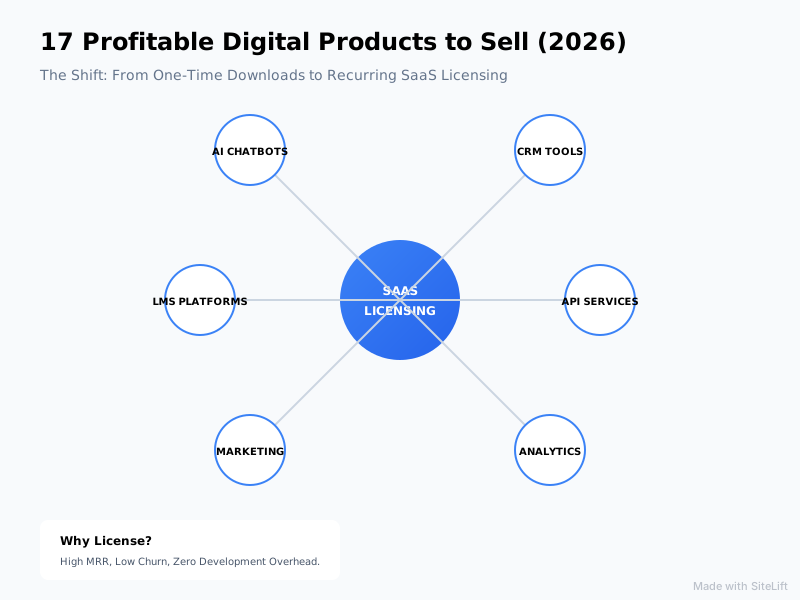
Infographic by SiteLift
In my experience, agencies should start with the sticky trio: CRM, booking, and reporting. They solve painful, visible problems and make every other service you sell look better. If you want fast cash flow as a solopreneur, pick AI chatbots, social scheduling, or SEO reporting — you can demo value in one call.
For long-term equity, I think helpdesk, LMS, and headless commerce APIs are underrated. They take more work to deploy, but buyers stay for years and source-code rights actually build enterprise value. That’s where licensing beats reselling generic downloads every time.
If you plan to buy code outright, study the founder's guide to selling white label software to understand what good update terms and support SLAs look like before you sign.
How to Start Selling Licensed Digital Products in 5 Steps?
You don't need to code. You need a niche, a vetted product, and a clean launch:
- Pick one painful niche. Dentists + missed calls, realtors + follow-up, creators + courses. One buyer, one outcome.
- Vet code quality and license terms. Ask for demo, docs, tech stack, customer list, IP assignment, update period, and reseller limits.
- Buy with escrow protection. Never wire directly. Hold funds until code, keys, and transfer docs are verified.
- Rebrand and deploy. Logo, domain, colors, pricing plans, Stripe, onboarding emails, and help docs. Keep it simple.
- Launch with proof. Offer 14-day trial, migrate 2-3 beta clients free, publish their results, then raise prices.
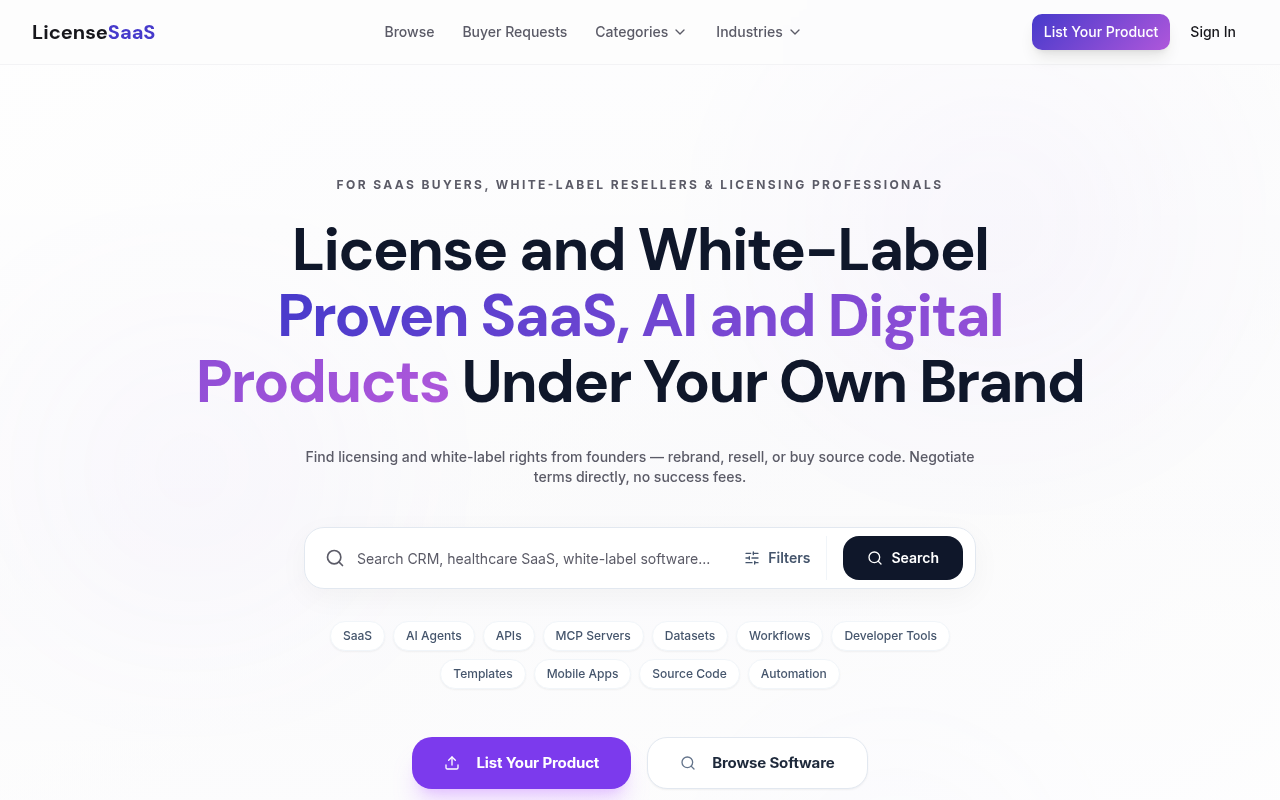
The hardest part is usually sourcing — finding legitimate sellers with clean IP and real traction. That's why I recommend browsing vetted listings on licensesaas.com. LicenseSaaS connects founders, agencies, and entrepreneurs to license, white-label, or acquire SaaS, AI agents, and APIs with escrow-protected payments and AI-driven deal matching, plus help with compliance and deployment.
Final Verdict: How to Choose the Right Licensed Product
Don't try to sell all 17. Pick one based on your unfair advantage:
- Have clients already? Add CRM, reporting, or chatbots as an upsell.
- No audience but can market? Start with SEO tools or social dashboards — low cost, fast sales cycle.
- Technical and want equity? Buy source code for micro-SaaS APIs or commerce tools and build a portfolio.
The best digital products to sell in 2026 aren't files. They're workflow tools people log into every day. License one, niche it down, price on value, and support it like it's your own — because to your customer, it is.
— licensesaas.com
FAQ
What are the most profitable digital products to sell in 2026?
The most profitable are licensable SaaS tools with recurring revenue: AI chatbots, white-label CRMs, booking software, LMS platforms, email automation, and analytics dashboards. They outperform ebooks and templates because customers pay monthly and churn is low when the tool runs daily operations.
How does white-label SaaS licensing work?
You pay the original maker a license fee or revenue share for the right to rebrand the software with your logo, domain, and pricing. The maker handles core updates and infrastructure, while you handle marketing, sales, and front-line support. Terms should cover territories, client limits, updates, and IP ownership in writing.
Do I need coding skills to sell rebrandable SaaS products?
No for most white-label SaaS — if you can connect a domain, set up Stripe, and follow docs, you can launch. You’ll need developer help for source-code deals, headless commerce APIs, or deep customizations. In those cases, hire a freelancer for deployment and budget for maintenance.
How much does it cost to license digital assets to resell?
White-label SaaS typically runs $50-$500/mo to the vendor plus your hosting, while API products are usage-based. Single commercial licenses can be $200-$2,000 one-time, and full source-code acquisitions range from $5,000 to $100,000+ depending on traction. Always factor in support time and update renewals.
Can I really make passive income selling licensed digital products?
It's semi-passive, not fully passive. Once set up, billing and delivery are automated, but you'll still handle onboarding, support, and churn prevention. Choose sticky, high-utility tools, price for margin, and systemize support to get closest to passive.
More from the Blog

License Compliance for White-Label Resellers: Stay Audit-Proof When Rebranding SaaS and AI Agents
Master license compliance for white-label SaaS & AI resellers. Audits, checklists & automation to stay audit-proof.

White Label Sportsbook Software: How to License and Launch Your Betting Brand
Learn how white label sportsbook software works, costs, licensing & launch steps. License safely and scale your betting brand.

Social Media Management Software White Label: Agencies Shortcut to Recurring Revenue
Discover how social media management software white label platforms help agencies launch proprietary dashboards, stop churn, and unlock high-margin MRR.