How to Monetize AI Agents Through Licensing: A Blueprint for Developers

If you know how to monetize AI agents beyond a $20/month SaaS wrapper, you’re already ahead of 90% of builders. I’ve watched talented developers burn out hosting chatbots for pennies while agencies and enterprises would happily pay five figures for the same logic — if only it was packaged as a license.
Licensing flips the model. Instead of chasing thousands of users, you sell deployment rights, source code, or a rebrandable framework to businesses that already have customers and distribution. Here’s the exact blueprint.
Key Takeaways
| Licensing Play | Best For | Revenue Model | Effort Level |
|---|---|---|---|
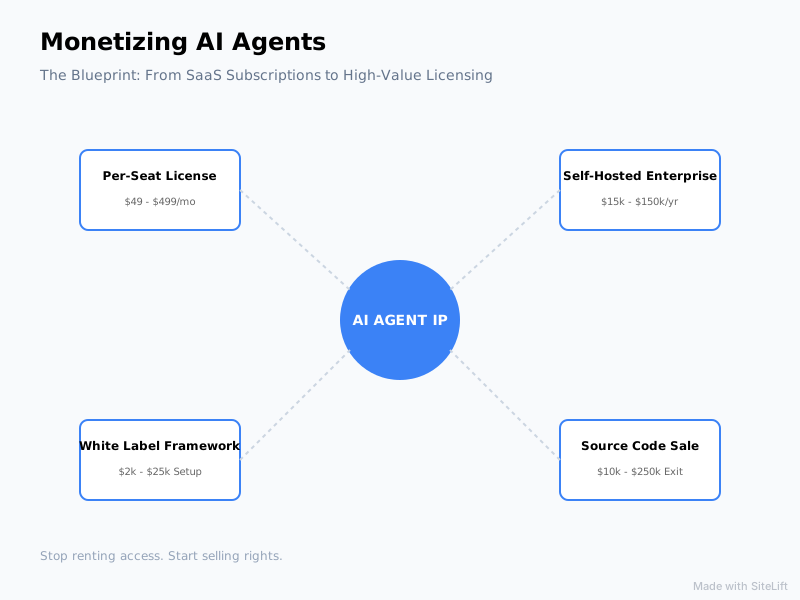
| Per-seat / per-workspace license | Internal productivity agents, sales or support copilots | $49–$499/seat/mo + onboarding | Low |
| Self-hosted enterprise license | Regulated industries, data-sensitive workflows | $15k–$150k/year + maintenance | Medium |
| White label AI software framework | Agencies, MSPs, consultants who resell | $2k–$25k setup + $500–$5k/mo per reseller | Medium-High |
| Source code sale with escrow | One-off exits, acqui-hires, custom builds | $10k–$250k one-time + support retainer | High |
| Usage-based API monetization | Developers embedding your agent logic | $0.002–$0.05 per call + tiered plans | Low-Medium |
Bottom line: If you want to monetize AI agents for serious money, stop renting access and start selling rights.
Why Should Developers Monetize AI Agents Through Licensing?
Most guides about how to monetize AI agents tell you to launch another chatbot SaaS. That advice is outdated. SaaS fatigue is real, churn is brutal, and you’re stuck paying the LLM bill for every free trial abuser.
Licensing solves that by shifting hosting costs, sales, and support to the buyer — while you keep the IP.
The Shift from SaaS Subscriptions to Enterprise Licensing
Buyers are tired of adding another $29 tool to the stack. What they actually want is capability inside their stack.
According to McKinsey & Company, generative AI could add up to $4.4 trillion annually to the global economy, as detailed in their report on the economic potential of generative AI. That value isn’t coming from consumer chat apps. It’s coming from custom agents embedded in finance, legal, healthcare, logistics, and customer operations.
Gartner backs this up, predicting that more than 80% of enterprises will have used generative AI APIs or deployed generative AI-enabled applications in production by 2026. Those enterprises don’t want to send sensitive data to your multi-tenant demo. They want a license to run it themselves.
Unlocking Value: Why Businesses Pay for Proprietary AI Agents
A generic wrapper is worth $0. A proprietary agent that knows how a mortgage broker underwrites loans or how a logistics firm handles customs exceptions is worth a lot.
Businesses pay for three things:
- Workflow specificity: Pre-built prompts, tools, retrievers, and guardrails for their niche
- Time to value: Weeks saved vs. building with internal AI teams
- Control: Ability to audit, self-host, and customize without vendor lock-in
That’s why AI agent licensing models focused on outcomes — tickets deflected, hours saved, leads qualified — command 10-50x higher prices than seat-based SaaS.
Overcoming the Limitations of Traditional API Monetization
Running your own API sounds great until OpenAI raises prices, a customer spams your endpoint, or your margin disappears overnight.
When you host everything, you absorb:
- Token cost volatility
- Abuse, rate-limiting headaches, and uptime SLAs
- Data privacy liability
Licensing lets the buyer bring their own keys and infrastructure. You sell the brain, they pay for the electricity.
Pro Tip: If your gross margin drops below 70% after LLM costs, stop scaling SaaS and switch to a licensed or bring-your-own-key model immediately.
What Are the Best AI Agent Licensing Models to Monetize AI Agents?
There’s no single best way to monetize AI agents. The right model depends on who you’re selling to and how sensitive their data is. Most successful developers offer two or three tiers.
Per-Seat vs. Per-Token Licensing Models
This is the simplest entry point.
Per-seat works for human-in-the-loop agents — SDR copilots, legal assistants, support agents. Example: $149/user/month for up to 5 workspaces, audit logs included.
Per-token or per-run works for autonomous agents — document processors, data enrichment bots, code reviewers. Example: 10,000 runs/month included, then $0.08 per additional run.
Smart move? Combine them. Charge a platform license fee for access, then meter heavy usage. That protects you when a client suddenly processes 2 million PDFs.
| Model | Pros | Cons | When to Use It |
|---|---|---|---|
| Per-seat | Predictable, easy to sell | Doesn’t scale with value | Human copilots |
| Per-token / per-run | Scales with usage | Unpredictable bills scare buyers | Backend automation |
| Platform + overage | Best of both | More complex billing | Most B2B agents |
On-Premises Deployment and Self-Hosted Enterprise Licenses
This is where the real money is. Banks, hospitals, governments, and large enterprises cannot send data to your cloud. They will pay a premium for a self-hosted enterprise license.
A typical package includes:
- Docker / Kubernetes deployment or VPC marketplace image
- Annual license: $25,000–$100,000+ based on company size
- 20% annual maintenance for updates and security patches
- Restricted rights: use, modify for internal use, but no resale or sublicensing
You’ll need to provide SBOMs, version pinning, and clear docs on what models and external calls are required. No black boxes.
Hybrid Licensing: Combining API Access with Source Code Rights
My favorite structure for developers who want to monetize AI agents without giving away the farm: hybrid.
Offer:
- Hosted API for fast start ($499/mo)
- Self-hosted binary for scale ($15k/year)
- Full source code rights as the top tier ($50k+ one-time)
Each tier unlocks more control. Buyers self-select, and you never have to negotiate from scratch. Just make sure your agreement defines what “source code rights” means — internal use vs. right to resell are wildly different prices.

How to Set Up a White Label AI Software Framework for Resellers
A white label AI software framework is a version of your agent that agencies can rebrand as their own. They handle sales and first-line support. You collect setup fees + recurring platform fees.
This is how you turn one product into 30 revenue streams.
Architecture Requirements for White-Label AI Solutions
If you bolt white-labeling on later, you’ll regret it. Build for it from day one:
- Config-driven branding: Logo, colors, domain, email templates, and system prompts stored per tenant, not hardcoded
- Separate LLM keys per tenant: Each reseller brings their own OpenAI / Anthropic / Azure key or uses sub-accounts with hard limits
- Modular tools: Let partners enable/disable tools (web search, SQL, CRM actions) without code changes
- Admin vs. end-user roles: Reseller admin dashboard + client-facing UI
Think of it as WordPress multisite for AI agents.
Multi-Tenant vs. Single-Tenant Deployments for Partners
- Multi-tenant: Cheaper for you, faster to onboard. Great for agencies with small clients. Risk: noisy neighbor problems and data co-mingling concerns.
- Single-tenant: One deployment per reseller or per end-client. More DevOps work, but you can charge $1,000+ more per month and pass enterprise security reviews.
Most developers start multi-tenant, then offer single-tenant as a $12k+/year upgrade. That upgrade path alone can double revenue.
Managing Brand Customization and API Gateway Routing
Use an API gateway (Kong, AWS API Gateway, Cloudflare Workers) to route client.agency.com → your backend with tenant ID injection. Enforce rate limits per tenant, per API key.
Keep audit logs per tenant. Agencies will need them to prove ROI to their clients.
Pro Tip: Charge resellers for outcomes, not just seats. A $997/month white-label fee is an easy yes if they can sell it to 5 local clients at $500/month each.
If you want to see what a license-ready product listing looks like, browse license-ready SaaS and AI products to study pricing and packaging from sellers already doing this.
How Can You Sell AI Source Code Safely to Enterprise Buyers?
Learning how to sell AI source code safely is what separates hobby projects from high-ticket exits. Yes, there’s risk. No, you shouldn’t just zip your repo and send it after a wire transfer.
Protecting Intellectual Property (IP) and LLM Weights
You have three layers to protect:
- Code and orchestration: Your LangChain / CrewAI graphs, tool definitions, evaluation harnesses
- Prompt IP: System prompts, few-shot examples, guardrail logic — this is often more valuable than code
- Weights and data: Fine-tuned adapters (LoRA), embeddings, proprietary datasets
You usually don’t own base model weights from OpenAI or Anthropic, and you can’t sell them. What you do own is everything around them. Document that clearly.
For guidance on what’s protectable, review WIPO’s guide to intellectual property and artificial intelligence. And file the basics: copyright notices in every repo, trade secret markings on prompts, and a written assignment from any contractors.
Practical tactics I use:
- Keep core prompts on your hosted evaluation server during trial, expose fully only after payment
- Split delivery: application code now, fine-tuning scripts and training data under a separate addendum
- Watermark demo outputs so leaked prompts are traceable
Structuring Escrow-Protected Source Code Sales
Never do a direct “pay then I’ll send code” deal over $5k. Use escrow.
A clean flow looks like this:
- Sign LOI + IP assignment terms (what’s included, what’s excluded)
- Buyer funds escrow
- You deposit full repo, env templates, model cards, and deployment docs to escrow
- Buyer gets 5–10 day inspection period to build and test
- On acceptance, funds release and IP transfers
Platforms built for software licensing handle this natively with AI-driven matching and compliance checks. If you’re ready, you can list your product for licensing and white-labeling instead of negotiating escrow over email threads.
Defining Post-Sale Support and Maintenance Agreements
Unlimited support will kill you. Define boundaries in writing:
- Included (30–60 days): Help deploying, fixing build-breaking bugs, one knowledge transfer call
- Paid retainer: $2,500–$7,500/month for new features, prompt tuning, model upgrades
- Excluded: Retraining on buyer’s new data, migrating to a different LLM provider, on-site work — all billable separately
Also specify who owns improvements. A common compromise: buyer owns modifications they make, you retain rights to generic improvements you ship to all licensees.
Infographic by SiteLift
What Are the Top AI API Monetization Strategies to Maximize Revenue?
If you want recurring revenue without managing UI users, AI API monetization strategies are your best friend. But flat-rate $99 APIs won’t cut it anymore.
Tiered Usage and Rate-Limiting Models
Copy what works from Twilio and Stripe:
- Sandbox (Free): 100 calls/month, community support, watermarked
- Builder ($49–$249): 10k calls, 10 req/sec, email support
- Scale ($499–$1,999): 500k calls, 50 req/sec, dedicated tenant, SLA
- Enterprise (Custom): Unlimited volume, VPC deployment, custom rate limits
Rate limits aren’t just technical — they’re pricing levers. When a customer hits 429s, that’s your upsell trigger.
Value-Based Pricing vs. Cost-Plus Token Pricing
Cost-plus (“OpenAI costs me $0.02, so I charge $0.04”) is a race to the bottom. Value-based wins.
If your lead-qualification agent replaces a $6,000/month SDR, charging $800/month is a steal even if your token cost is $40. Anchor price to the salary, software, or agency fee you replace.
Formula I recommend: (Token cost x 3) + value floor. The 3x covers retries, evals, and price hikes. The value floor ensures you never charge $19 for something worth $1,900.
Track your effective cost per successful task weekly. LLM pricing changes fast — your pricing page should have room to adjust overages without renegotiating base plans.
Monetizing Custom Fine-Tuning and Embeddings
The API is the wedge. The upsell is customization:
- Custom vector DB build + sync pipeline: $3k–$10k setup + $300/mo maintenance
- Domain fine-tune (LoRA adapter): $5k–$20k + per-inference premium
- Private evaluation + guardrail pack for compliance: $7k+
These services are high-margin, hard to churn, and make your core API sticky. One compliance-ready example is the Axiom AI Governance codebase for consultancies, which packages governance logic agencies can rebrand instead of building from scratch.
My Take: Why I’d Never Launch Another AI SaaS Without a Licensing Option
I’ll be blunt: running a pure AI SaaS right now feels like opening a restaurant where the food supplier can triple ingredient prices overnight and your customers can walk out with zero switching costs.
I’ve done the hosted chatbot grind. Support tickets at 2 a.m. because Azure OpenAI was down. A power user burning $400 in tokens on a $49 plan. Endless feature requests for SSO, audit logs, and “can we self-host?”
Licensing changed everything for me. One white-label deal with a marketing agency — they rebranded my lead-gen agent, sold it to 12 dentists, and I collected a setup fee plus $750 a month without onboarding a single dentist myself. No ad spend. No churn emails.
If you’re technical, lean into that advantage. Agencies and enterprises need builders who can ship deployable, documented, compliant code. They don’t want another login. They want leverage.
My rule now: every agent I build ships with a hosted demo, a licensable repo, and a one-page enterprise license. It takes 20% more work upfront and pays 10x on the back end.
— licensesaas.com
How to Get Your First Licensing Deal Without Cold Outreach
You don’t need an enterprise sales team to monetize AI agents. You need packaging and trust.
Start by productizing what you already have: clean README, demo video with real data, architecture diagram, sample license terms, and escrow-ready delivery checklist. Then put it where buyers are already looking for licensable software.
That’s exactly why I recommend licensesaas.com — it’s a marketplace built for licensing and white-label deals, not just code dumps. You can list your agent, get matched with agencies and founders who want to rebrand, and close with escrow-protected payments and license compliance built in.
List once, get discovered repeatedly. That beats DMing 100 agencies on LinkedIn.
FAQ
How do I protect my proprietary prompt engineering and LLM weights when licensing an AI agent?
Treat prompts as trade secrets: store them server-side or in encrypted config, never in client-side JavaScript, and mark them confidential in your contract. For weights, license only your adapters, embeddings, and orchestration code — you can’t transfer base models you don’t own. Use the NIST AI Risk Management Framework to document risks, testing, and guardrails, which also builds buyer trust. Always include non-extraction clauses prohibiting buyers from mining your prompts to train competing models.
What is the difference between white-labeling an AI agent and selling its source code?
White-labeling sells usage and branding rights — the partner can rebrand and resell access, but you still own and host the core code. Selling source code transfers possession and defined IP rights — the buyer can deploy, modify, and sometimes resell it depending on the license. White-label = recurring channel revenue with control. Source code sale = larger upfront payout with less control. Many developers offer both as tiers.
How do I price an enterprise license for a custom AI agent?
Start with value, then sanity-check with costs. Calculate: (annual salary cost replaced + software consolidated) x 10–20% = anchor price. Then ensure your token + support costs stay under 30% of that price. Typical ranges I see: $15k–$50k/year for departmental agents, $75k–$200k/year for company-wide or self-hosted deployments with SLAs. Always add a 20% maintenance fee and charge separately for fine-tuning and integrations.
Can I license AI agents that rely on third-party APIs like OpenAI or Anthropic?
Yes, and most licensed agents do. You just need to structure it correctly. Require buyers to bring their own API keys (BYOK) so they accept the third-party terms and pay usage directly. Disclose all dependencies, data flows, and retention policies in your docs. For regulated buyers, offer support for Azure OpenAI, Bedrock, or self-hosted open models as an enterprise add-on.
What security standards do enterprise buyers look for when licensing AI software?
At minimum: SOC 2 Type II (or a clear roadmap to it), SSO/SAML, role-based access control, audit logs, encryption at rest and in transit, and data processing agreements for GDPR/CCPA. For AI specifically, they’ll ask about prompt injection defenses, PII redaction, model data retention, and eval results. Provide a security one-pager, SBOM, and deployment architecture upfront — it shortens procurement by weeks.
More from the Blog

Escrow Protection for Software Transactions: Securing Code and Capital
Learn how software escrow protection secures B2B SaaS transactions. Protect your IP and capital with smart contract and modern source code escrow services.